


Question
If T is related to Q and S is related to R then in the same way who is related to U?
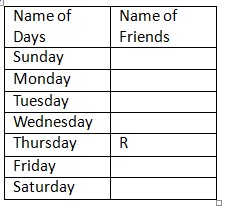 There is a gap of one day in between R and T. As per this statement,there are two possible cases and the arrangement will look like this: Case-1
 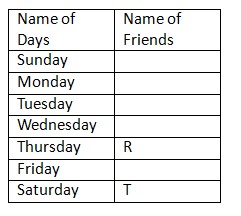 Case-2
 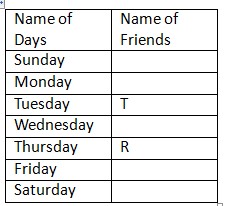 V and T are going for the party on consecutive days. As per this statement CAS E II will further gets plitintoone more case and the arrangement will look like this: CASEI:
 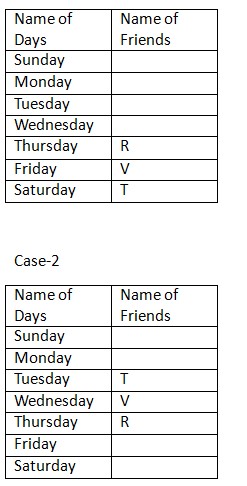 Case-2A
 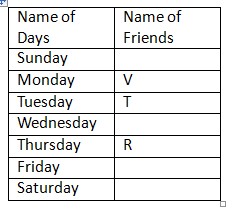 There is agap of two days in betweenV and S. As per this statement, CASE II (A) will get eliminated and CASEII will further gets plitintoone more case and the arrangement will look like this: Case-1
 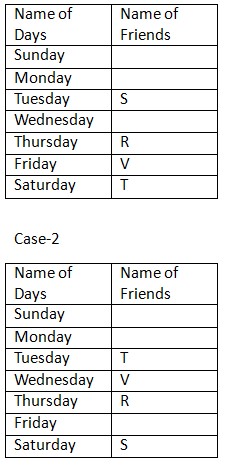 Case-2B
 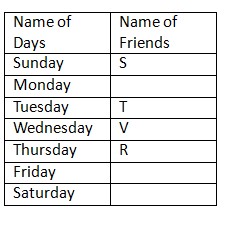 Q go for party on one of the days before U who goes for party neither on Friday nor on Wednesday.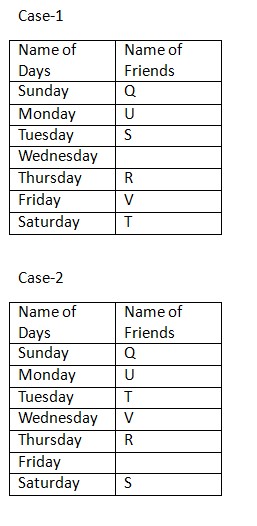
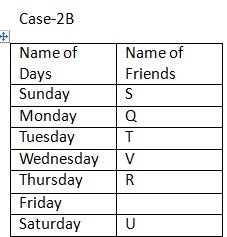 P goes before S but after T. As per this statement, CASE I and CASE II (B) will get eliminated and we will continue with CASE II and the arrangement will look like this: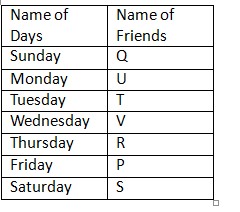
More Puzzles Questions
- How many persons live between the floors on which F and G live?
- On which of the following floor does G live?
- What is the position of R with respect to W?
- Who among the following person likes Papaya?
- What is the designation of RAMAN?
- Which of the following month T gives exam?
- How many boxes are kept between box X and the box which contains Pencil?
- Who among the following person was born in the same month along with B?
- Which of the following statement/statements are true?
- Who worked with Yahoo?
Relevant for Exams:
Hey! Ask a query
Please enter email id
The email must be a valid email address.
Please enter Mobile Number
Please enter valid Mobile Number
Please enter your Doubt

Think You're Ready for RBI Grade B?
RBI Grade B 2026 Phase 1 Memory Based Paper
- 200 Questions with Detailed Solutions
- Section-wise Coverage (GA, English, Quant & Reasoning)