RBI Grade B Exam 2027: Complete Guide to Recruitment, Vacancy, Salary, Eligibility & Selection Process
The RBI Grade B 2026 recruitment cycle has now moved past the Phase 1, Phase 2 and interview stages. The final results for the 2026 RBI Grade B (General) exam cycle have just been released, with ixamBee students bagging 9 of the total 40 vacancies.
This means that if you appeared for the RBI Grade B 2026 recruitment, you can now access the results on the official website. You also need to know that the results for the DSIM and DEPR recruitment will be released soon.
If you weren’t able to appear for the RBI Grade B recruitment this time around, or didn’t clear the stages you were aiming for, there’s a full shot waiting for you in 2027.
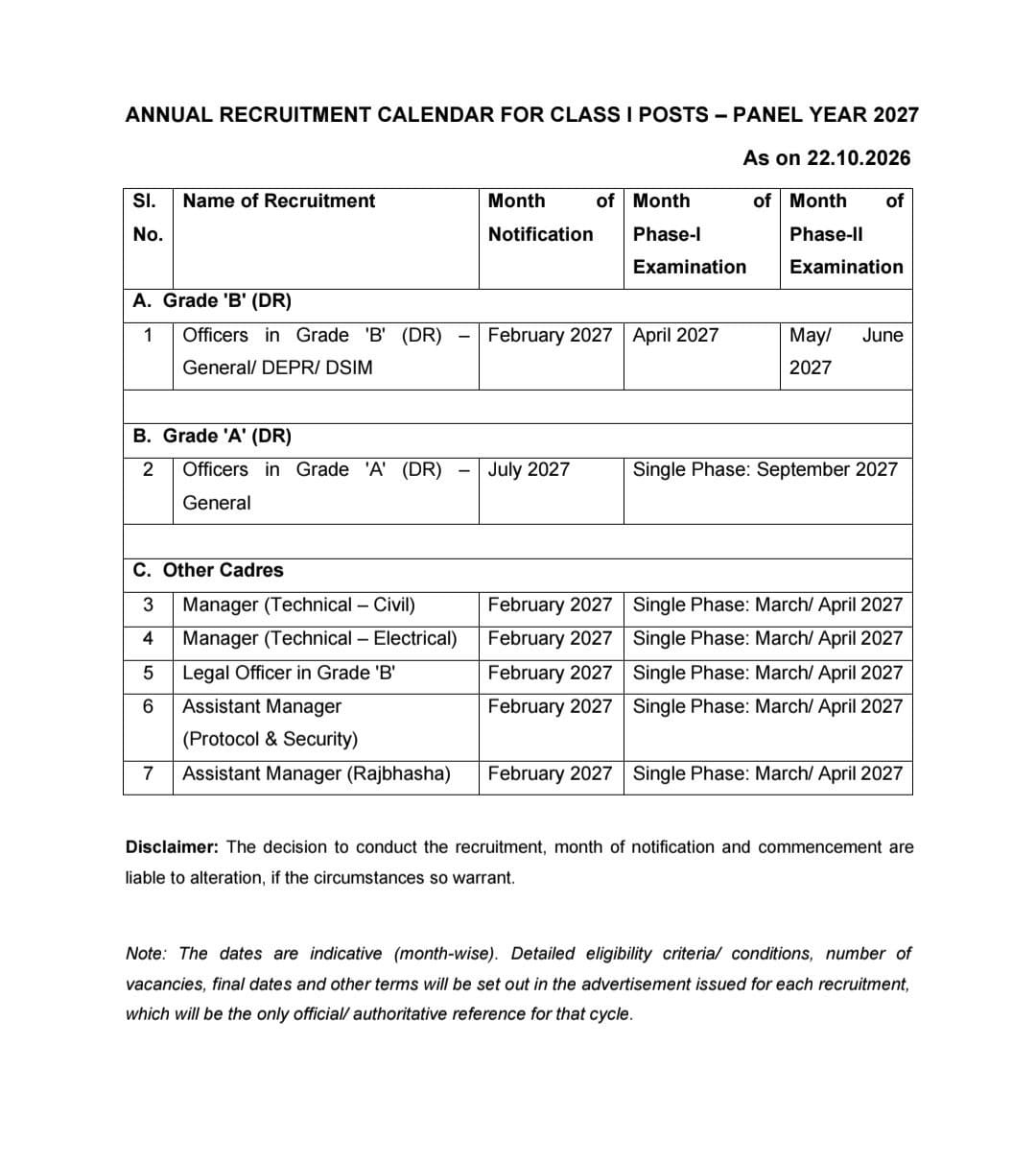
As per the annual recruitment calendar for Panel Year 2027, the notification for Grade B (DR) General/DEPR/DSIM is expected in February 2027, with Phase I in April 2027 and Phase II in May/June 2027. The best use of the coming months is to start preparing from scratch rather than waiting for the official notification to drop..


The Reserve Bank of India is the central bank responsible for regulating India's monetary system and ensuring financial stability. Securing a Grade B officer position here is widely regarded as one of the most prestigious outcomes in the banking and regulatory exam space.
The popularity of RBI is both for the competitive salary and perks, along with the opportunity to work within one of India's most respected institutions. Read on to know everything a 2027 RBI Grade B aspirant needs to know.
That way, you can plan with a full picture rather than piecing information together from scattered sources.
Download the study material for free
RBI Grade B 2027 Exam Information
| Particulars | Details |
|---|---|
| Conducting Authority | Reserve Bank of India (RBI) / Reserve Bank of India Services Board |
| Official Website | www.rbi.org.in |
| Name of Posts | Grade B Officer (General / DEPR / DSIM) |
| Mode of Application | Online only |
| Selection Process | Phase I (Objective) → Phase II (Objective + Descriptive) → Interview |
| Eligibility (General) | Graduation with 60% marks (50% SC/ST/PwBD), or Post-Graduation with 55% (pass marks SC/ST/PwBD) |
| Age Limit | 21 to 30 years |
| Nationality | Indian, with specific provisions for Nepal/Bhutan subjects, Tibetan refugees, and PIOs |
| Application Fee | General/OBC/EWS: ₹850 + 18% GST; SC/ST/PwBD: ₹100 + 18% GST |
| Number of Attempts | General/EWS: 6; SC/ST/OBC/PwBD: Unlimited (within age limit) |
| Phase 1 Marks | 200 (Qualifying only) |
| Phase 2 Marks | 300 |
| Interview Marks | 75 |
| Official RBI Calendar 2027 PDF | |
RBI Grade B Notification 2027 Important Updates
Latest Update – The official RBI notification has not been announced yet for 2027 although the calendar for 2027 is out. The calendar indicates that the notification is is expected to be around February 2027 with the Phase I expected in April and Phase II in May/June 2027..
RBI Grade B newspaper advertisement 2027: RBI usually publishes an advertisement in newspapers announcing the vacancy number and notification date but aspirants can get a better idea of when the notification is expected with the recently released RBI Calendar.
RBI Grade B Notification 2027: RBI releases the notification for the Grade B examination. The notification is expected to include important details regarding the exam dates, eligibility criteria, exam pattern, syllabus, number of vacancies, and step-by-step application process.
RBI Grade B Application Window 2027: The application window for RBI Grade B 2027 is expected to open with the release of the official notification.
RBI Grade B Vacancy Details 2027: The official number of vacancies has not been announced yet since the notification has not been released. However, candidates could expect vacancies to be around 50-100 as indicated by recent recruitment cycles.
RBI Grade B Exam Dates 2027: The exact dates of the examination are included in the official notification, keep an eye on the official website of the RBI.
RBI Grade B Admit Card 2027: RBI will issue the admit cards for the upcoming examinations 10-15 days before the exam date.
If you are planning to appear for the RBI Grade B this year, you should begin your preparation right now. Stay tuned to the RBI Grade B Notification 2027 for all the latest news and official updates when they are released.

RBI Grade B 2026 Recruitment Timeline
Since the 2026 cycle is the most recently completed reference point for 2027 aspirants, understanding its full timeline is genuinely useful:
- 16th April 2026: RBI Grade B Tender process began (bid submissions opened at 1700 hrs)
- 21st April 2026: Bidding window closed at 11:30 hrs
- 28th April 2026: Newspaper advertisement released, along with the announcement of 60 total vacancies
- 29th April 2026: Official notification released, and the online application process began
- 20th May 2026 (till 6:00 PM): Application window closed
- 5th June 2026: Phase 1 admit card released
- 13th June 2026: Phase 1 exam conducted (General stream)
- 14th June 2026: Phase 1 exam conducted (DEPR/DSIM streams)
- 14th July 2026: Phase 1 cut-off released
- 25th/26th June 2026: Phase 1 result declared
- 25th July 2026: Phase 2 exam conducted (General stream)
- 26th July 2026: Phase 2 exam conducted (DEPR/DSIM streams)
- 22 September 2026: Final interview for RBI Grade B selection begins
- 09 October 2026: Interview stage for RBI Grade B selection ends
- 15 October 2026: Final Result for RBI Grade B released.
| 2026 Events | Dates | |
|---|---|---|
| RBI Notification 2026 | Release of Newspaper Advertisement | 28th April 2026 |
| Release of Official Notification | 29th April 2026 | |
| RBI Application Process | Starting Date | 29th April 2026 |
| End Date | 20th May 2026 (06:00 PM) | |
| RBI Phase I | Admit Card Release | 5th June 2026 |
| Exam Date (General) | 13th June 2026 | |
| Exam Date (DEPR/DSIM) | 14th June 2026 | |
| Result (General) | 25th/26th June 2026 | |
| Phase I Cut-off Release | 14th July 2026 | |
| RBI Phase II | Exam Date (General) | 25th July 2026 |
| Exam Date (DEPR/DSIM) | 26th July 2026 | |
| Result | 22nd August 2026 | |
| RBI Grade B Interview | Interview Starting Date | 22nd September 2026 |
| Interview End Date | 9th October 2026 | |
| Final Phase | Final Result | 15th October 2026 |
With the final stage for RBI Grade B at an end with the publication of the final result, we at ixamBee congratulate those aspirants who cleared the exam. Candidates who are awaiting the results can check them from the official RBI Grade B website right away.
This full-cycle view is genuinely useful for candidates who cleared the 2026 cycle and have not cleared the exam. This schedule will help you if you plan on taking the exam once more and are preparing for it. This offers a realistic sense of how long each stage of the exam can possibly take.
RBI Grade B 2025 Timeline, for Additional Reference
Since the 2025 cycle is completely done, it offers a clearer picture of what a complete cycle timeline looks like, including the stages the 2026 cycle hasn't reached yet:
- 8th September 2025: Newspaper advertisement released
- 10th September 2025: Official notification released; application process began, with a total of 120 vacancies announced
- 30th September 2025: Application window closed
- 12th October 2025: Phase 1 admit card released
- 18th–19th October 2025: Phase 1 exam conducted (General on 18th, DEPR/DSIM on 19th)
- 11th November 2025: Phase 1 result declared
- 28th November 2025: Phase 2 admit card released
- 6th–7th December 2025: Phase 2 exam conducted (General on 6th, DEPR/DSIM on 7th)
- 19th January 2026: Phase 2 result declared (283 candidates cleared, compared to 198 in the 2024 cycle)
- 9th February – 18th March 2026: Interviews conducted
- 24th March 2026: Final result declared
- 13th April 2026: Final cut-off released
How Did the Reserve Bank of India Come to Be?
The RBI was established on 1st April 1935, set up in response to the economic challenges India faced following World War I.
It began as a privately owned institution before being nationalized in 1949, transferring all shares to the Government of India and making it a fully state-owned entity.
A significant turning point came in 1969 under Prime Minister Indira Gandhi, when 14 major commercial banks were nationalized to strengthen the banking system and improve financial inclusion.
This was followed by a second wave of nationalization in 1980, when 6 more banks came under government control. During the 1973 global oil crisis, the RBI adopted restrictive monetary policies to control the resulting inflation, demonstrating its role as a stabilizing force during economic shocks.
More recently, the RBI has embraced fintech collaboration, notably signing an MoU with the Central Bank of the UAE (CBUAE) to promote cooperation in financial technology.
Core Functions of the RBI
As outlined in the Preamble of the RBI Act, the central bank's responsibilities are broad and essential to the country's economic functioning:
- Financial Supervision: The RBI oversees banks and NBFCs through the Board for Financial Supervision (BFS), led by the RBI Governor.
- Regulator and Supervisor of the Financial System: It regulates the financial system, protects depositors, ensures banking stability, and handles complaints through the Banking Ombudsman Scheme, while also controlling monetary supply and designing currency.
- Payment and Settlement Systems: The RBI manages payment systems under the Payment and Settlement Systems Act, 2007, and has developed secure, round-the-clock transfer mechanisms like NEFT and RTGS. As of December 2019, NEFT operates 24/7, and RTGS transactions are processed around the clock as well.
- Banker and Debt Manager to Government: It acts as banker to the Government of India, managing accounts, processing payments, and assisting in raising funds through bonds and securities, effectively performing merchant banking functions for central and state governments.
- Managing Foreign Exchange: Under the Foreign Exchange Management Act, 1999, the RBI oversees foreign trade and payments, regulating foreign exchange and gold reserves in line with global trade and capital flows.
- Issue of Currency: The RBI, alongside the Government of India, holds sole authority to issue banknotes, manage destruction of old or damaged currency, and prevent counterfeiting through enhanced security features, operating printing facilities in partnership with SPMCIL and BRBNMPL.
- Banker's Bank: It manages accounts and reserves of commercial banks, controls credit using tools like CRR, repo rates, and open market operations, and assists banks with cheque clearing, fund transfers, and emergency loans.
RBI Grade B Selection Process
RBI Grade B recruitment is a three-stage process, combining both objective and descriptive components across the written examinations.
- Phase 1 (Prelims): This is essentially an objective, online, qualifying-in-nature exam. Out of the lakhs of candidates who apply, only a few thousand advance to the next stage.
- Phase 2 (Mains): This phase determines the top-scoring candidates who move forward. Every candidate scoring above the cut-off is allocated a score, and those with the highest Mains scores are selected for the interview round. This phase includes both objective and descriptive papers.
- Interview: The final stage, meant to select the highest-scoring candidates based on combined Mains and Interview performance. After this round concludes, the final merit list is prepared, combining the scores of candidates with the highest marks across both Mains and Interview.
- Final Selection: Candidates on the final list are recruited and undergo training as RBI Grade B officers.
RBI Grade B Vacancy Trend
The number of vacancies for RBI Grade B fluctuates every year based on the Bank's internal requirements, retirements, and staffing needs, and this figure is always among the most closely watched details once a notification drops.
| Post | GEN/UR | EWS | OBC | SC | ST | Total |
|---|---|---|---|---|---|---|
| General Cadre (2026) | 16 | 4 | 9 | 7 | 4 | 40 |
| DEPR Cadre (2026) | 4 | 1 | 1 | 3 | 1 | 10 |
| DSIM Cadre (2026) | 4 | 1 | 4 | 1 | – | 10 |
| Total (2026) | 24 | 6 | 14 | 11 | 5 | 60 |
In addition to the 40 General Cadre vacancies, 3 seats are reserved for PwBD candidates — 1 for blindness/low vision, 1 for locomotor disability (including cerebral palsy, leprosy cured, dwarfism, acid attack victims, and muscular dystrophy), and 1 for candidates with autism, intellectual disability, specific learning disability, or mental illness under the General cadre, with an additional PwBD vacancy under DSIM.
RBI Grade B Vacancy History (Past 5 Years)
| Year | General | DEPR | DSIM | Total |
|---|---|---|---|---|
| 2026 | 40 | 10 | 10 | 60 |
| 2025 | 83 | 17 | 20 | 120 |
| 2024 | 66 | 21 | 7 | 94 |
| 2023 | — | — | — | 222 |
| 2022 | — | — | — | 238 |
| 2021 | — | — | — | 270 |
The sharp drop from 120 vacancies in 2025 to just 60 in 2026 reflects how significantly vacancy numbers can swing year to year.
This variability is an important reminder for 2027 aspirants not to anchor their expectations too firmly on any single year's vacancy count, since a lower 2026 vacancy count doesn't necessarily predict a similarly low count for 2027.
Reservation Certificate Requirements
- EWS Category: EWS vacancies remain tentative and depend on government rules and legal outcomes. To claim EWS reservation, candidates must hold a valid Income and Asset Certificate for the applicable financial year, issued by a Competent Authority and available before the application deadline.
- OBC Category: Only candidates under the Non-Creamy Layer are eligible to claim OBC reservation. Such candidates must submit an OBC certificate based on income across the preceding three financial years, and this certificate must be issued on or after 1st April of the notification year.
RBI Grade B Eligibility Criteria
Age Limit
Candidates must be between 21 and 30 years of age as of the date specified in the notification (typically 1st April of the notification year). For instance, for the 2026 cycle, candidates needed to be born not earlier than 2nd April 1996 and not later than 1st April 2005.
| Category | Age Relaxation | Upper Age Limit |
|---|---|---|
| General | None | 30 years |
| OBC (Non-Creamy Layer) | 3 years | 33 years |
| SC/ST | 5 years | 35 years |
| M.Phil. holders | 2 years | 32 years |
| Ph.D. holders | 4 years | 34 years |
| PwBD (General/EWS) | 10 years | 40 years |
| PwBD (SC/ST) | 15 years | 45 years |
| PwBD (OBC) | 13 years | 43 years |
| Ex-Servicemen | 5 years | 35 years |
| Ex-Bank Employees (terminated for economic reasons/liquidation) | 5 years | 35 years |
| Officers with experience in Scheduled Commercial Banks/PSICs/AIFI | Up to years of experience (max 3 years) | 33 years |
Candidates belonging to SC, ST, or OBC categories who are also Ex-servicemen or PwBD are eligible for cumulative age relaxation across both applicable categories.
For DEPR/DSIM candidates specifically, those holding a Master's degree with research or teaching experience at a recognized university are eligible for additional age relaxation equal to their years of such experience.
Educational Qualification
| Post | Minimum Educational Qualification |
|---|---|
| General | Graduation with 60% marks (50% for SC/ST/PwBD) in aggregate, OR Post Graduation with 55% marks (pass marks for SC/ST/PwBD) in aggregate |
This percentage is based on the average across all semesters/years, not any single semester. A Graduation-level course must be from a recognized university, taken after Class XII, and at least 3 years in duration; a Post-Graduation course must be taken after Graduation and at least 2 years in duration, or recognized by the Government as equivalent.
DEPR Stream Qualification: Candidates need an MA/MSc in Economics (or related fields like Quantitative Economics, Applied Economics, Econometrics, Financial Economics, Business Economics, Development Economics) or an MA/MSc in Finance (or related fields like Quantitative Finance, International Finance, Corporate Finance). A Doctorate in Economics, or research/teaching experience and publications in the field, is desirable but not mandatory.
DSIM Stream Qualification: Candidates need a Master's degree with minimum 55% marks (50% for SC/ST/PwBD) in Statistics, Mathematics, Mathematical Statistics, Applied Statistics, Quantitative Economics, Econometrics, Informatics, or related branches; OR a Master's in Data Science, Artificial Intelligence, Machine Learning, or Big Data Analytics; OR a 4-year Bachelor's degree with minimum 60% marks (50% for SC/ST/PwBD) in these same fields. A Doctorate in a related subject, along with research/teaching experience and publications, is given preference.
Number of Attempts
| Category | Number of Attempts |
|---|---|
| General/EWS | Maximum 6 attempts |
| SC/ST/OBC/PwBD | No limit (until upper age limit is reached) |
Nationality
A candidate must be one of the following: a citizen of India; a subject of Nepal or Bhutan; a Tibetan refugee who arrived in India before 1st January 1962 with the intention of permanent settlement; or a person of Indian origin who migrated from Pakistan, Burma, Sri Lanka, or East African countries (Kenya, Uganda, Tanzania, Zambia, Malawi, Zaire, Ethiopia, Vietnam) with the intention of settling permanently in India. Candidates in categories other than Indian citizens must hold a Certificate of Eligibility issued by the Government of India.
Apply Online for RBI Grade B
Applications are submitted entirely online through www.rbi.org.in, with a typical application window of 15–20 days once the notification is released. The broad process runs as follows:
- Visit the official RBI website and navigate to Opportunities@RBI → Current Vacancies → Vacancies.
- Click the "Online Application Form" hyperlink and select "Click here for New Registration."
- Enter basic details to generate a Provisional Registration Number and Password, sent via email and SMS.
- Upload a scanned photograph, signature, left thumb impression, and a handwritten declaration as per the specified format.
- Fill in personal details, educational qualifications, and select exam centre preferences (typically 4 centres, in order of priority).
- Preview the entire form carefully — no edits are possible after final submission (except through the separate edit window mentioned below).
- Complete payment through the available online modes and submit the application.
Candidates already employed in Government Sector organizations, PSUs, financial institutions, or similar bodies must inform their employer in writing about applying before submitting their online application.
Candidates are advised to submit only a single application; however, if multiple applications are submitted due to unavoidable circumstances, only the application with the higher Registration ID (RID), and complete in all respects, will be considered valid.
RBI also provides a 2-day application edit window after the closure of the application process, allowing candidates to correct submitted details within that limited timeframe. DigiLocker integration is available on a voluntary basis, allowing candidates to provide access to issued credentials like Aadhaar and educational documents during the application process.
What Documents Are Required, and What Are the Upload Specifications?
| Document | Specifications |
|---|---|
| Photograph | 4.5cm × 3.5cm, colour, white background; 200×230 pixels (preferred); 20–50 KB |
| Signature | Black ink on white paper, not in capital letters; 140×60 pixels; 10–20 KB |
| Left Thumb Impression | Black or blue ink on white paper; 240×240 pixels at 200 DPI (3cm×3cm); 20–50 KB; JPG/JPEG |
| Handwritten Declaration | English only, own handwriting, not in capital letters; 800×400 pixels at 200 DPI (10cm×5cm); 50–100 KB; JPG/JPEG |
The handwritten declaration must read exactly: "I, ______ (Name of the candidate), hereby declare that all the information submitted by me in the application form is correct, true and valid. I will present the supporting documents as and when required."
Visually impaired candidates who cannot write may instead get the declaration text typed and place their left thumb impression below it before uploading.
Scanning guidelines include setting the resolution to at least 200 DPI, using True Colour mode, cropping documents to size, and saving all files in JPG/JPEG format using tools like MS Paint or MS Office Picture Manager if needed.
RBI Grade B Application Fee
| Category | Charges | Amount |
|---|---|---|
| SC/ST/PwBD | Intimation charges only | ₹100 + 18% GST |
| GEN/OBC/EWS | Application fee including intimation charges | ₹850 + 18% GST |
| RBI Staff | Nil | Nil |
Payment can be made via Credit/Debit Card, Net Banking/IMPS, or Mobile Wallets/Cash Cards, with an e-receipt generated upon successful transaction. If payment fails, the process must be restarted from the beginning using the same registration credentials.
RBI Grade B Exam Pattern
Phase 1 (Prelims) Exam Pattern
| Subject | Number of Questions | Maximum Marks | Duration |
|---|---|---|---|
| General Awareness | 80 | 80 | Composite 120 minutes |
| Reasoning | 60 | 60 | |
| Quantitative Aptitude | 30 | 30 | |
| English Language | 30 | 30 | |
| Total | 200 | 200 | 120 minutes |
The Phase 1 exam is conducted in computer-based mode and is purely objective in nature, with a negative marking of 1/4th mark deducted for every wrong answer.
Phase 1 is qualifying only, marks here don't carry forward into final selection, but candidates must clear both sectional and overall cut-offs (decided by the Board based on the number of vacancies) to advance to Phase 2.
Phase 2 (Mains) Exam Pattern — General Stream
| Paper | Type | Duration | Marks |
|---|---|---|---|
| Paper 1: Economic & Social Issues | 50% Objective + 50% Descriptive (typed) | 120 minutes | 100 |
| Paper 2: English (Writing Skills) | Descriptive (typed) | 90 minutes | 100 |
| Paper 3: General Finance & Management | 50% Objective + 50% Descriptive (typed) | 120 minutes | 100 |
| Grand Total | 300 | ||
For Paper 1 and Paper 3, the objective portion carries 30 questions worth 50 marks (a mix of 1-mark and 2-mark questions), while the descriptive portion includes 6 questions, of which candidates must attempt 4, 2 questions worth 15 marks each and 2 worth 10 marks each.
All question papers, except the English tests, are set bilingually in Hindi and English, and candidates typing Hindi answers can use either the Inscript or Remington (GAIL) keyboard layout.
Phase 2 Exam Pattern — DEPR Stream
| Phase | Paper | Duration | Maximum Marks |
|---|---|---|---|
| Phase 1 | Paper I: Objective (Economics) | 120 minutes | 100 |
| Phase 1 | Paper II: Descriptive (English, typed) | 120 minutes | 100 |
| Phase 2 | Paper I: Descriptive (Economics), written on paper | 120 minutes | 100 |
| Phase 2 | Paper II: Descriptive (Economics), written on paper | 120 minutes | 100 |
| Total | 400 | ||
DEPR candidates are shortlisted for Phase 2 based on aggregate marks in Phase 1 Papers I & II. Question papers are bilingual except Paper II (English), which must be answered only in English; Phase 2 answers may be written in either Hindi or English.
Phase 2 Exam Pattern — DSIM Stream
| Paper | Duration | Maximum Marks |
|---|---|---|
| Paper I: Objective (Statistics) | 120 minutes | 100 |
| Paper II: Descriptive (Statistics), written on paper | 180 minutes | 100 |
| Paper III: English – Descriptive (typed) | 90 minutes | 100 |
| Total | 300 | |
DSIM candidates who clear Paper I are shortlisted for Papers II and III. Similar to DEPR, question papers are bilingual except for the English paper, which must be answered only in English.
Interview Pattern
Candidates shortlisted based on aggregate Phase 2 marks appear for a 75-mark interview, which carries a 20% weightage in final selection. A mandatory Personality Assessment (Psychometric Test) precedes the interview for all streams.
Candidates may opt for the interview in either English or Hindi. Final selection is based on the combined merit of Phase 2 and Interview marks, plus any applicable grace marks under extant rules.
DEPR and DSIM Job Requirements
- DEPR (Department of Economic and Policy Research): Officers here primarily undertake economic analysis and research, contributing to policy formulation, alongside compiling data relating to select economic sectors, essentially forming the analytical backbone behind many of RBI's policy decisions.
- DSIM (Department of Statistics and Information Management): This role involves collecting, compiling, analyzing, and interpreting data related to banking, corporate, and external sectors, with heavy emphasis on advanced statistical and econometric techniques for modelling and forecasting indicators like inflation and growth. The role also involves designing and executing complex sample surveys, managing large-scale structured and unstructured datasets, and applying data science, AI, and machine learning techniques to extract insights.
RBI Grade B Officer Salary
RBI Grade B compensation has been recently revised and now ranks among the more attractive entry-level packages in India's regulatory banking space.
| Component | Details |
|---|---|
| Starting Basic Pay | ₹78,450 per month |
| Pay Scale | ₹78450-4050(9)-114900-EB-4050(2)-123000-4650(4)-141600 (16 years) |
| Initial Gross Monthly Emoluments | Approximately ₹1,54,936 (with HRA) |
| Annual Salary (Metro) | Approximately ₹40–42 lakh, with ₹20–22 lakh in-hand including allowances |
Beyond basic pay, officers receive Dearness Allowance, House Rent Allowance (15% of pay if accommodation isn't provided), Special Allowance, Grade Allowance, Local Compensatory Allowance, Special Grade Allowance, Learning Allowance, Medical Allowance, Education Allowance, and Conveyance Allowance, along with additional perks like newspaper, telephone, and book allowances, and furnished accommodation benefits where applicable.
Important note: For candidates with exceptionally high academic or professional qualifications of significant value to the Bank, RBI may, at its sole discretion, consider granting up to four advance increments — a request that can only be raised at the interview stage through the Bio-data Form, and not entertained afterward.
RBI Grade B Job Profile and Work Life
Once selected, RBI Grade B officers benefit from a professional work culture, structured working hours, and a genuinely balanced lifestyle compared to many other officer-level roles in the banking sector.
- Work Timing: Officers typically work from 9:00 AM to 5:00 PM, 5 days a week, though this can vary based on department and workload.
- Posting Location: Officers may be posted at RBI's Central Office in Mumbai or any of its regional offices across India.
- Departments: Roles span areas like Banking Supervision, Financial Markets, and Monetary Policy, among others, offering a genuinely wide range of responsibilities.
- Role: Work typically involves policy formulation, regulation, and economic research — intellectually engaging work that builds strong analytical skills over time.
- Career Growth: Officers move up through the hierarchy via internal promotions, progressing from managerial roles toward Executive Director and beyond.
- Training: Selected officers undergo 15 weeks of training during a 2-year probation period, with initial postings across functions like finance, regulation, currency management, or data analysis, before eventual transfers across departments.
- Pension: RBI officers are not covered under a traditional pension scheme; since 2012, new employees, including Grade B officers, fall under the Contributory Provident Fund (CPF) scheme instead.
- Transferability: The role is transferable, with officers subject to posting or relocation across RBI's various regional offices and departments at the organization's discretion.
RBI Grade B Admit Card and Pre-Exam Training Process
The RBI Grade B Admit Card contains the examination centre, centre address, date, and time of the exam, released on the official website roughly 10–15 days before each phase.
Candidates need their registration number and password to download it, and must carry the admit card along with valid original photo ID (plus a photocopy) to the exam centre.
For Phase 1, candidates typically need one photocopy of ID proof; for Phase 2, which runs across two or three shifts, two or three photocopies may be required. Female candidates who've changed their name must produce an original Gazette Notification, marriage certificate, or affidavit, along with a photocopy.
Any mismatch between the name on the admit card and photo ID proof results in the candidate not being allowed to appear for the exam.
RBI also conducts Pre-Exam Training (PET) for candidates belonging to reserved categories, but only for those who've indicated their intent to attend this training at the time of application.
RBI Grade B Cut-Offs in Recent Cycles
Understanding historical cut-off trends helps 2027 aspirants set realistic score targets for their preparation.
RBI Grade B Phase 1 Cut-Off 2026
| Section | GEN/UR | EWS | OBC | SC | ST | PwBD C | PwBD D |
|---|---|---|---|---|---|---|---|
| General Awareness | 39.00 | 30.25 | 34.25 | 32.00 | 28.75 | 27.00 | 15.00 |
| English Language | 14.50 | 11.25 | 12.75 | 12.00 | 10.75 | 10.00 | 5.50 |
| Quantitative Aptitude | 14.50 | 11.25 | 12.75 | 12.00 | 10.75 | 10.00 | 5.50 |
| Reasoning | 29.25 | 22.75 | 25.75 | 24.00 | 21.50 | 20.25 | 11.25 |
| Total/Aggregate | 108.75 | 86.00 | 99.00 | 88.75 | 86.75 | 81.75 | 53.50 |
RBI Grade B Phase 1 Cut-Off 2025
| Section | General | EWS | OBC | SC | ST |
|---|---|---|---|---|---|
| General Awareness | 24.00 | 16.00 | 20.00 | 16.00 | 16.00 |
| Reasoning | 18.00 | 12.00 | 15.00 | 12.00 | 12.00 |
| English Language | 9.00 | 6.00 | 7.50 | 6.00 | 6.00 |
| Quantitative Aptitude | 9.00 | 6.00 | 7.50 | 6.00 | 6.00 |
| Total Score | 77.50 | 64.75 | 69.00 | 65.00 | 64.75 |
RBI Grade B Phase 2 Cut-Off 2025 (Out of 300)
| Category | GEN/UR | EWS | OBC | SC | ST |
|---|---|---|---|---|---|
| Aggregate Cut-Off | 171.50 | 163.75 | 164.25 | 157.75 | 155.50 |
RBI Grade B Final Cut-Off 2025 (Out of 375, including Interview)
| Category | GEN/UR | EWS | OBC | SC | ST |
|---|---|---|---|---|---|
| Final Cut-Off | 230.75 | 199.75 | 218.00 | 216.00 | 210.50 |
The notable jump in Phase 1 cut-offs between 2025 and 2026 (77.50 to 108.75 for General) reflects the sharp reduction in vacancies from 120 to 60 — fewer seats naturally push cut-offs higher, reinforcing why aspirants should always prepare for a competitive scenario rather than anchoring expectations to a single prior year's cut-off.
Prepare for RBI Grade B 2027
Study Sequence to Follow
- Take enough mock tests to build exam-day familiarity
- Organize subjects category-wise rather than jumping between them randomly
- Create a realistic study timeline
- Brush up on current affairs consistently, particularly the last 6 months of banking and economic news
- Practice typing regularly, since Phase 2's descriptive papers must be typed on-screen
Do's and Don'ts
Focus on genuinely understanding concepts rather than memorizing them, study from a limited, well-chosen set of resources. Along with that, instead of scattering effort across too many books, attempt mock tests regularly, and avoid distractions like excessive social media or phone use during study hours.
Recommended Study Resources
| Section | Books/Resources |
|---|---|
| General Awareness | Lucent's General Knowledge (static portion), Manorama Yearbook |
| Quant, Reasoning & English | Kiran's BANK PO Quantitative Aptitude, R.S. Aggarwal's Verbal & Non-Verbal Reasoning |
| Economic & Social Issues | Indian Economy by Ramesh Singh, Indian Economy by Nitin Singhania |
| Finance | Indian Financial System by Bharati V. Pathak, Fundamentals of Financial Management by Prasanna Chandra and R.P. Rustagi |
| Management | Organization Behaviour by Stephen P. Robbins, Organization Theory and Behaviour by T.N. Chhabra & B.P. Singh |
| Accounting | NCERT Accountancy textbooks (11th & 12th) |
Using Previous Year Papers Effectively: Start by solving a random previous year paper to assess current strengths and weaknesses, then focus preparation on weak areas first before returning to strengthen existing strong areas.
Solving previous year papers also familiarizes candidates with the exact type and difficulty of questions typically asked across General Awareness, Reasoning, English, Quant, Finance & Management, and Economic & Social Issues.
Since RBI Grade B is genuinely challenging with a vast syllabus, most successful candidates report needing around 8 to 10 months of dedicated, consistent preparation, with the right direction and strategy mattering as much as sheer effort.
RBI Grade B Exam Centres Located
RBI conducts its Grade B exam across multiple cities in India, and candidates must carefully select their preferred exam centre at the time of application to ensure a smooth process. Separate centres exist for Phase 1, Phase 2, and the Interview:
- Phase 1 centres include cities like Shimla, Patna, Delhi-NCR, Amritsar, and Dehradun, among many others spread widely across the country.
- Phase 2 centres include cities like Lucknow, Jammu, Kochi, Hyderabad, and Bhubaneswar, among others — generally a more limited list than Phase 1.
- Interview centres include cities like Kolkata, Ahmedabad, Mumbai, Chennai, and Bengaluru.
Candidates typically indicate up to 4 centre preferences in order of priority during the application process.
RBI Grade B vs Other Career Paths: Common Comparisons
RBI Grade B vs IAS: There's no straightforward "better" option between the two since it depends on individual priorities. IAS offers broader administrative influence, policy-making exposure, and diverse field postings, often starting in rural areas before promotions bring officers to metro cities.
RBI Grade B, by contrast, offers a strong work-life balance with postings in major cities from the outset, along with a specialized focus on finance and economics. Both carry strong salaries and social prestige, so the choice often comes down to the kind of work and lifestyle an aspirant prefers.
RBI Grade B vs CA: Both exams are genuinely challenging and highly competitive, though which is "tougher" depends on individual strengths. RBI Grade B emphasizes economics, finance, and general aptitude, while the CA exam goes deeper into accounting, taxation, and auditing, making them fundamentally different in orientation rather than directly comparable in difficulty.
RBI Grade B Previous Year Cut-off
Before starting your RBI Grade B exam preparation, it’s important to gather all the necessary information about the exam. Since the 2026 exam cycle is done and aspirants who did not appear in the exam this would be preparing for the next exam cycle, a smart step is to review the RBI Grade B previous year cut-offs. With the final cutoff for 2025 exam released, apsirants can boost their exam preparation for next year.
RBI Grade B Phase 1 Cut off 2026
| Name of the Test | Category | ||||||||
|---|---|---|---|---|---|---|---|---|---|
| GEN/UR | EWS | OBC | SC | ST | PwBD A | PwBD B | PwBD C | PwBD D | |
| General Awareness (Maximum Marks = 80) | 39.00 | 30.25 | 34.25 | 32.00 | 28.75 | - | - | 27.00 | 15.00 |
| English Language (Maximum Marks = 30) | 14.50 | 11.25 | 12.75 | 12.00 | 10.75 | - | - | 10.00 | 5.50 |
| Quantitative Aptitude (Maximum Marks = 30) | 14.50 | 11.25 | 12.75 | 12.00 | 10.75 | - | - | 10.00 | 5.50 |
| Reasoning (Maximum Marks = 60) | 29.25 | 22.75 | 25.75 | 24.00 | 21.50 | - | - | 20.25 | 11.25 |
| Total Score / Aggregate (Maximum Marks = 200) | 108.75 | 86.00 | 99.00 | 88.75 | 86.75 | - | - | 81.75 | 53.50 |
RBI Grade B Salary and Job Profile
The RBI Grade B salary is lucrative. The initial monthly salary, inclusive of all allowances, is approximately ₹1,54,936/-. You also receive benefits and perks such as housing, medical cover, vehicle maintenance, and travel allowance. These could vary depending on where you're posted.
Upon selection, RBI Grade B officers receive 15 weeks of training throughout a period of 2-year probation. Your role can include working on finance, regulation, currency, or data analysis. You might be transferred from department to department eventually, but you get to know various tasks.
There are good opportunities for growth in the job. You can get promotions quickly by sitting for promotional examinations and internal growth schemes.