RBI Grade B Syllabus 2027: Phase 1, Phase 2 & Interview
The Reserve Bank of India is among the country's most important financial institutions, playing a central role in economic stability and financial inclusion — which is exactly why the RBI Grade B exam remains such a sought-after opportunity year after year.
With the 2026 recruitment cycle having now moved past its Phase 2 (Mains) exam, held on 25–26 July 2026, and entering its final stages of interviews and result declaration, attention naturally turns to what comes next: the RBI Grade B 2027 cycle.
If you weren't able to participate this year, or didn't manage to clear a stage, there's no reason to worry . A fresh opportunity awaits in 2027, and there's no better time to begin than right now, starting from the very basics.
And the natural starting point for that preparation is the syllabus itself. A thorough understanding of what the exam actually tests is the single most important factor in shaping an effective study strategy, since it's what determines where your time and effort should go over the coming months.
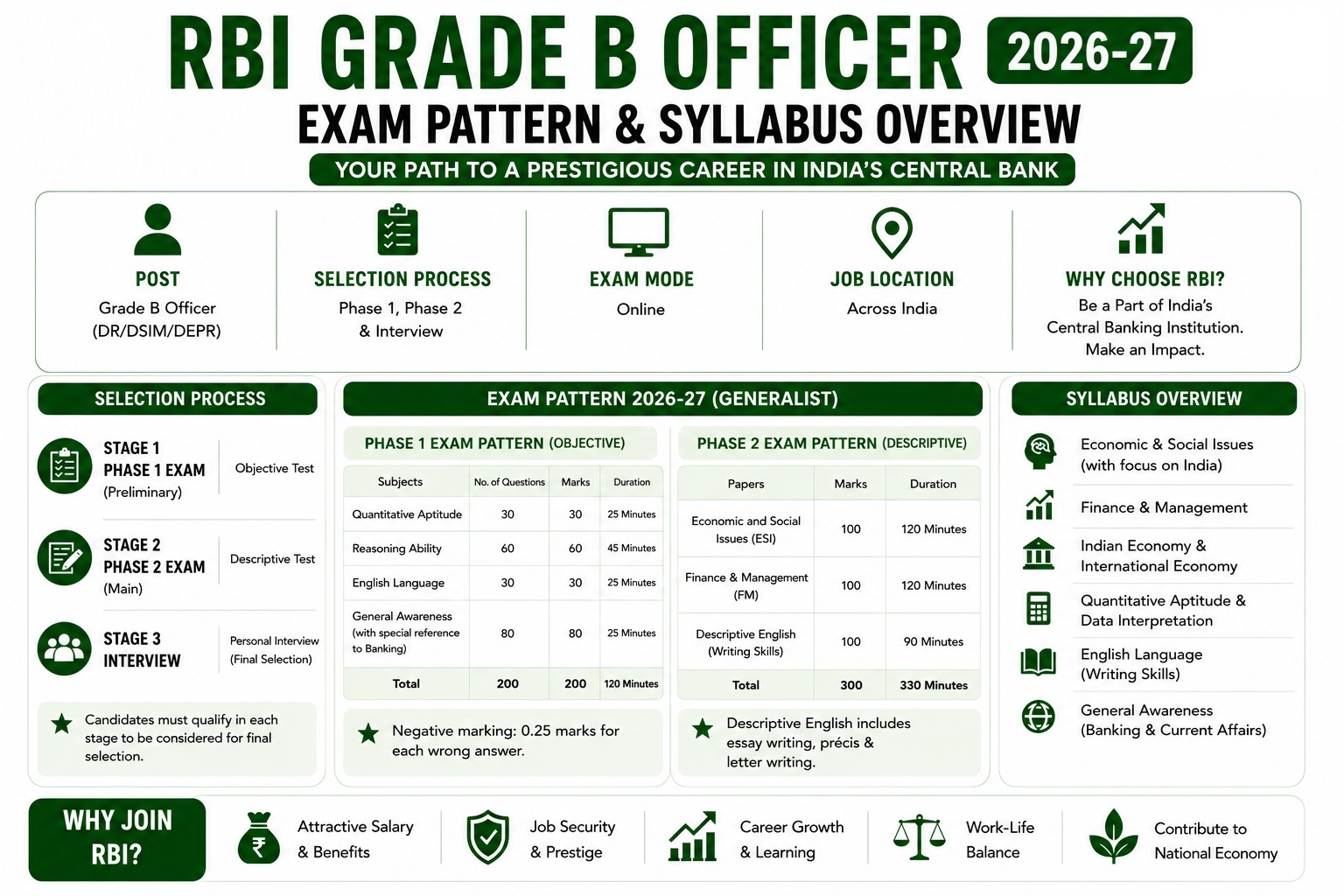
The syllabus spans three stages: Phase 1 (Prelims), Phase 2 (Mains), and the Interview. Phase 1 covers four sections — Quantitative Aptitude, Reasoning, English, and General Awareness — while Phase 2 spans three papers: Economic & Social Issues, Finance & Management, and Descriptive English.
Download the study material for free
What is the RBI Grade B Syllabus 2027?
The RBI Grade B syllabus spans three streams and three phases. Most aspirants apply under the General Stream, though candidates with a strong academic background in Economics or Statistics can also opt for the DEPR (Department of Economic & Policy Research) or DSIM (Department of Statistics and Information Management) streams.
Across the General stream, the syllabus breaks down as follows:
- Phase 1 (Prelims): 4 sections — Quantitative Aptitude, Reasoning Ability, English Language, and General Awareness
- Phase 2 (Mains): 3 papers — Economic & Social Issues (ESI), Finance & Management (F&M), and English Descriptive (Writing Skills)
- Phase 3 (Interview): No fixed syllabus, but expect questions on current affairs, Indian and global economic policy, and RBI's functioning
The official notification typically presents the syllabus in broad strokes rather than an exhaustive topic list, so it's best treated as a framework to build on with current affairs and RBI publications, rather than a rigid checklist.
What is the RBI Grade B Phase 1 Syllabus?
Each of the four Phase 1 sections carries roughly equal weight in determining whether a candidate clears the qualifying stage.
General Awareness
General Awareness carries the highest weightage in Phase 1, with 80 out of 200 marks riding on this single section, making it the section most capable of swinging your overall score. It draws heavily from banking-specific current affairs and RBI's own functioning, alongside standard national and international news.
General Awareness Syllabus
| Category | Topics |
|---|---|
| Current Affairs | Union Budget, government schemes, appointments/resignations, important days, awards, defence news, books & authors, obituaries; international news, global agreements, summits; banking & economy news, RBI-related news |
| Banking Awareness | Structure of Indian banking system, types of banks & financial institutions, money & banking concepts, basic terminology, digital payment systems |
| RBI-Specific Topics | RBI terms & definitions, functions and role of RBI, banking-related Acts & laws, monetary policy basics |
| Static GK | Structure of Indian banking system, reports/rankings/indexes, committees and councils |
Quantitative Aptitude
The Quant section tests core arithmetic and data-handling skills rather than advanced mathematics, so the focus should be on speed and accuracy over conceptual depth. Most questions are drawn from standard bank-exam-style topics that repeat across cycles with only minor variation in difficulty.
| Category | Topics |
|---|---|
| Arithmetic | Percentages, Ratio & Proportion, Profit/Loss/Discount, Simple & Compound Interest, Ages & Partnerships, Average & Alligation, Time & Work, Pipes & Cisterns, Time-Speed-Distance, Trains & Boats |
| Algebra, Number System & Mensuration | Simplification, Number System, Quadratic Equations, Mensuration (2D & 3D) |
| Data Interpretation & Advanced Maths | Bar/Pie/Line Graphs, Caselets, Probability, Permutation & Combination |
Reasoning Ability
Reasoning carries the highest question count in Phase 1 at 60 questions, making it a section where consistent daily practice pays off significantly. Puzzles and seating arrangements tend to be the most time-consuming, so building speed here specifically is worth prioritizing.
| Category | Topics |
|---|---|
| Logical Reasoning | Syllogism, Inequalities, Statement & Conclusion, Statement & Assumption, Statement & Argument, Cause & Effect, Course of Action |
| Analytical & Puzzle-Based | Puzzles (Floor, Box, Scheduling, Comparison), Seating Arrangement (Linear, Circular, Square, Mixed), Machine Input-Output, Data Sufficiency |
| Basic Reasoning | Coding-Decoding, Alphabet/Alphanumeric Series, Blood Relations, Direction Sense, Order & Ranking |
English Language
English tends to be the most time-constrained section relative to its question count, with only 25 minutes for 30 questions, so building reading speed alongside grammar accuracy matters here. A steady habit of reading financial editorials also helps beyond just this section, since it feeds directly into the Descriptive English paper in Phase 2.
| Category | Topics |
|---|---|
| Question Types | Reading Comprehension, Gap Fillers, Double Fillers, Error Spotting, Sentence Rearrangement, Idiom/Phrase Usage, Word Swap, Para Jumbles, Cloze Test |
| Grammar | Subject-Verb Agreement, Parts of Speech, Tenses, Articles, Conditional Sentences, Modals, Active/Passive Voice |
There's a useful overlap worth noting between Phase 1's General Awareness and Phase 2's ESI syllabus — preparing one tends to reinforce the other, just tested at different depths, which is a good reason to start covering both together early on.
What is the RBI Grade B Phase 2 Exam Pattern?
Phase 2 comprises three papers carrying a combined 300 marks across 330 minutes, and is generally conducted across multiple shifts.
| Paper | Name | Exam Type | Questions | Marks | Duration |
|---|---|---|---|---|---|
| Paper 1 | Economic & Social Issues | Objective (50%) | 30 | 50 | 30 minutes |
| Descriptive (50%, typed) | 6 (attempt 4) | 50 | 90 minutes | ||
| Paper 2 | English (Writing Skills) | Descriptive, typed | 3 | 100 | 90 minutes |
| Paper 3 | Finance & Management | Objective (50%) | 30 | 50 | 30 minutes |
| Descriptive (50%, typed) | 6 (attempt 4) | 50 | 90 minutes |
What is the RBI Grade B Phase 2 Paper 1 (ESI) Syllabus?
Economic & Social Issues (ESI)
ESI is one of the more theory-heavy papers, requiring candidates to connect historical economic developments with current policy debates rather than just memorizing facts. A mix of NCERT-level foundational reading and the latest Economic Survey tends to work well for covering this paper comprehensively.
| Category | Topics |
|---|---|
| Basic Economic Concepts | National Income Accounting, Schools of Economic Thought, Economic Growth & Development, Human Development, Sustainable Development |
| Indian Economic Development | Pre- and Post-1991 macroeconomy, agriculture, industry, services, and external sector; economic reforms |
| Public Finance & Macro Policy | Public Expenditure & Receipts, Public Debt, Fiscal Policy, Federal Finance, Inflation, Indian Taxation, Five-Year Plans |
| Social & Development Issues | Poverty, Unemployment, Population & Demographics, Health, Education, Gender, Urbanisation & Migration |
| Banking, Institutions & Development | Key international institutions, role of banks & RBI in development, rural credit and microfinance |
A few topics have reportedly been trimmed from the Social Structure section in recent notifications — including certain aspects of social movements and specific health/education sub-areas — though the core structure of the syllabus has stayed largely stable.
Paper 2 (Descriptive English) Syllabus
This paper is less about vocabulary and more about structured thinking and clarity — panelists are essentially checking whether you can organize an argument and communicate it cleanly within a time limit. Regular timed practice across all three formats below tends to matter more here than broad reading alone.
| Component | Details |
|---|---|
| Essay Writing | Themes drawn from economic/financial issues, social developments, governance, technology, environment, and ethics |
| Precis Writing | Condensing a long passage into roughly 170–180 words without adding personal opinion |
| Reading Comprehension | A passage followed by around 5 questions requiring short, well-structured descriptive answers |
Paper 3 (Finance & Management)
This paper blends two fairly different disciplines — Finance, which requires staying current with RBI publications and financial news, and Management, which is largely theoretical and doesn't shift much year to year.
| Category | Topics |
|---|---|
| Banking & Financial System | Regulatory bodies, Indian banking system, non-banking systems, financial markets, risk management, financial inclusion, NaBFID, digital payments |
| Global Finance | FinTech, global financial markets, international banking, global financial crisis impact |
| Public Finance | Inflation, FDI/FPI, Disinvestment, GST, FRBM Act, Finance Commission, PPP |
| Accounting | Basics of Accounting, Company Final Accounts, Cash Flow Statements, Ratio Analysis |
Management
The Management portion of the syllabus is entirely theoretical and largely static — concepts you study today will remain relevant for several years, unlike the more dynamic Finance and current affairs-driven sections.
| Category | Topics |
|---|---|
| Principles of Management | Evolution of management thought, management functions, managerial roles, organisation structure |
| Organisational Behaviour | Personality, Perception, Motivation, Stress, Learning, Interpersonal Relationships |
| Leadership & Skills | Leadership theories, Authority & Power, Communication, Emotional Intelligence, Decision Making |
| OD & Ethics | Organisational Change, Nudge Theory, Ethics, Corporate Governance |
What is the RBI Grade B DEPR Syllabus?
The DEPR stream syllabus reflects the role of DEPR cadre officers, who handle economic policy analysis at RBI.
- The Economics papers are set to a standard comparable to a Master's Degree examination in Economics at any Central University in India.
- The English paper assesses writing skills, expression, and understanding of a topic.
Recommended study material for DEPR includes RBI's Annual Reports, Monetary Policy Report, Report on Trend and Progress of Banking in India, Financial Stability Report, and the Economic Survey from the past two years.
What is the RBI Grade B DSIM Syllabus?
DSIM is the most technically specialized of the three streams, built for candidates comfortable with advanced statistical methods and data analysis rather than general finance or economics knowledge.
- Paper 1 is objective (multiple-choice) and covers Probability, Large and Small Sample Theory, Analysis of Variance, Estimation, Standard Distributions, Testing of Hypotheses, Multivariate Analysis, and Stochastic Processes.
- Paper 2 is descriptive (typed) and covers Statistical Inference, Linear Models and Economic Statistics, Probability and Sampling, Stochastic Processes, Multivariate Analysis, and Numerical Analysis/Basic Computer Techniques — candidates get sufficient choice to attempt from any three or more of these groups.
- Paper 3 is the English paper, assessing writing skills and comprehension, similar to the DEPR stream.
| Paper | Coverage |
|---|---|
| Paper 1 (Objective, MCQ) | Probability, Large & Small Sample Theory, Analysis of Variance, Estimation, Standard Distribution, Hypothesis Testing, Multivariate Analysis, Stochastic Processes |
| Paper 2 (Descriptive, typed) | Statistical Inference, Linear Models & Economic Statistics, Probability & Sampling, Stochastic Processes, Multivariate Analysis, Numerical Analysis & Computer Techniques |
| Paper 3 | English paper assessing writing skills and topic understanding |
What is the RBI Grade B Interview Syllabus?
There's no fixed syllabus for the Interview stage, which carries 75 marks in the final selection. Candidates can choose to be interviewed in either English or Hindi. Broadly, expect questions across these areas:
- Personal background: Educational qualifications, work experience, hobbies, and how these shape your thinking
- RBI's functions: Role in currency regulation, monetary policy, RBI as "Lender of Last Resort," interpretation of the Financial Stability Report and Annual Report
- Economic trends: GDP growth measurement, inflation trends, financial inclusion, green finance, global economic impact on India
- Government schemes: Stand Up India, MUDRA, Kisan Credit Card, PMJDY, APY
- Current affairs: Latest Union Budget, Economic Survey, recent RBI notifications
- Situational and decision-making questions: Managing financial crises, balancing growth with compliance
Panelists typically evaluate candidates on analytical decision-making, clarity of thought, depth of knowledge, communication skills, and awareness of current economic trends — rather than testing against a predefined topic list.
What is the RBI Grade B Selection Process?
The RBI Grade B recruitment process unfolds across three phases, and clearing each stage is necessary to move to the next.
| Phase | Exam Type | Marks | Duration | Exam Language |
|---|---|---|---|---|
| Phase 1 (Prelims) | Objective | 200 | 2 hours | Bilingual (except English Language paper) |
| Phase 2, Paper 1 | Objective & Descriptive | 100 | 30 min (Objective) + 90 min (Descriptive) | Bilingual (except Descriptive) |
| Phase 2, Paper 2 | Descriptive (Writing Skills) | 100 | 90 minutes | English only |
| Phase 2, Paper 3 | Objective & Descriptive | 100 | 30 min (Objective) + 90 min (Descriptive) | Bilingual (except Descriptive) |
| Phase 3 (Interview) | Personal Interview | 75 | — | Candidate's choice: English or Hindi |
Final selection is based on combined performance in Phase 2 (all three papers) and the Interview — Phase 1 marks are used only to shortlist candidates and don't carry forward to the final merit list.
What are the Three Streams Under RBI Grade B?
RBI Grade B recruitment covers three distinct streams, and most aspirants opt for the General stream unless they hold a specific academic background:
- General Stream (DR): Open to all eligible graduates, this is the stream the majority of aspirants apply for.
- DEPR (Department of Economic & Policy Research): Suited to candidates with a strong academic background in Economics.
- DSIM (Department of Statistics and Information Management): Suited to candidates with a background in Statistics.
What is the RBI Grade B Phase 1 Exam Pattern?
Phase 1 consists of four sections, each carrying its own time allocation, held together as a single 2-hour objective exam.
| Section | Questions | Marks | Duration |
|---|---|---|---|
| English Language | 30 | 30 | 25 minutes |
| Quantitative Aptitude | 30 | 30 | 25 minutes |
| Reasoning Ability | 60 | 60 | 45 minutes |
| General Awareness | 80 | 80 | 25 minutes |
| Total | 200 | 200 | 120 minutes |
What is the RBI Grade B Marking Scheme?
| Criteria | Marks Deducted |
|---|---|
| Wrong Answer (Objective sections, Phase 1 & Phase 2) | −0.25 (1/4th mark) |
| Unattempted Question | No penalty |
What Language is the RBI Grade B Exam Conducted In?
All Phase 1 and Phase 2 objective papers are available in both English and Hindi, with the sole exception of the English Language paper, which is conducted only in English.
The Interview, meanwhile, can be conducted in either English or Hindi, based on the candidate's preference.
How Should You Approach Preparing for RBI Grade B 2027 From Scratch?
Since the 2026 cycle has now moved into its final stages, aspirants whether entirely new or those who missed out this year have a full runway ahead to prepare properly for 2027. A structured, subject-wise approach works best:
- General Awareness: Review the last 6 months of current affairs regularly, and lean on RBI circulars to stay current on banking-specific developments.
- Quantitative Aptitude: Build accuracy first with percentages, ratios, and time-work-speed-distance problems, then work on speed through regular mock tests.
- Reasoning Ability: Practice puzzles, seating arrangements, and syllogism under timed conditions to build both speed and accuracy.
- English Language: Read editorials and financial publications to build vocabulary and comprehension, alongside regular grammar practice.
- Economic & Social Issues: Build a strong base with an overview of the Indian economy, then go deeper with the Economic Survey, Budget highlights, and RBI reports.
- Finance & Management: Prepare concise notes on financial institutions, markets, and risk management, and stay current through PIB and RBI notifications.
- Descriptive English: Practice essay writing on economic and financial themes, and work through past papers for precis and comprehension.
Most aspirants starting from scratch typically need around 6–8 months of consistent, structured preparation to cover the full syllabus comfortably which makes now an ideal time to begin, well ahead of the expected 2027 notification.