RBI Grade B Exam Pattern 2027: Phase 1, Phase 2 & Interview — Complete Guide
The RBI Grade B 2026 recruitment cycle has now moved past Phase 2, with the Mains exam conducted on 25–26 July 2026 for the General, DEPR, and DSIM streams.
With this stage complete, the current cycle is winding down toward final results and interviews, which means the door is now opening on the next opportunity — the RBI Grade B 2027 cycle.
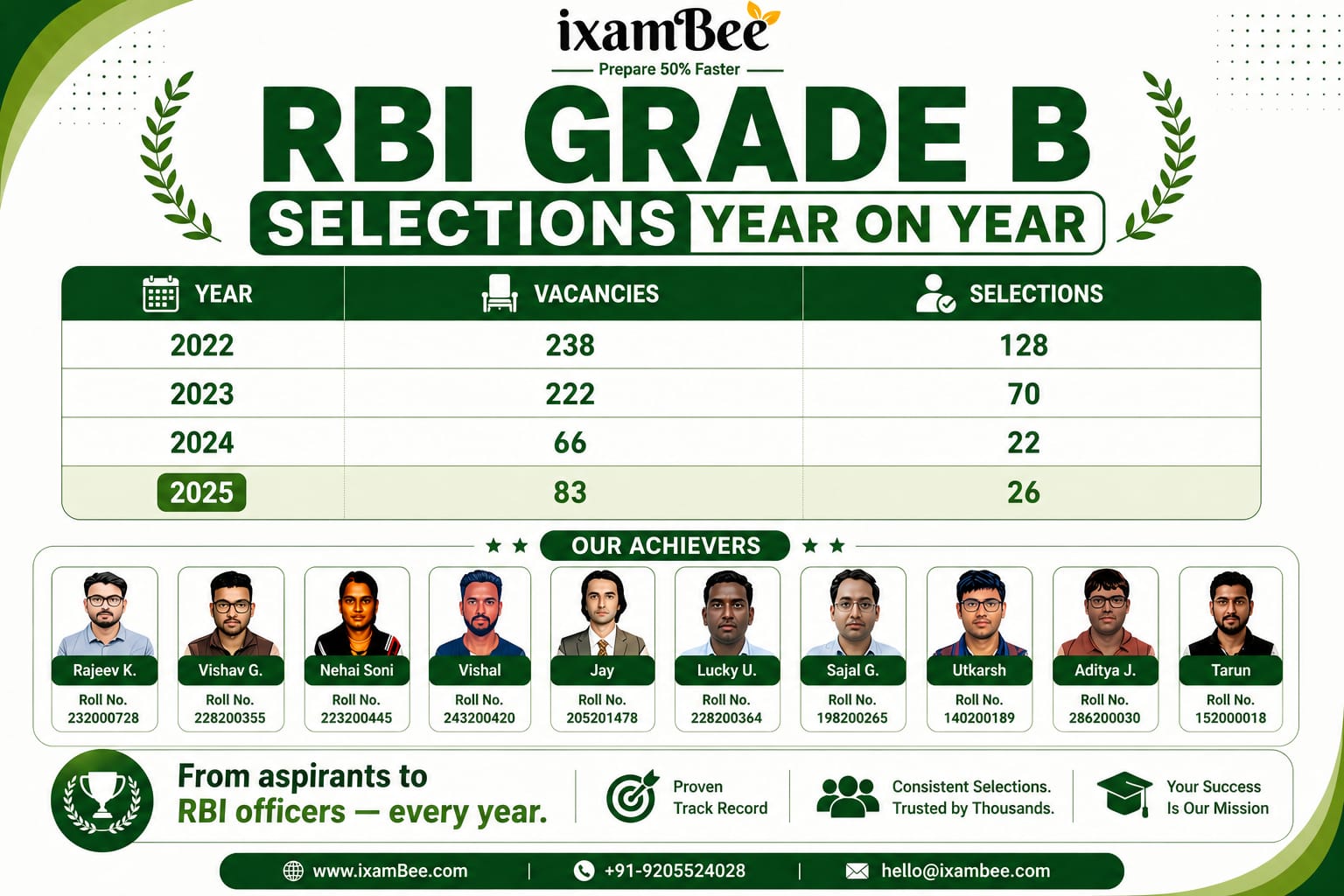
Aspirants who weren't able to participate this time around, or who didn't clear the stages they were aiming for, have a full shot waiting for them in 2027, and the smartest move at this point is to begin preparing from scratch rather than wait around for the next notification to drop.
The Reserve Bank of India conducts the RBI Grade B exam through the Reserve Bank of India Services Board to recruit officers for policy-making and regulatory roles.
The exam pattern is structured across three stages: Phase 1 (Prelims), Phase 2 (Mains), and Interview, for the General stream, with the DEPR and DSIM streams following a somewhat different structure tailored to their specialized subject matter.
Understanding this pattern in depth which includes details like the number of papers, question types, marking scheme, sectional timing, and language options is essential.
This is especially true when it comes to building an effective 2027 preparation strategy well ahead of time, and it also helps you approach preparation in a more focused, systematic manner rather than studying blindly.
Download the study material for free
What is the RBI Grade B Selection Process Overview?
| Phase | Exam Type | Marks | Duration | Counted in Final Merit? |
|---|---|---|---|---|
| Phase 1 (Prelims) | Objective | 200 | 2 hours | No |
| Phase 2 (Mains) | Objective + Descriptive | 300 (100 per paper) | 330 minutes (5.5 hours) | Yes |
| Phase 3 (Interview) | Personality Test | 75 | 20–45 minutes | Yes |
Only Phase 2 and Interview marks are counted toward final selection — Phase 1 exists purely to screen candidates through to the Mains stage.
In overall merit selection, Phase 1 only requires you to qualify, but Phase 2 requires you to actually perform well across all three sections consistently to clear the exam.
What is the RBI Grade B Phase 1 Exam Pattern?
Phase 1 is a fully objective screening test covering four sections: English Language, Quantitative Aptitude, Reasoning Ability, and General Awareness.
This stage carries a strict sectional timing structure once the time allotted to a section runs out, the system automatically moves you to the next one, so switching back isn't possible, unlike many other exams where candidates can freely move between sections.
| Section | Questions | Marks | Duration |
|---|---|---|---|
| English Language | 30 | 30 | 25 minutes |
| Quantitative Aptitude | 30 | 30 | 25 minutes |
| Reasoning Ability | 60 | 60 | 45 minutes |
| General Awareness | 80 | 80 | 25 minutes |
| Total | 200 | 200 | 120 minutes |
Key Points on Phase 1
- The exam is conducted online in computer-based format, with all questions selected on-screen.
- Candidates must clear both the sectional cut-offs and the overall aggregate cut-off to advance to Phase 2.
- General Awareness carries the single highest weightage of any section, at 80 out of 200 marks.
- Time management across sections is critical, since unused time in one section cannot be carried over to another.
- A useful time-per-question benchmark: aim for roughly 20 seconds per General Awareness question, 50 seconds for Quant, 45 seconds for Reasoning, and around 50 seconds for English, to comfortably finish within each section's limit.
What Topics Does Each Phase 1 Section Cover?
Beyond just the marks and timing, it helps to understand what each Phase 1 section actually tests, since this shapes how you allocate preparation time.
What Does the General Awareness Section Cover?
| Category | Topics Covered |
|---|---|
| Banking System | Structure of the Indian banking system, types of banks |
| RBI & Monetary Policy | Functions of RBI, Repo rate, Reverse repo, CRR, SLR |
| Financial Awareness | Inflation, financial inclusion, Basel norms |
| Government Schemes | PMJDY, MUDRA, Digital India |
| Current Affairs | Budget, Economic Survey, national & international updates |
| Reports | RBI Annual Report, Financial Stability Report |
General Awareness is widely considered the most decisive section in Phase 1 given its high weightage, and the focus here leans far more toward financial and economic awareness than toward static general knowledge of the kind seen in other government exams.
What Does the Quantitative Aptitude Section Cover?
| Category | Topics Covered |
|---|---|
| Arithmetic | Percentage, Profit & Loss, Time & Work, Time-Speed-Distance |
| Data Interpretation | Table, Bar Graph, Line Graph, Caselet DI |
| Algebra | Quadratic Equations |
| Number System | Series, Simplification, Approximation |
This section evaluates numerical ability, speed, and accuracy, with Arithmetic and Data Interpretation typically dominating the question count.
Many candidates consider this the toughest section in Phase 1, since questions demand strong conceptual clarity along with speed, and the tight 25-minute window leaves little room for slow calculation.
What Does the Reasoning Ability Section Cover?
| Category | Topics Covered |
|---|---|
| Puzzles | Seating arrangement, floor puzzles, scheduling |
| Logical Reasoning | Syllogism, Inequalities, Coding-Decoding |
| Analytical Reasoning | Input-output, Data sufficiency |
Reasoning tests a candidate's ability to spot patterns, work through complex logical structures, and interpret data logically. Puzzles typically make up the largest share of this section, making them especially important to practice given the 45-minute time allotment for 60 questions.
What Does the English Language Section Cover?
| Category | Topics Covered |
|---|---|
| Reading Skills | Reading Comprehension |
| Grammar | Error Detection, Sentence Improvement |
| Vocabulary | Cloze Test, Fill in the blanks |
| Verbal Ability | Para Jumbles |
The English section centers on reading comprehension ability, grammar accuracy, and contextual understanding. It's generally considered moderate in difficulty, but still requires consistent daily practice to build both speed and accuracy within the 25-minute window.
What is the RBI Grade B Phase 2 Exam Pattern?
Once a candidate clears Phase 1, the Mains exam becomes the stage that actually determines merit standing.
Phase 2 consists of three papers — Economic & Social Issues (ESI), English (Writing Skills), and Finance & Management (FM) — combining both objective and descriptive formats, and is typically conducted across multiple shifts with separate call letters issued for each shift.
| Paper | Exam Type | Questions | Marks | Duration |
|---|---|---|---|---|
| Paper 1: Economic & Social Issues | Objective (50%) | 30 | 50 | 30 minutes |
| Paper 1: Economic & Social Issues | Descriptive (50%), attempt 4 of 6 | 6 | 50 | 90 minutes |
| Paper 2: English (Writing Skills) | Descriptive, typed | 3 | 100 | 90 minutes |
| Paper 3: Finance & Management | Objective (50%) | 30 | 50 | 30 minutes |
| Paper 3: Finance & Management | Descriptive (50%), attempt 4 of 6 | 6 | 50 | 90 minutes |
| Total | 300 | 330 minutes |
Key Points on Phase 2
- Paper 1 and Paper 3 each combine objective MCQs with descriptive answers, while Paper 2 (English) is entirely descriptive with no objective component.
- In the descriptive sections of Paper 1 and Paper 3, candidates must attempt 4 out of 6 questions — 2 worth 15 marks each and 2 worth 10 marks each. If more than 4 are attempted, only the first 4 are evaluated.
- Descriptive answers are typed directly on the keyboard, and candidates can choose to type in Hindi using either the Inscript or Remington (GAIL) keyboard layout.
- A significant share of Phase 2 marks — roughly two-thirds of the 300 total — comes from descriptive sections that carry no negative marking, making strong writing skills a genuine scoring advantage.
- Candidates must clear both sectional and overall cut-offs across all three papers to qualify for the Interview.
- One year's notification specified that Paper 3 (Finance & Management) would carry a consolidated 120-minute time block for its 100 marks, rather than separately timed objective and descriptive sections as in earlier cycles — worth double-checking against the latest notification, since this detail has shifted between cycles.
Before writing, it's worth reading through all 6 descriptive questions in a paper first, then choosing the 4 you're most confident about, rather than starting to write on the first one you see.
What Does Each Phase 2 Paper Actually Test?
What Does Paper 1: Economic & Social Issues (ESI) Cover?
| Area | Topics Covered |
|---|---|
| Growth & Development | GDP, GNP, HDI, Sustainable Development Goals |
| Macroeconomics | Inflation (CPI, WPI), Monetary policy, Fiscal policy |
| Indian Economy | Economic reforms, agriculture, industry, infrastructure |
| Social Issues | Poverty, unemployment, inequality |
| Current Affairs | Budget, Economic Survey, RBI reports |
This paper requires candidates to connect static economic concepts with real-world applications and current government policy, and to present structured, well-reasoned answers rather than simply reciting facts.
What Does Paper 2: English (Writing Skills) Cover?
| Component | Description |
|---|---|
| Essay Writing | Analytical and opinion-based writing |
| Precis Writing | Summarization of passages |
| Reading Comprehension | Analytical understanding |
This paper evaluates writing clarity, logical organization of ideas, and the ability to present arguments effectively — regular, deliberate writing practice tends to matter more here than broad reading alone.
What Does Paper 3: Finance & Management (FM) Cover?
Finance
| Area | Topics Covered |
|---|---|
| Financial System | Structure, regulators (RBI, SEBI) |
| Financial Markets | Money market, capital market |
| Banking System | NPAs, Basel norms |
| Risk Management | Credit risk, market risk |
Management
| Area | Topics Covered |
|---|---|
| Leadership | Leadership theories |
| Motivation | Maslow, Herzberg |
| Organizational Behavior | Communication, conflict management |
| Decision Making | Organizational processes |
The Finance portion requires a solid understanding of banking operations and financial systems, along with the ability to apply concepts to real scenarios. The Management portion, by contrast, is largely conceptual and theory-based, and many candidates find it comparatively easier to score in, provided the core theories and examples are clear.
Does the RBI Grade B Exam Have Sectional Timing?
Unlike exams that allow free movement between sections, RBI Grade B enforces fixed sectional time limits in both Phase 1 and Phase 2 — once a section's allotted time expires, candidates are automatically moved forward and cannot return to it.
Phase 1 Sectional Timing
| Section | Time Allotted |
|---|---|
| General Awareness | 25 minutes |
| English Language | 25 minutes |
| Quantitative Aptitude | 25 minutes |
| Reasoning Ability | 45 minutes |
Phase 2 Sectional Timing
| Paper | Time Allotted |
|---|---|
| ESI — Objective | 30 minutes |
| ESI — Descriptive | 90 minutes |
| English (Writing Skills) | 90 minutes (no internal sectional split) |
| Finance & Management — Objective | 30 minutes |
| Finance & Management — Descriptive | 90 minutes |
Notably, the Descriptive English paper in Phase 2 has no internal sectional divisions the way ESI and FM do — candidates simply need to complete the full paper (essay, precis, and comprehension) within the overall 90-minute window at their own pace.
What is the RBI Grade B Exam Pattern for DEPR?
The DEPR (Department of Economic & Policy Research) stream follows a distinct pattern built around specialized Economics content, spanning both Phase 1 and Phase 2, and its selection process consists of an online exam followed by a Personal Interview.
| Phase | Paper | Exam Type | Marks | Duration |
|---|---|---|---|---|
| Phase 1 | Paper 1 | Objective (Economics) | 100 | 2 hours |
| Phase 1 | Paper 2 | Descriptive English (typed) | 100 | 2 hours |
| Phase 2 | Paper 1 | Descriptive (Economics), written on paper | 100 | 2 hours |
| Phase 2 | Paper 2 | Descriptive (Economics), written on paper | 100 | 2 hours |
| Phase 3 | Interview | Based on aggregate Phase 1 + Phase 2 marks | 75 | — |
DEPR candidates are shortlisted for Phase 2 based on their combined performance across both Phase 1 papers, and the Economics content is set at a standard comparable to a Master's degree examination in Economics from any Central University in India.
Unlike the General stream's Phase 2, DEPR's Phase 2 papers are handwritten rather than typed — the question paper is displayed on a computer screen, but answers are written on paper, and the combined total across all four papers (Phase 1 + Phase 2) comes to 400 marks.
What is the RBI Grade B Exam Pattern for DSIM?
The DSIM (Department of Statistics and Information Management) stream is structured around advanced Statistics, with Paper 1 conducted online as an objective test and Papers 2 and 3 involving handwritten descriptive responses to questions displayed on-screen.
| Paper | Exam Type | Marks | Duration |
|---|---|---|---|
| Paper 1 | Objective (Statistics) | 100 | 2 hours |
| Paper 2 | Descriptive (Statistics), written on paper | 100 | 3 hours |
| Paper 3 | English — Descriptive (typed) | 100 | 90 minutes |
| Total | 300 |
Candidates who clear Paper 1 are called for Papers 2 and 3, both of which fall within Phase 2 of the DSIM selection process, and candidates are required to appear across all shifts scheduled for these papers.
Paper 2 carries a notably longer 3-hour duration given its descriptive, handwritten format on Statistics, while Paper 3 reverts to a typed English descriptive format similar to the General stream's Paper 2.
How Does the Negative Marking Scheme Work in RBI Grade B?
Negative marking applies across the objective portions of both Phase 1 and Phase 2, making careful, deliberate answer selection important throughout the exam — RBI's own guidelines are explicit that candidates should not guess indiscriminately.
| Stage | Correct Answer | Incorrect Answer | Unattempted |
|---|---|---|---|
| Phase 1 (Prelims) | +1 mark | −0.25 marks | No penalty |
| Phase 2 — Objective (1-mark questions) | +1 mark | −0.25 marks | No penalty |
| Phase 2 — Objective (2-mark questions) | +2 marks | −0.50 marks | No penalty |
| Phase 2 — Descriptive (English, ESI, FM) | Evaluated on clarity, structure & presentation | No negative marking | — |
Consider a candidate who attempted 125 out of 200 questions in Phase 1, with the following section-wise breakdown of incorrect answers:
| Subject | Incorrect Answers | Penalty |
|---|---|---|
| General Awareness | 6 | 1.5 marks (0.25 × 6) |
| Quantitative Aptitude | 10 | 2.5 marks (0.25 × 10) |
| Reasoning | 12 | 3 marks (0.25 × 12) |
| English | 2 | 0.5 marks (0.25 × 2) |
| Total Deduction | 30 | 7.5 marks |
Out of 125 attempted questions, 95 were correct and 30 were incorrect, giving a raw score of 95. After the 7.5-mark penalty from negative marking, the candidate's actual score dropped to 87.5.
This illustrates a common misconception — many candidates believe attempting more questions automatically improves their score, but unless accuracy stays high, the negative marking can quietly erode a meaningful chunk of marks.
Negative Marking Formula: Incorrect Answers × 0.25 = Penalty Final Score Formula: Total Attempted Questions − (Incorrect Answers + Extra Penalty)
Which Languages Can Candidates Use in the RBI Grade B Exam?
All Phase 1 and Phase 2 papers are bilingual, available in both Hindi and English, with one consistent exception — the English Language test in Phase 1 and the English Descriptive paper in Phase 2 must both be attempted in English only.
In the descriptive sections of ESI and Finance & Management, candidates can choose to type their answers in Hindi using either the Inscript or Remington (GAIL) keyboard layout, and can switch between the two languages at different points during the exam if needed.
What is the Pattern of the RBI Grade B Interview Round?
Once a candidate clears both Phase 1 and Phase 2 cut-offs, the Interview forms the final stage of selection.
| Aspect | Details |
|---|---|
| Total Marks | 75 |
| Weightage in Final Selection | 20% |
| Duration | Typically 20–45 minutes |
| Language Choice | English or Hindi, candidate's preference |
| Selection Ratio | Roughly 3 candidates interviewed per vacancy |
| Panel Size | Typically 5–6 members, including senior officers |
The interview panel generally has a reputation for being supportive rather than adversarial — candidates can switch between English and Hindi mid-interview if they get stuck, and conceptual clarity tends to matter far more than polished language skills.
What Type of Questions Come Up in the Interview?
While there's no officially published list of interview questions, candidates who've cleared this stage commonly report being asked about:
- Educational qualifications, hobbies, and prior work experience (if any)
- RBI's role in the Indian economy, its functions, policies, and current initiatives
- Understanding of economic trends, financial developments in India, and the impact of global economic policy on the Indian economy
- Situational and behavioral questions testing how candidates handle stress, moral dilemmas, or internal conflicts
- Opinion-based questions on current economic policies and their broader impact
What Are the RBI Interview Tie-Breaking Rules?
If two or more candidates end up with the same aggregate marks, ranking is determined through the following sequence of tie-breakers:
- The candidate with higher Phase 2 marks is ranked first.
- If Phase 2 marks are also equal, the candidate with the higher educational qualification takes precedence.
- If qualifications match too, the candidate with higher marks in their graduation degree is prioritized.
- If even that is equal, the older candidate (by age) is given preference.
Is the RBI Grade B Psychometric Test Mandatory for Candidates?
A mandatory Psychometric Test conducted online and taking around 15–20 minutes precedes the interview for all shortlisted candidates. It carries no marks and doesn't factor into final selection, but its results are shared with the interview panel beforehand to help them assess personality and behavioral traits.
| Aspect | Details |
|---|---|
| Mandatory | Yes, for all shortlisted candidates |
| Graded | No, carries no marks |
| Mode | Online, can be completed from home |
| Language Options | English or any of 9 other Indian languages |
| Number of Questions | Approximately 100–120 |
| Time Limit | Around 15–20 minutes, though tracked rather than strictly enforced |
| Purpose | Assesses thinking patterns, intelligence, inclinations, leadership, and decision-making |
The logic behind this test is to help RBI understand a candidate's thinking patterns, tendencies, and typical reactions to various situations, giving the interview panel useful context before they sit down with the candidate.
How is the RBI Grade B Final Selection Determined?
Final selection is based on combining Phase 2 marks (300) with Interview marks (75), for a total of 375 — Phase 1 marks are not carried forward at any stage.
This effectively means a candidate's real competitive standing is determined entirely by performance across the three Mains papers plus the interview, making consistent effort across all three Phase 2 papers just as important as interview preparation itself.
The official list of selected candidates is typically released on the RBI website within 3–4 weeks of the interview process wrapping up.
Final Selection — Illustrative Case Study
Here's how the final merit calculation plays out for a sample candidate who scored moderately in mocks but performed steadily and consistently across all papers rather than over-focusing on just one:
| Component | Marks |
|---|---|
| Economic and Social Issues (ESI) | 62.5 |
| English Descriptive (Writing Skills) | 74.5 |
| Finance & Management | 71 |
| Personality Test/Interview | 55 |
| Total Score | 263 out of 375 |
The candidate's combined Phase 2 total (62.5 + 74.5 + 71 = 208) was added to the Interview score of 55, resulting in a final score of 263 out of 375. This kind of balanced approach — where no single paper is neglected in favor of another — tends to produce a more competitive final score than excelling in one paper while underperforming in the rest.