


Question
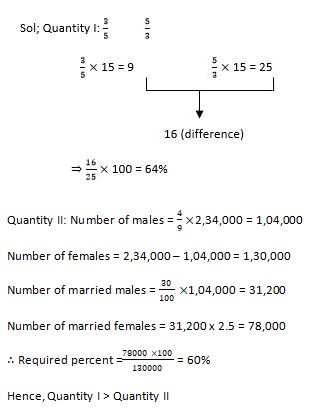
Quantity I: A student multiplied a number by 3/5 instead of 5/3 . What is the % error in the calculation? Quantity II: The population of a town is 2,34,000. 4/9 of them are males . If 30% of males are married and number of married females is 2.5 times of married males. Find the percent of married females out of total females in the town?
More Quantity Inequality Questions
- What is the population of village A in 2021? Quantity I: Population of village A in 2020 was 65,000 and it increased by 12% in 2021 over 2020. Quantity II:...
- The following questions each present two quantities, Quantity I and Quantity II. Compare the values of the two quantities and determine their relationship....
- Quantity-I: 'B' can do 75% of work in 45 hours. Find the value of 'T' if the time taken by him to complete the whole work is 'T' hours. Quantity-II: What i...
- Quantity I: In how many ways can a committee consisting of 2 Managers and 5 Team Leaders be selected from a group of 7 Managers and 8 Team Leaders? Quantit...
- The ratio of present ages of A and B is 5:8 respectively and the average of present ages of A and C is equal to 80% of the present age of B. 4 years ago fr...
- In the question, two quantities I and II are given. You have to solve both the quantities to establish the correct relation between Quantity-I and Quantity...
- The question consists of two quantities, choose the correct option which represents the. correct relation between Quantity I and Quantity II. Quantity I . ...
- Which of the following is the correct relation between Quantity I and Quantity II? Quantity I: The area of a square is 81 cm². Find the perimeter of the s...
- 1st type of 5X tap can fill a tank in X/2 hours while 2nd type of 2Y taps can fill the same tank in 4Y/5 hours. Quantity 1 : Value of Y + 10. Quantity 2 ...
- Which of the following pair of symbols will define the relation between Quantity I and Quantity II Quantity 1: A and B together can complete a task in 15 d...
Relevant for Exams:
Hey! Ask a query
Please enter email id
The email must be a valid email address.
Please enter Mobile Number
Please enter valid Mobile Number
Please enter your Doubt

Think You're Ready for RBI Grade B?
RBI Grade B 2026 Phase 1 Memory Based Paper
- 200 Questions with Detailed Solutions
- Section-wise Coverage (GA, English, Quant & Reasoning)