


Question
How many persons were born after C?
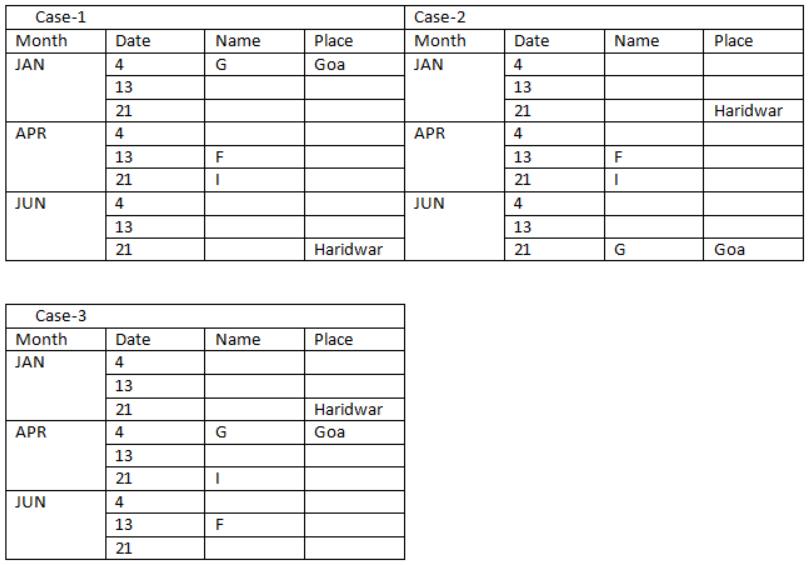 The one who likes Dehradun was born two months after H, who likes Mysore. The number of persons born after the one who likes Dehradun is one more than the number of persons born before A. That means, in case (1), case (2b) & case (3) A was born on 13th January, in case (2a) A was born on 4th January. D neither likes Shimla nor was born on the 13th of the month. The number of persons was born between D and the one who likes Nainital is one less than the number of persons between B and the one who likes Mysore. B was born on the 21st of the month and likes Varanasi. That means, in case (3) I likes Nainital, and D likes Haridwar, case (1), case (2a) & case (2b) are not valid. Based on the above given information we have:
 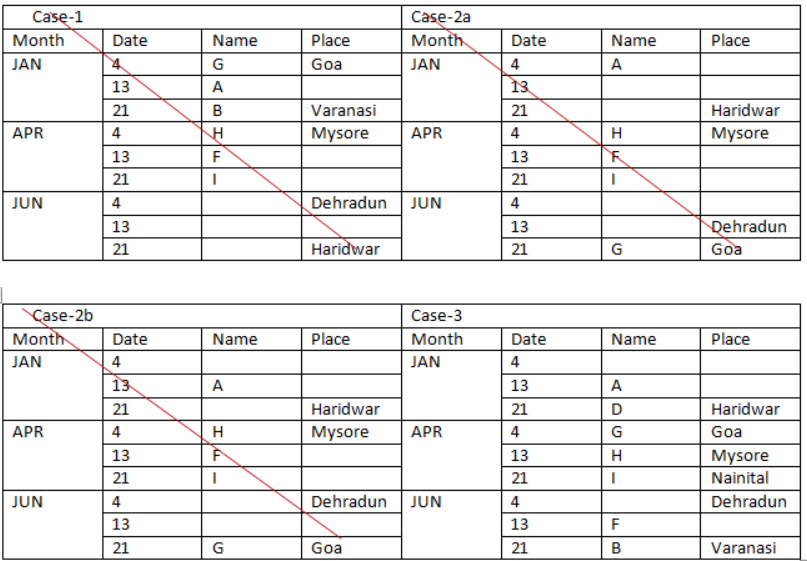 Case (1) is not valid as B was born on 21st of the month and likes Varanasi, case (2a) & case (2b) are not valid as the number of persons were born between D and the one who likes Nainital is one less than the number of persons between B and the one who likes Mysore. Again, we have: E was not born in the same month along with B but was born in the same month along with the one who likes Jaipur. The one who likes Shimla was born on one of the odd days. That means, F likes Shimla, and E likes Agra. Based on the above given information we have the final arrangement as follows: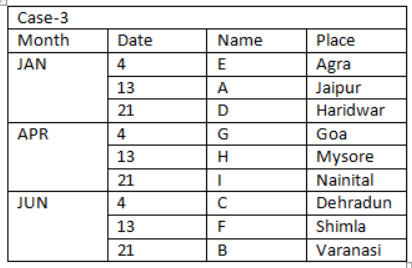
More Puzzles Questions
- Who among the following live on the even floor? I. N II. Z III. B
- Which of the following box is placed third from the top?
- Who among the following attends the music class immediately after the one who has tuition in Ashok nagar?
- Who lives on 10th floor?
- B goes for practical exam on which of the following days?
- How many persons live between A and the one who likes apple?
- Four of the following five are alike in a certain way and thus form a group. Which of the following does not belong to the group?
- Which of the following statement(s) is/are true? I) Three floors are between T and X II) U lives on the lowermost floor III) W lives two floors above T
- How many persons live between A and the one who likes green?
- Seven persons D, E, F, G, H, I and J went to Delhi on seven different days of a week starting from Monday. Only two persons went before I. At least two per...
Relevant for Exams:
Hey! Ask a query
Please enter email id
The email must be a valid email address.
Please enter Mobile Number
Please enter valid Mobile Number
Please enter your Doubt

Think You're Ready for RBI Grade B?
RBI Grade B 2026 Phase 1 Memory Based Paper
- 200 Questions with Detailed Solutions
- Section-wise Coverage (GA, English, Quant & Reasoning)