


Question
Who lives two floor below the floor on which S lives in the same flat number?
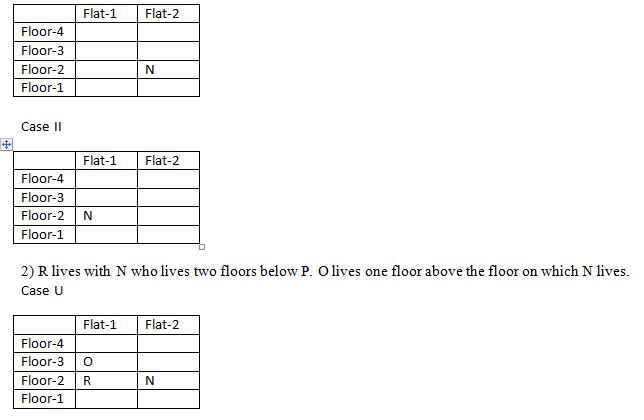 Case II
 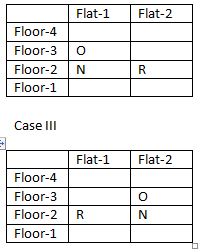 Case IV
 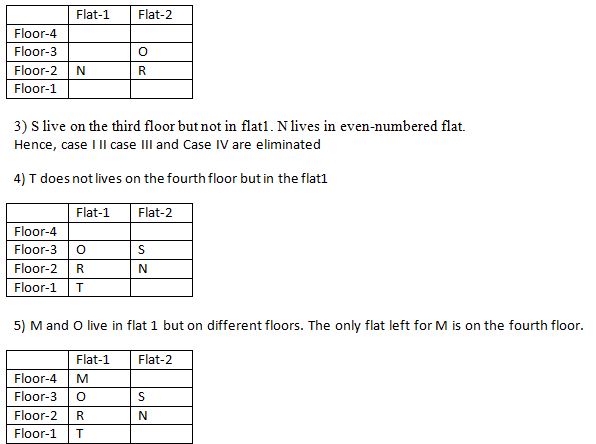 6) Q lives in flat2 of the first floor. The only person left is P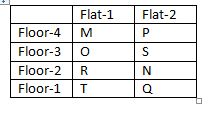
More Puzzles Questions
- What is the position of the box with red?
- How many floor between P and the one who likes WHITE?
- Who among the following born on 5th of February?
- Statements: G ≥ J > L ≥ M = Q =T; Q < C = J < B Conclusions: I). T < B II). G ≤ B
- E likes which of the following game?
- Which of the following plants was exhibited on Thursday?
- Which of the following colour is filled in box D?
- Who among the following is the BO?
- Which of the following statement(s) is false?
- Which of the following Flat is vacant?
Relevant for Exams:
Hey! Ask a query
Please enter email id
The email must be a valid email address.
Please enter Mobile Number
Please enter valid Mobile Number
Please enter your Doubt

Think You're Ready for RBI Grade B?
RBI Grade B 2026 Phase 1 Memory Based Paper
- 200 Questions with Detailed Solutions
- Section-wise Coverage (GA, English, Quant & Reasoning)