


Question
How many persons stand between Q and V?
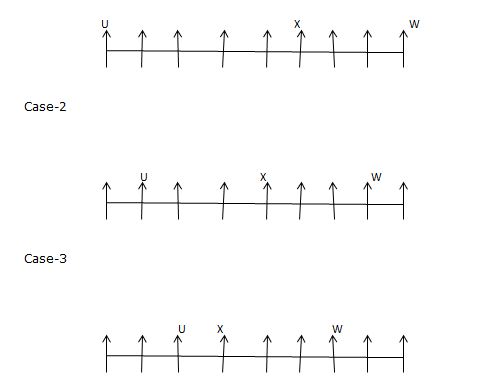 2) V stands fourth from one of the ends and is to the immediate right of P. The number of persons between U and P is the same as the number of persons between X and T. The consecutive alphabetically named person doesn’t stand adjacent to each other. Hence, case 3 gets eliminated.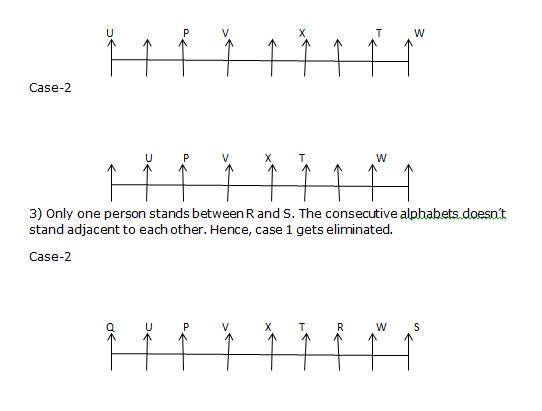
More Puzzles Questions
- Who among the following celebrate their birthdays immediately before and immediately after Kansal?
- How many persons attending the seminar between S and V?
- Six persons N, O, P, Q, R and S live in a six storey building but not necessarily in the same order. The bottommost floor is numbered as 1st and the topmos...
- Who among the following person lives on the fifth floor?
- Four of the following five are alike to in a certain way and so form a group. Which one of the following does not belong to the group?
- Who among of the following sit in same cars?
- Read the direction carefully and answer the following question. Six students A, B, C, D, E and F are sitting in the field. A and B are from Nehru House whi...
- __ and __ live on same floor.
- Which fruit does N like?
- How many persons visits after the one who visits Bilaspur?
Relevant for Exams:
Hey! Ask a query
Please enter email id
The email must be a valid email address.
Please enter Mobile Number
Please enter valid Mobile Number
Please enter your Doubt

Think You're Ready for RBI Grade B?
RBI Grade B 2026 Phase 1 Memory Based Paper
- 200 Questions with Detailed Solutions
- Section-wise Coverage (GA, English, Quant & Reasoning)