


Question
C bought the shirt of which colour?
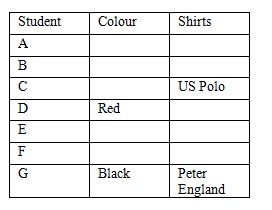 From (iii), (iv) and (v) we get, E bought Allen solly shirt, B have violet colour shirt, A did not bought Red tape. The one who bought yellow colour shirt have the brand Tommy Hilfiger. The one who bought Red tape shirt is of blue colour. A did not bought Red tape shirt, this means F bought Red tape shirt of blue colour. C did not like yellow and pink colour, this means E likes Pink colour. D did not have the brand Tommy Hilfiger or Adidas, so B is having Adidas brand.
 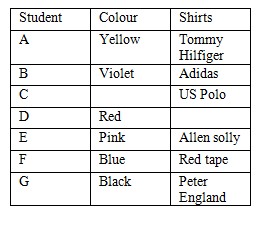 Now the final arrangement is: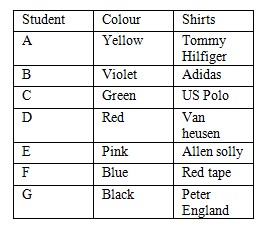
More Puzzles Questions
- How many boxes are kept between box N and the box which contains Dates?
- Which of the following box is placed immediately above Box E, on the same stack?
- Which of the following statements is correct?
- Who among the following likes Titan?
- Six boxes W, M, P, N, C and D, are kept one above the other however not in this particular order. The box, which is kept at the bottommost position is numb...
- who visits just before the one who has White?
- Who among the following person give interview on 7th October?
- Which of the following is true regarding box P?
- Four of the following five are a like in a certain way based on the given arrangement and thus form a group. Which is the one that does not belong to that...
- Which box is the lightest?
Hey! Ask a query
Please enter email id
The email must be a valid email address.
Please enter Mobile Number
Please enter valid Mobile Number
Please enter your Doubt

Think You're Ready for RBI Grade B?
RBI Grade B 2026 Phase 1 Memory Based Paper
- 200 Questions with Detailed Solutions
- Section-wise Coverage (GA, English, Quant & Reasoning)