


Question
The question given below consists of three statements numbered I, II and III given below it. You have to decide whether the data provided in the statements are sufficient to answer the question. Read all the statements and answer the question. Nine boxes R, S, T, U, V, W, X, Y, and Z are one above other in a stack however not necessarily in the same order. The dimension of each box is same. Which box is the topmost box? Statement I: Only four boxes are between Y and Z. U is three boxes below Y. Only three boxes are between U and R, which is above U. As many boxes are between Z and R as between Y and
The question given below consists of three statements numbered I, II and III given below it. You have to decide whether the data provided in the statements are sufficient to answer the question. Read all the statements and answer the question. Nine boxes R, S, T, U, V, W, X, Y, and Z are one above other in a stack however not necessarily in the same order. The dimension of each box is same. Which box is the topmost box? Statement I: Only four boxes are between Y and Z. U is three boxes below Y. Only three boxes are between U and R, which is above U. As many boxes are between Z and R as between Y and
V. X is one box below V but not the bottommost box. S is one box below T. Statement II: U is one box below S. Only two boxes are between S and R. Only two boxes are between U and Y. Y is one box above T. Only two boxes are below T. Only one box is between X and R. Z is above V, which is above W. Statement III: R is three boxes below
V. V is second box from the top. Only one box is between R and T, which is one box above S. Y is three boxes above U. Y is not adjacent to
V.
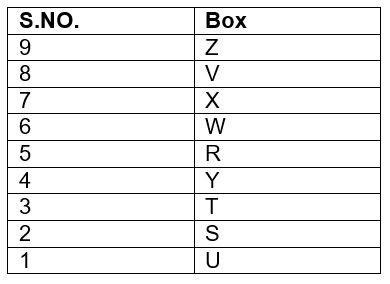 Box Z is the topmost box. Thus, data given in statement I alone is sufficient. From statement II alone, U is one box below S. Only two boxes are between S and R. Only two boxes are between U and Y. Y is one box above T. Only two boxes are below T. Only one box is between X and R. Z is above V, which is above W. We get:
 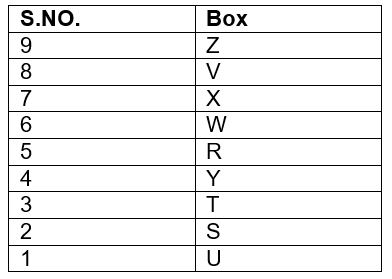 Box Z is the topmost box. Thus, data given in statement II alone, is sufficient. From statement III alone, R is three boxes below V. V is second box from the top. Only one box is between R and T, which is one box above S. Y is three boxes above U. Y is not adjacent to V. We get: Case 1: When V is not adjacent to T.
 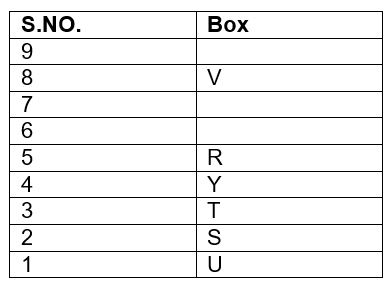 Case 2: When V is adjacent to T.
 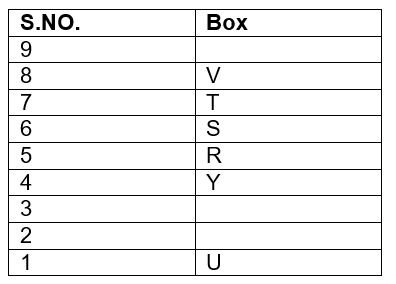 One of the boxes among Box Z, Box X or Box W is the topmost box. Thus data given in statement III is not sufficient. So, data given in either statement I alone or statement II alone is sufficient to answer the question.
More Data Sufficiency Questions
- The question given below consists of two statements numbered I and II given below it. You have to decide whether the data provided in the statements are su...
- Statements: M > N, M > P, O = N Conclusions: I. P > M II. O < M
- Seven boxes viz. S, T, U, V, W, X and Y are kept one above other in the form of stack. How many boxes are kept above box W? I. Only two boxes are kept betw...
- On which date, did Sohan retire? I. Sohan retired on the even numbered date out of the two dates falling exactly in the middle of the two two-digit dates,...
- A question is given, followed by two statements I and II. Select which of the statement(s) is/are sufficient to answer the question. Question: How many ca...
- Among P, Q, R, S, T and U, each has a different height. Who is the smallest? I. P is not the shortest. R is taller than S but shorter than P. II. Q is shor...
- S, B, T, H, M and R are sitting around a circular table. S, Band M are males while the rest are females. Who are the neighbours of S? I. T does not want a...
- Which among the six boxes viz. A, B, C, D , E and F is the smallest? I. B is bigger than E and F and equal to D. II. D is smaller than or equal to C, whi...
- Eight boxes M, N, O, P, Q, R, S and T are kept one above the other, such that the bottommost box is numbered as 1, the box above it is numbered as 2 and so...
- The question given below consists of two statements numbered I and II given below it. You have to decide whether the data provided in the statements are su...
Relevant for Exams:
Hey! Ask a query
Please enter email id
The email must be a valid email address.
Please enter Mobile Number
Please enter valid Mobile Number
Please enter your Doubt

Think You're Ready for RBI Grade B?
RBI Grade B 2026 Phase 1 Memory Based Paper
- 200 Questions with Detailed Solutions
- Section-wise Coverage (GA, English, Quant & Reasoning)