


Question
How many people are sitting in a circle, where all the people are facing the centre?
How many people are sitting in a circle, where all the people are facing the centre?
I. Priya sits second to the left of Gaurav. Mayank is an immediate neighbour of Priya. Mayank sits second to the right of Kamya. Only one person sits between Kamya and Gaurav.
II. Reena sits third to the right of Gaurav . Only one person sit between Reena and Priya. Priya sits third to the left of Sachin. Priya is an immediate neighbour of Mayank.
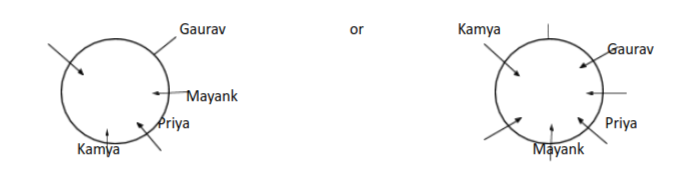 From I there are either five or seven persons. From II :
 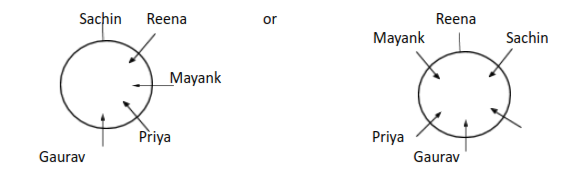 From II there are either five or six persons.
More Data Sufficiency Questions
- How is R related to Q? I. A is wife of one of the sons of T and mother of Q who is grandson of R. II. R is mother of Y. Y is father of Q but Q is not daugh...
- Given below is a question followed by two statements numbered I and II, each containing some information. Decide which of the statement(s) is/are sufficien...
- The question given below consists of two statements numbered I and II given below it. You have to decide whether the data provided in the statements are su...
- What is Pankaj’s ranking among the boys in his class? Statement I. There are 32 students in the class and Pankaj’s rank is second from the bottom. Statemen...
- The question given below consists of three statements numbered I, II and III given below it. You have to decide whether the data provided in the statements...
- In the question below is given a statement followed by two courses of action, numbered I and II. It is assumed that everything in the statement is true. Th...
- Among A, B, C, D, E and F, is A greater than C? I. B is equal to D, who is equal or smaller than A. E is greater than or equal to D and smaller than or eq...
- Six people - A, B, C, D, E and F are sitting in a straight line facing north. Who sits to the immediate left of D? (I) A sits second from one of the extrem...
- Six persons, A, B, C, D, E and F are sitting around a circle facing outside the centre. What is the position of B with respect to A? I. A sits third to th...
- What is Joy’s position in boys when counting from bottom? I. There are 80 students in the class and Joy is ranked fifteenth from the top, and there are 6 ...
Relevant for Exams:
Hey! Ask a query
Please enter email id
The email must be a valid email address.
Please enter Mobile Number
Please enter valid Mobile Number
Please enter your Doubt

Think You're Ready for RBI Grade B?
RBI Grade B 2026 Phase 1 Memory Based Paper
- 200 Questions with Detailed Solutions
- Section-wise Coverage (GA, English, Quant & Reasoning)