


Question
The question given below consists of three statements numbered I, II and III given below it. You have to decide whether the data provided in the statements are sufficient to answer the question. Read all the statements and answer the question. Seven boxes L, M, N, O, P, Q, and R are kept one above another in a stack. How many boxes are between N and R? Statement I: Only four boxes are between L and Q. R is two boxes above Q. Only three boxes are between O and R. P is above N, which is above
The question given below consists of three statements numbered I, II and III given below it. You have to decide whether the data provided in the statements are sufficient to answer the question. Read all the statements and answer the question. Seven boxes L, M, N, O, P, Q, and R are kept one above another in a stack. How many boxes are between N and R? Statement I: Only four boxes are between L and Q. R is two boxes above Q. Only three boxes are between O and R. P is above N, which is above
M. Statement II: Only one box is below
M. Only three boxes are between M and
L. O is three boxes above N. R is two boxes above Q. P is neither the topmost box nor the bottommost box. Statement III: P is above Q. Only five boxes are between Q and O. Only two boxes are between M and P. M is two boxes below N. L is above R.
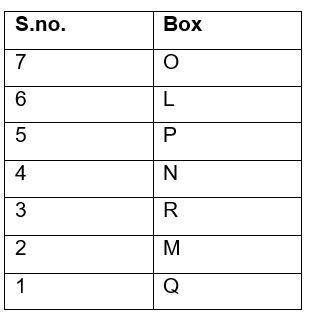 So, from statement I alone, we get no box is between N and R. Thus, data given in statement I alone is sufficient to answer the question. From statement II alone, only one box is below M. Only three boxes are between M and L. O is three boxes above N. R is two boxes above Q. P is neither the topmost box nor the bottommost box. We get:
 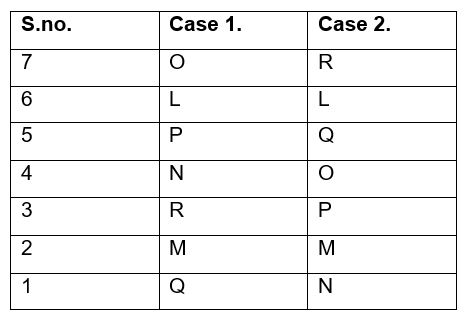 So, from statement II alone, we get that either no box or five boxes are between N and R. Thus, data given in statement II alone is not sufficient to answer the question. From statement III alone, P is above Q. Only five boxes are between Q and O. Only two boxes are between M and P. M is two boxes below N. L is above R. We get:
 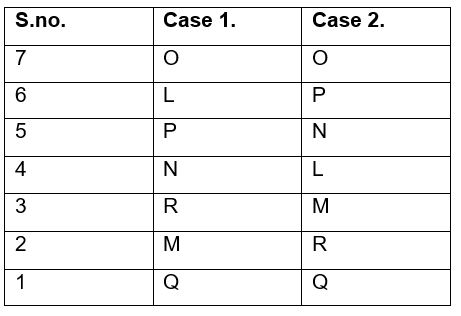 So, from statement III alone, we get that either no box or two boxes are between N and R. Thus, data given in statement III alone is not sufficient to answer the question. Therefore, data given in statement I alone is sufficient to answer the question.
More Data Sufficiency Questions
- The question given below consists of three statements numbered I, II and III below them. You have to decide whether the data provided in the statements are...
- Six persons J, K, L, M, N, and O live on different floors of a six-floor building. The bottommost floor is numbered as 1 and the topmost floor is numbered ...
- The question given below consists of three statements numbered I, II and III given below it. You have to decide which of the statements are redundant to an...
- Five persons R, S, T, U, and V live on different floors of a five-storey building such that the bottommost floor is numbered 1 and the floor immediately ab...
- There are seven letters E, R, P, T, C , H and A. Can the word CHAPTER be formed? I. T is placed third to the right of H. E is placed second to the right o...
- What is Priya’s rank from top in a class? I. In the class of 80 children, Priya is 56 from the bottom. II. Priya is sixteen ranks below Shakti.
- In the following question below consists of a question and two statements numbered I and II given below it. You have to decide whether the data provided in...
- The question given below consists of two statements numbered I and II given below it. You have to decide whether the data provided in the statements are su...
- Seven boxes viz. S, T, U, V, W, X and Y are kept one above other in the form of stack. How many boxes are kept above box W? I. Only two boxes are kept betw...
- Six persons, Adolf, Bailey, Caesar, Dalton, Easton and Fabio are sitting around a circle facing outside the centre. What is the position of Bailey with res...
Relevant for Exams:
Hey! Ask a query
Please enter email id
The email must be a valid email address.
Please enter Mobile Number
Please enter valid Mobile Number
Please enter your Doubt

Think You're Ready for RBI Grade B?
RBI Grade B 2026 Phase 1 Memory Based Paper
- 200 Questions with Detailed Solutions
- Section-wise Coverage (GA, English, Quant & Reasoning)