SEBI Grade A Salary
Becoming a Grade A Officer at the Securities and Exchange Board of India (SEBI) is a top career choice and one of the biggest reasons is the attractive salary package. The pay structure includes several components and is updated from time to time.
With the SEBI Grade A Notification for 2026 expected soon, aspirants who didn't appear for the SEBI Grade A exam in 2025 will be waiting eagerly to know exactly what the role pays, how it grows over a career, and what life looks like on the other side of the exam.
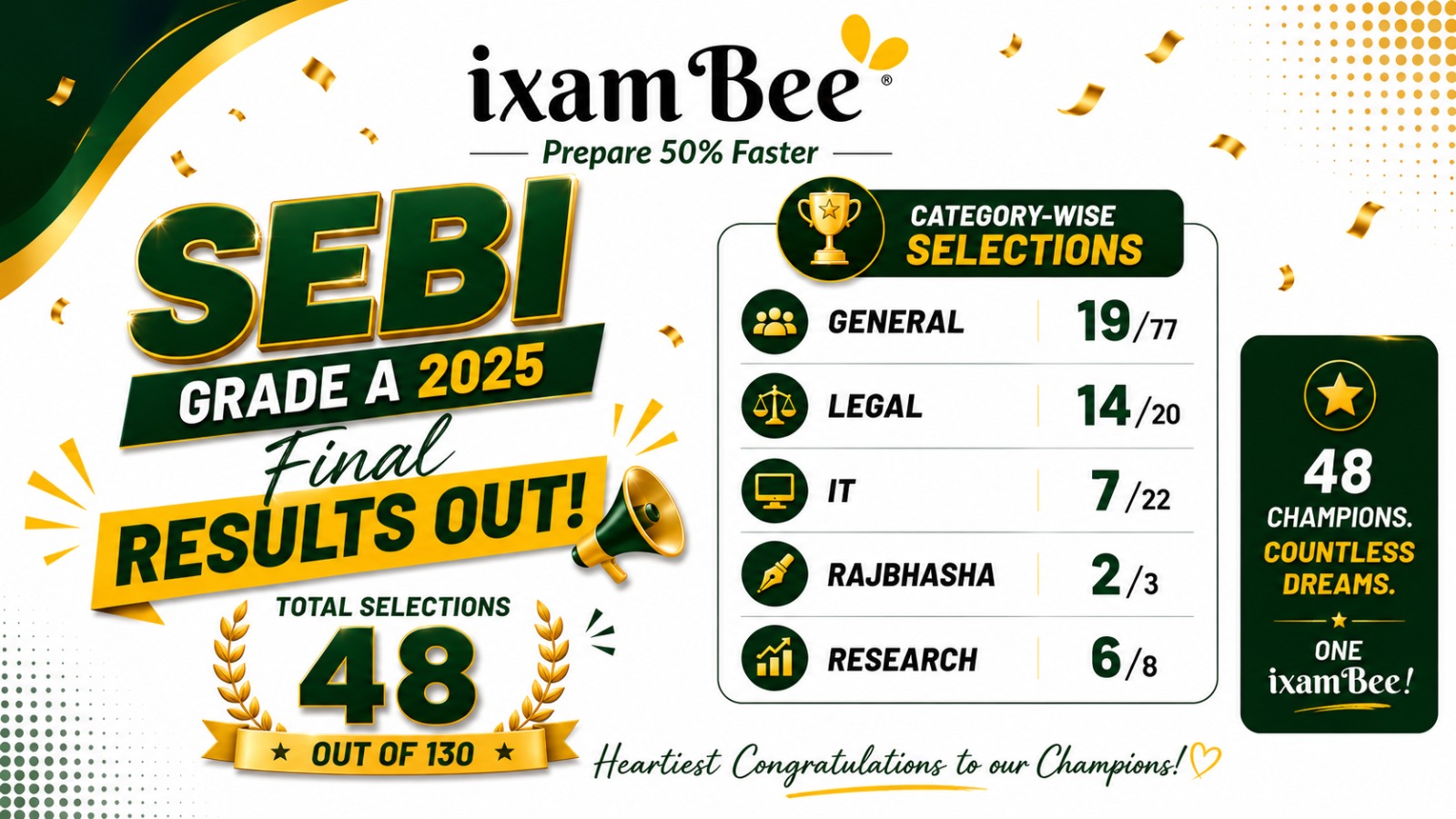
This page covers the complete salary structure along with the job profile, career growth path, posting policy, probation, leave policy, and everything else you need to know.
Download the study material for free
What Is the SEBI Grade A Salary at a Glance?
| Particulars | Details |
|---|---|
| Post | Grade A Officer (Assistant Manager) |
| Basic Pay (Starting) | ₹62,500 per month |
| Pay Scale | ₹62,500 – 3,600(4) – 76,900 – 4,050(7) – 1,05,250 – EB – 4,050(4) – 1,21,450 – 4,650(1) – 1,26,100 (17 years) |
| Gross Monthly Salary (Without Accommodation) | Approximately ₹1,84,000 |
| Gross Monthly Salary (With Accommodation) | Approximately ₹1,43,000 |
| In-Hand Monthly Salary | Approximately ₹1,70,000 |
| Annual CTC | Approximately ₹27 lakh |
| Probation Period | 2 years (1 year if promoted internally) |
| Job Title After Selection | Assistant Manager |
In 2025, SEBI revised its pay scale and increased the basic pay from ₹44,500 to ₹62,500 per month so candidates applying now or for the 2026 cycle can expect this higher starting income.
Along with basic pay, officers receive allowances, benefits, and performance-linked incentives that make this role not just financially rewarding, but also stable and prestigious.
What Is the Complete SEBI Grade A Salary Breakdown — Gross, In-Hand, and CTC?
The basic pay of ₹62,500 is only the starting point. Once allowances, accommodation status, and deductions are factored in, the numbers look quite different:
| Component | Amount (Approx.) |
|---|---|
| Basic Pay | ₹62,500 per month |
| Gross Monthly Salary (Without SEBI Accommodation) | ₹1,84,000 per month |
| Gross Monthly Salary (With SEBI Accommodation) | ₹1,43,000 per month |
| In-Hand Monthly Salary (After Deductions) | Approximately ₹1,70,000 per month |
| Annual CTC | Approximately ₹27 lakh per year |
The gap between gross and in-hand salary comes mainly from Income Tax and NPS contributions (both employee and employer share), which are part of the CTC but not paid out as monthly cash.
| Deduction | Monthly Amount (Approx.) | Yearly Amount (Approx.) |
|---|---|---|
| Income Tax | ₹25,000 | ₹3,00,000 |
| Employee NPS Contribution | ₹13,500 | ₹1,62,000 |
| Employer NPS Contribution | ₹16,000 | ₹1,92,000 |
| Total Deductions | ₹55,000 (approx.) | ₹6,54,000 (approx.) |
Officers can choose between SEBI-provided accommodation or an HRA of around 15% of basic pay if accommodation isn't availed, and this choice is the biggest factor behind the ₹1,43,000 vs. ₹1,84,000 gross salary difference.
Officers may still be eligible for HRA even if they own a house, provided they are living in rented accommodation in another city.
What Allowances Does a SEBI Grade A Officer Receive?
Apart from the basic pay, a SEBI Grade A Officer receives several structured allowances calculated either as a percentage of basic pay or as a fixed monthly amount:
| Allowance | Amount (Per Month) |
|---|---|
| Dearness Allowance (DA) | Approximately 30.38% of basic pay |
| Special Allowance | 16.4% of basic pay (minimum ₹11,000) |
| Grade Allowance | 14% of basic pay (minimum ₹10,400) |
| City Compensatory Allowance (CCA) | 5% of basic pay (maximum ₹2,500) |
| Special Pay | ₹3,300 (after completion of 1 year) |
| Special Functional Allowance | ₹4,000 |
| Family Allowance | ₹2,850 |
| Learning Allowance | ₹2,500 |
| Local Allowance | ₹3,450 |
| Personal Fixed Allowance (PFA) | ₹3,850 |
| Special Compensatory Allowance | ₹500 – ₹625 |
- Dearness Allowance (DA): Paid to help offset the impact of inflation and revised periodically.
- Special Allowance: Helps officers meet general financial requirements and forms a significant chunk of the gross salary.
- Grade Allowance: A fixed percentage tied to the officer's grade.
- City Compensatory Allowance: Compensates for the higher cost of living in metro cities.
- Family Allowance: Provided for the maintenance of the officer's family.
What Additional Perks and Lifestyle Allowances Do SEBI Grade A Officers Get?
Beyond the core salary-linked allowances above, SEBI Grade A Officers are entitled to a long list of lifestyle and convenience allowances that meaningfully add to the take-home package.
| Allowance | Monthly Amount | Yearly Amount |
|---|---|---|
| Petrol (up to 200 litres/month) | ₹20,000–21,700 | ₹2.4–2.6 lakh |
| Servant/Maid Allowance | ₹1,667 (paid quarterly as ₹5,000) | ₹60,000 |
| Medical Allowance | ₹4,000–4,333 | ₹48,000–52,000 |
| Furniture Allowance | ₹5,000 (plus ₹3 lakh lump sum every 5 years) | ₹60,000 |
| Telephone Allowance | ₹2,700 | ₹32,400 |
| Laptop Allowance | ~₹1,000 (₹40,000 once every 4 years) | ₹12,000 |
| Newspaper Allowance | ₹800 | ₹9,600 |
| Sodexo (Meal Benefit) | ₹800 | ₹9,600 |
| Book Allowance | ₹600 | ₹7,200 |
| Spectacle Allowance | ₹600 | ₹7,200 |
| Briefcase Allowance | ₹350 | ₹4,000–4,200 |
| Total Additional Allowances | ~₹40,850 | ~₹4,90,200 |
On top of these, officers also receive:
- Leave Fare Concession (LFC) for travel.
- Vehicle Insurance coverage of up to ₹25,000 per annum.
- Annual Health Check-up allowance of up to ₹10,000.
- Subsidized Loans at a concessional interest rate of around 4.5%, for amounts up to ₹1.5 crore (available after completing probation).
- Children's Education Allowance of around ₹13,000 per month per child, for up to 2 children.
- Canteen, Gym, and Sports Facilities, including unlimited subsidized lunch for around ₹100/month and free gym access.
- BSP Program (Brainstorming Sessions) with an annual budget of ₹11,000 per officer.
- Biannual Party Budget of ₹5,000 per officer.
Residential accommodation is provided depending on availability. Even where accommodation isn't available, SEBI offers housing assistance to help officers find a suitable place to stay.
How Does SEBI Grade A Salary Grow With Annual Increments?
The pay scale of ₹62,500 – 3,600(4) – 76,900 – 4,050(7) – 1,05,250 – EB – 4,050(4) – 1,21,450 – 4,650(1) – 1,26,100 (17 years) translates into the following basic pay milestones over time, even without any promotion:
| Duration | Basic Pay |
|---|---|
| At Joining | ₹62,500 |
| For the Next 4 Years | ₹62,500 + ₹3,600 (4 annual increments) |
| For the Next 7 Years | ₹76,900 + ₹4,050 (7 annual increments) |
| For the Next 4 Years | ₹1,05,250 + ₹4,050 (4 annual increments) |
| For the Next 1 Year | ₹1,21,450 + ₹4,650 (1 increment) |
| Total After 17 Years | ₹1,26,100 (maximum basic pay on this scale) |
Mapped against actual years of service, the salary progression looks like this:
| Years of Service | Approximate Basic Pay |
|---|---|
| After 5 Years | ₹62,500 (still within the initial increment bracket) |
| After 10 Years | ₹80,950 |
| After 15 Years | ₹1,09,300 |
| After 17 Years | ₹1,26,100 (maximum basic pay) |
| After 20–25 Years | ₹1,26,100 (basic pay caps here; further growth comes through promotion, DA revisions, and periodic pay revisions) |
This is the fixed basic pay component alone. Dearness Allowance (DA), HRA, and other allowances are revised periodically and add further growth on top of this salary trajectory.
What Are the Post-Retirement Benefits for a SEBI Grade A Officer?
Since SEBI officers are covered under the National Pension System (NPS) rather than a traditional defined-benefit pension, retirement planning works a little differently.
- Pension (NPS): SEBI contributes to the National Pension System throughout an officer's service, building a retirement corpus that provides regular pension benefits and long-term financial stability.
- Gratuity & Provident Fund (PF): Officers are eligible for both, ensuring a substantial lump-sum payout at retirement or exit.
- Leave Encashment: Unused earned leave can be encashed at retirement, capped at up to 10 months of pay plus allowances.
- Medical Benefits: Medical coverage continues for the officer and eligible dependents even after retirement.
- Post-Retirement Career Opportunities: A SEBI career often opens doors to consulting, advisory roles, and positions in banks and financial institutions after retirement.
How Does SEBI Grade A Salary Compare With Other Top Government Exams?
Aspirants often compare the SEBI Grade A salary with other prestigious government and PSU jobs. The table below gives an approximate comparison of starting basic pay, maximum basic pay, annual CTC, and in-hand monthly salary.
| Exam | Starting Basic Pay | Maximum Basic Pay | Annual CTC | In-Hand Monthly Salary |
|---|---|---|---|---|
| SEBI Grade A | ₹62,500 | ₹1,26,100 (17 years) | ~₹27 lakh | ~₹1,70,000 |
| RBI Grade B | ₹78,450 | ₹1,41,600 (16 years) | ~₹34 lakh | ~₹1,60,000 |
| NABARD Grade A | ₹62,500 | ₹1,26,100 (17 years) | ~₹28.3 lakh | ₹80,000–90,000 |
| IRDAI Grade A | ₹44,500 | ₹89,150 (17 years) | ~₹25 lakh | ~₹1,20,000 |
| IAS Officer | ₹56,100 | ₹2,50,000 (37 years, Cabinet Secretary) | Varies | ₹60,000–80,000 |
| IBPS PO | ₹36,000 | ₹54,320 (16 years) | ₹5–8 lakh | ₹52,000–55,000 |
| SBI PO | ₹36,000 (₹41,960 with advance increments) | ₹63,840 (16 years) | ₹8–10 lakh | ₹52,000–55,000 |
| SSC CGL | ₹25,500–₹47,600 | Varies by post | ₹4.5–10 lakh+ | ₹40,000–80,000+ |
While RBI Grade B offers a higher annual CTC, SEBI Grade A provides an in-hand monthly salary that is competitive with, and in some cases higher than, several other prestigious government and regulatory jobs.
What Is the Job Profile of a SEBI Grade A Officer?
Once you clear the SEBI Grade A Exam and are appointed as an Assistant Manager, you will undergo training followed by a two-year probation period.
Since SEBI recruits officers across multiple streams, including General, Legal, Information Technology, Research, Rajbhasha, and others, your job profile depends on the stream selected during the application process.
Each stream is assigned to different departments within SEBI, and responsibilities vary according to departmental requirements. As per SEBI's transfer and placement policy, officers may be posted across different departments and offices depending on organizational needs.
Common areas of responsibility include:
- Policy Formulation: Drafting and updating policies, regulations, and guidelines for the securities market based on market trends and data analysis.
- Regulation and Compliance: Monitoring entities in the securities market to ensure compliance with SEBI's rules and regulations.
- Inspection and Surveillance: Conducting inspections, monitoring market activities, and investigating complaints to identify irregularities or misuse.
- Investor Education and Protection: Participating in seminars, workshops, and awareness campaigns to educate investors.
- Legal and Enforcement Actions: Assisting in legal matters, preparing legal documents, and supporting enforcement activities.
- Research and Analysis: Studying market trends, financial data, and economic indicators to support sound policy recommendations.
- Stakeholder Engagement: Interacting with market participants, industry bodies, government departments, and international agencies.
The exact job profile depends on the stream selected during recruitment, and responsibilities may differ based on the officer's specialization.
What Are the SEBI Grade A Officer Roles and Responsibilities?
As a SEBI Grade A Officer, you will be entrusted with a range of important duties that help maintain transparency and fairness in the securities market.
- Approving and amending stock exchange by-laws.
- Inspecting the accounts of stock exchanges and various market participants/traders.
- Identifying and investigating any malpractices within the securities markets.
- Promoting investor awareness about the securities market, investors' rights, and safe investing practices.
- Suspending the trading of securities on a stock exchange, if necessary, to prevent market disruptions.
- Granting or withdrawing recognition of a stock exchange.
- Working on the implementation of new policies and regulations and coordinating with other international regulatory bodies.
- Conducting market surveillance to monitor irregular activities, insider trading, and fraud.
- Ensuring regulatory compliance among brokers, intermediaries, and listed entities.
- Promoting good corporate governance practices among listed companies.
The exact roles and responsibilities may vary depending on the department and stream assigned, as officers are placed based on organizational requirements.
What Is the Work Environment and Timing for a SEBI Grade A Officer?
SEBI Grade A Officers work Monday to Friday, with weekends off. The role typically follows a 9:00 AM to 5:30 PM schedule (timings can vary slightly by department) and is known for offering one of the better salary-to-workload ratios among regulatory government jobs in India.
- Low Work Pressure: Officers generally work in a calm environment with a manageable workload, which increases only during major regulatory deadlines or significant market events.
- Professional Work Culture: The work environment closely resembles a corporate culture, emphasizing professionalism, commitment, and teamwork.
- Predictable Routine: Fixed working hours provide a stable routine compared to the private finance sector, where long working hours and higher pressure are more common.
- Holiday Policies: Officers receive weekends off, public holidays, and multiple categories of leave, allowing them to maintain a healthy work-life balance.
How Does Career Growth and Promotion Work for a SEBI Grade A Officer?
One of the biggest attractions of joining SEBI is its well-defined, merit-based promotion structure. Officers generally become eligible for their first promotion after approximately 3–5 years of service, subject to performance assessment and the prescribed promotion process.
| Stage | Position | Typical Timeline |
|---|---|---|
| Joining | Assistant Manager (Grade A) | Entry level after clearing the exam |
| After 3–5 Years | Manager (Grade B) | Based on performance assessment and interview |
| After the Next 3–5 Years | Assistant General Manager (Grade C) | Same promotion process as above |
| After the Next 3–5 Years | Deputy General Manager (Grade D) | Same promotion process as above |
| Based on Performance & Experience | General Manager (Grade E) | Eligible after minimum stipulated years of service, followed by interview |
| Based on Performance & Experience | Chief General Manager (Grade F) | Eligible after minimum stipulated years of service, followed by interview |
| Government Appointment | Executive Director | Appointed by the Government of India |
| Government Appointment | Whole Time Director | Appointed by the Government of India |
| Government Appointment | Chairperson | Appointed by the Government of India |
A few notes on how promotions actually work:
- Managers are responsible for implementing regulatory policies, supervising staff, and ensuring compliance with SEBI's guidelines.
- Assistant General Managers are often involved in policy formulation, regulatory enforcement, and overseeing critical functions.
- Deputy General Managers hold substantial authority in managing departments and implementing regulatory policies.
- General Managers play a pivotal role in shaping SEBI's policies and provide strategic guidance within their departments.
- Chief General Managers oversee major divisions, set organizational objectives, and ensure efficient implementation of SEBI's regulatory framework.
- The Executive Director, Whole Time Director, and Chairperson positions are the highest levels in the organization and are appointed directly by the Government of India rather than through internal promotion.
Beyond formal promotions, SEBI also supports career growth through departmental transfers (to gain wider exposure), regular training and development programs, and cross-functional projects that help officers build a well-rounded skill set.
Where Are SEBI Grade A Officers Posted, and How Do Transfers Work?
While officers are technically liable to be posted anywhere in India, the real picture is more concentrated than many aspirants expect:
- Around 90% of newly selected SEBI Grade A officers are posted in Mumbai, where SEBI's Head Office is located.
- The remaining officers are typically posted in other major metro cities, including Delhi, Bangalore, Chennai, Ahmedabad, and Kolkata.
- SEBI does not post officers in rural areas.
- During the training period, officers are usually posted at SEBI's headquarters in Mumbai. After training, they can be posted or transferred to any SEBI office across India, regardless of stream.
- Service at the Head Office in Mumbai is usually longer in duration compared to postings at Regional or Local Offices.
- Transfers do happen but are relatively rare compared to many other government roles. Postings are planned so officers get exposure to different departments and locations over time.
What Is the Probation Period for a SEBI Grade A Officer?
Probation at SEBI is a genuine performance assessment period, not just a formality:
- Duration: A directly appointed officer is on probation for 2 years, while an officer promoted internally to a new grade is on probation for 1 year.
- Extension: The Chairman may extend the probation period by up to 1 additional year in case of unsatisfactory performance. It may also be reduced or waived, with reasons recorded in writing.
- Confirmation: An officer is confirmed in the post only after successfully completing probation.
- Termination During Probation: In the first month, an officer may be discharged without reason at 1 day's notice. After that, discharge may happen at 1 month's notice or by paying salary in lieu of notice.
- Reversion: An officer promoted internally may be reverted to their previous grade without notice or compensation if performance is unsatisfactory during probation.
Officers receive full salary and benefits during the probation period and can resign during probation, though some advance notice is typically required before the resignation becomes official.
What Is the Leave Policy for a SEBI Grade A Officer?
SEBI's leave policy is fairly generous and includes several categories:
| Leave Type | Entitlement |
|---|---|
| Casual Leave (CL) | Up to 12 days/year for short-term personal needs |
| Special Casual Leave (SCL) | Granted for medical emergencies, training, injury on duty, or family planning |
| Earned Leave (Ordinary Leave) | 30 days/year, accumulable up to 300 days, with encashment options |
| Sick Leave | 20 days/year with medical proof, can be carried forward (usually on half pay) |
| Maternity Leave | Up to 180 days per pregnancy, with full pay |
| Paternity Leave | 15 days around childbirth or adoption |
| Extraordinary Leave (EOL) | Unpaid leave when no other leave is available |
| Accident Leave | Provided for on-duty injuries, based on duration and recovery |
| Special Leave | For personal matters or long-term needs, generally on reduced pay |
Officers transferred to a new location also receive Joining Time to relocate and settle in. Unused joining time can be converted into Special Casual Leave of up to 7 days.
What Are the Training and Development Opportunities at SEBI?
SEBI invests significantly in continuously upgrading its officers' skills through structured learning and professional development initiatives.
- Regular nomination for domestic training programs, workshops, and seminars across different levels.
- Opportunities for international training, seminars, workshops, and study tours.
- Exposure to international securities-market practices.
- Participation in programs through SEBI's association with the International Organization of Securities Commissions (IOSCO).
- Opportunities to represent SEBI in international committees and groups.
- Access to fellowships at reputed institutions.
These initiatives ensure that SEBI officers remain well-equipped to handle evolving challenges in the financial markets while also strengthening their profile for future promotions.
Can SEBI Grade A Be Called a Government Job?
Not in the strictest sense. SEBI Grade A Officers are not Central Government employees. They are employees of SEBI, a statutory body established in 1992 by an Act of Parliament.
SEBI functions independently and is not directly controlled by the Government, though it remains a highly respected, government-established regulatory institution with job security and benefits comparable to government service.
Is It Realistic for a SEBI Grade A Officer to Eventually Earn ₹1 Crore a Year?
It's a common question among aspirants comparing long-term earning potential. On average, total compensation (including DA revisions, periodic pay revisions, and promotions) grows by roughly 12–15% annually, which can effectively double earnings in about 7–8 years. Starting from a gross package of around ₹18–22 lakh per year:
- After 7–8 years: approximately ₹35–36 lakh per annum.
- After 14–16 years: approximately ₹70–72 lakh per annum.
- After 20+ years, with consistent promotions: ₹1 crore+ per annum is a realistic outcome.
This depends heavily on individual promotions, tenure, and future pay revisions, so it should be read as a directional estimate rather than a guarantee.
What Is Life Like as a SEBI Grade A Officer?
The role is both dynamic and rewarding, offering a mix of responsibility, learning, and career growth:
- Professional Environment: Officers work in a highly professional setting that promotes transparency and integrity in the securities market, regularly interacting with market participants, regulators, and stakeholders.
- Regulatory Authority: A core part of the role involves enforcing SEBI's rules, monitoring compliance, and ensuring ethical practices that protect investors and strengthen market integrity.
- Challenging Assignments: The job often involves complex assignments requiring critical thinking, financial analysis, and sound judgment.
- Learning Opportunities: Regular training, seminars, and exposure to diverse areas of the financial market keep officers proactively improving their skills.
- Work-Life Balance: While important market events or critical regulatory actions may occasionally require working beyond regular hours, SEBI is known for valuing employee well-being and maintaining a healthy, supportive work environment overall.
SEBI Grade A 2026 Exam Preparation Strategy
To crack the SEBI Grade A 2026 Exam, it's essential to have a focused strategy and stay committed throughout your preparation journey. A few starting points:
- Build a strong grip on core subjects relevant to your chosen stream (General, Legal, IT, Research, Rajbhasha, etc.).
- Practice regularly with topic-wise and full-length mock tests to track speed and accuracy.
- Stay updated with current affairs, especially related to the securities market, financial regulation, and the economy.
- Structure your preparation in phases: concept-building, practice, and revision, and track your progress consistently.
ixamBee's SEBI Grade A Online Course offers structured content, relevant study material, and expert-led guidance to help you prepare effectively and stay on track throughout your exam journey.