


Question
Read the given statements and conclusions carefully. Assuming that the information given in the statements is true, even if it appears to be at variance with commonly known facts, decide which of the given conclusions logically follow(s) from the statements. Statements: Some reds are blues. All blues are greens. Some greens are not yellows. Conclusions:
Read the given statements and conclusions carefully. Assuming that the information given in the statements is true, even if it appears to be at variance with commonly known facts, decide which of the given conclusions logically follow(s) from the statements. Statements: Some reds are blues. All blues are greens. Some greens are not yellows. Conclusions:
I. Some yellows are reds.
II. Some yellows are blues.
III. Some greens are reds.
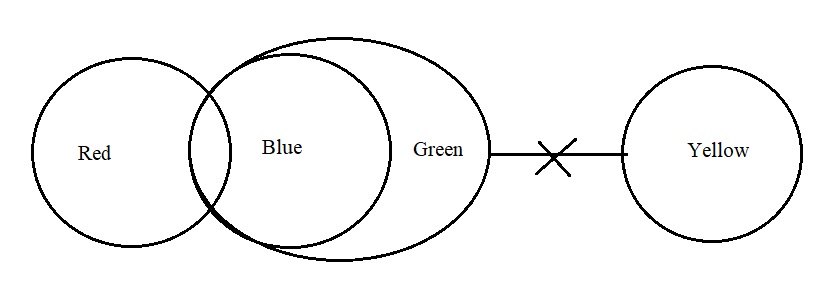 Conclusion I: Not necessarily true based on given venn diagram. Conclusion II: Not necessarily true based on given venn diagram. Conclusion III: It is true based on given venn diagram. Hence, option (d) is the correct answer.
 More Syllogism Questions
- Statements: No number is a symbol. No symbol is a letter. No letter is a draft. Conclusions: I. No number is draft. II. Some letters are not symbols...
- Statement: Only a few Men is Women. All Women is Wife. Some Women is Husband. Conclusion: I. No Wife is Men II. Some Husband is Wife
- Statements: All mouse are keyboard. Some keyboard are speaker. No monitor is speaker. Conclusions: I. Some monitor are mouse. ...
- In the question below some statements are given followed by three conclusions I, II, and III. You have to take the given statements to be true even if they...
- In the question below there are four statements followed by four conclusions I, II, III and IV. You have to take the four given statements to be true even ...
- Statements: All Books are Flight. Only a few Flight are Ticket. No Ticket is a Memo. Conclusions: I. Some Flights are not Memos II. Some Books are not Memo...
- Statements: Some Pulsar are not bajaj. All bajajs are Hero. Conclusions: I. Some bajaj are not Pulsar. I...
- Statement: Some Sparrow are Bird. Few Bird are not Camel. Only Parrot is Camel. Conclusion: I. Some Camel are Bird is a poss...
- Statements: Every friendship is loyal. Only a few loyal are honest. None of the honest are intelligent. 92% intelligent are smart. Conclusions: I. All loya...
- Statements: Some bags are trolleys. All trolleys are luggage. Some luggage is a warehouse. Conclusions: I. Some trolleys are ...
Hey! Ask a query
Please enter email id
The email must be a valid email address.
Please enter Mobile Number
Please enter valid Mobile Number
Please enter your Doubt

Think You're Ready for RBI Grade B?
RBI Grade B 2026 Phase 1 Memory Based Paper
- 200 Questions with Detailed Solutions
- Section-wise Coverage (GA, English, Quant & Reasoning)