


Question
How many seats are between P and O when counted from the left of O?

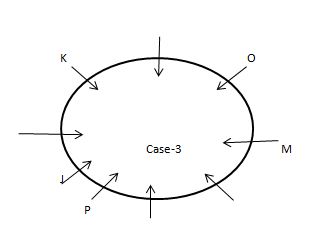 STEP II: L sits to the immediate left of N who sits second to the left of P. Both L and J sit adjacent to each other. The number of persons sits between N and O is one less than the number of persons sits between O and L when counted from the right of both N and O respectively. At least one person sits between K and L when counted from the right of K. As per these statements, CASE I and CASE III get eliminated and we continue with CASE II and the final arrangement will look like this: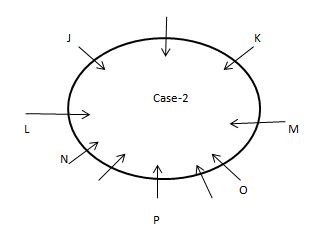
More Reasoning Miscellaneous Questions
- How many persons are living between H and the one who goes to Indore?
- If a mirror is placed on the line XY, then which of the answer figures is the mirror image of the given figure?
- Statement: At-most some Black are White. Only a few Pink are Black. Some Pinks are White. No Pinks are Red. Conclusion: 1. All White can be Red. 2. Some...
- How many persons goes between A and G?
- In the question given below, a premise is given followed by three statements which may or may not be inferred from the passage. Select the correct combinat...
- If √256 ÷ √x = 2√2, then detemine the value of √x.
- After 3 years, B’s age will be?
- If 23, 142, 348, 96, 400, 200, 410 is the second step of an input, which of the following steps will be 23, 96, 142, 348, 200, 400, 410?
- In which direction is Saurabh with respect to Nisha?
- In the question given below, a passage is followed by three statements which may or may not be inferred from the passage. Select the correct combination of...
Relevant for Exams:
Hey! Ask a query
Please enter email id
The email must be a valid email address.
Please enter Mobile Number
Please enter valid Mobile Number
Please enter your Doubt

Think You're Ready for RBI Grade B?
RBI Grade B 2026 Phase 1 Memory Based Paper
- 200 Questions with Detailed Solutions
- Section-wise Coverage (GA, English, Quant & Reasoning)