


Question
If Sanjay and the person who have Red interchange their visiting days then how many persons visits after the person who likes BLACK colour?
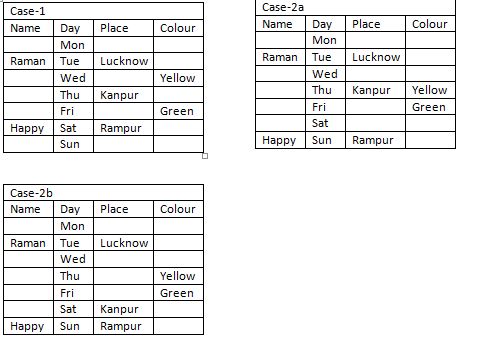 Again, we have: Aadil neither visits on adjacent day of the one likes Yellow nor on adjacent day of Happy. One person visits between the one who visits Jhansi and Aadil, who has Red, that means Aadil visits on Monday. There were three days gap between the one who likes Pink and the one who visits Jhansi. Sanjay neither likes Pink nor he visits before the one who visits Kanpur and he visits Saharanpur. There were two days gap between Sanjay and the one who likes White, who visits on adjacent day of the one who likes Yellow, that means case (2b) is not valid, in case (1) Sanjay visits on Friday, in case (2a) Sanjay visits on Saturday. Based on above given information we have: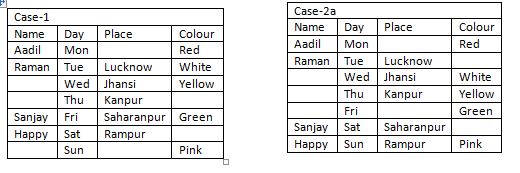
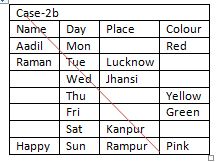 Case (2b) is not valid as Sanjay doesn’t visit before the one who visits Kanpur. Again, we have: The one who likes Black and Farun visits on adjacent days. There were three days gap between Farun and the one who visits Meerut, that means in case (1) Farun visits on Wednesday, in case (2) Farun visits on Friday. Neither Farun nor Yogesh visits Meerut, that means in case (1) Yogesh visits Kanpur. At least three person visits between the one, who visits Bareilly and the one, who has Blue, that means case (2a) is not valid. Based on above given information we have final arrangement we have: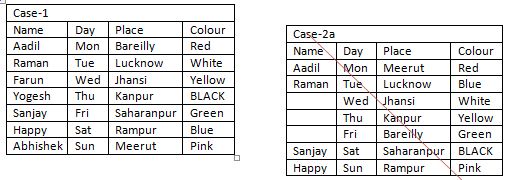
More Puzzles Questions
- On which floor does the person live who likes Apple?
- In which of the following banks does Z’s mother work and lives on which of the following floor?
- How many floors are there between Friend of P and the person who lives on the second floor of the building?
- How many members are there in Anmol’s family?
- Which of the following other boxes are placed in a stack where H is placed?
- Find the correct statement?
- Who among the following live on the odd floor? I. R II. N III. O
- Five persons D, E, F, G and H live on different floors of a five-storey building. The bottommost floor is numbered as 1 and the topmost floor is numbered a...
- Who lives on 4TH floor?
- Six persons (F, G, H, I, J, and K) live on different floors of a six-floor building. The bottommost floor is numbered as 1 and the topmost floor is numbere...
Relevant for Exams:
Hey! Ask a query
Please enter email id
The email must be a valid email address.
Please enter Mobile Number
Please enter valid Mobile Number
Please enter your Doubt

Think You're Ready for RBI Grade B?
RBI Grade B 2026 Phase 1 Memory Based Paper
- 200 Questions with Detailed Solutions
- Section-wise Coverage (GA, English, Quant & Reasoning)