


Question
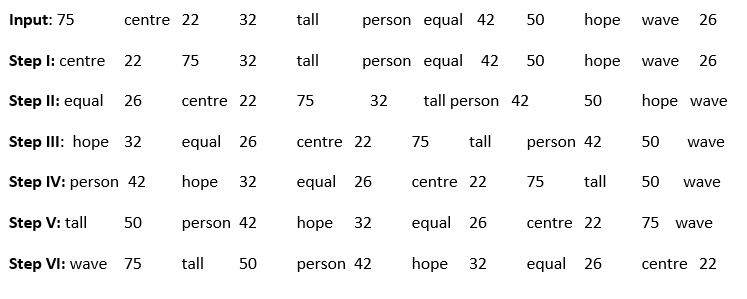
Which of the following elements is third to the left of the 10th element from the left in Step III?
More Input Output Questions
- How many steps are required to rearrange the given input?
- What will be the 14th step for the following input? Input: the rule changes will come into effect for
- Input: he does not even claim that motifs Which of the following steps will be the last but one?
- How many steps will be required to get the final output from the following input? Input: 18, 93, 11, 43, 113, 65, 8, 58
- Input for Qs. 6 - 10: 28 33 92 35 73 46 84 11 Which step number would be the following output? 11 28 33 35 46 73 92 ...
- What is the sum of all the elements of step V?
- How many steps will be required to complete the arrangement?
- How many steps is required to complete the rearrangement?
- Which of the following elements is third to the left of the 10th element from the left in Step III?
- How many steps are required to complete the rearrangement of the given input?
Hey! Ask a query
Please enter email id
The email must be a valid email address.
Please enter Mobile Number
Please enter valid Mobile Number
Please enter your Doubt

Think You're Ready for RBI Grade B?
RBI Grade B 2026 Phase 1 Memory Based Paper
- 200 Questions with Detailed Solutions
- Section-wise Coverage (GA, English, Quant & Reasoning)