


Question
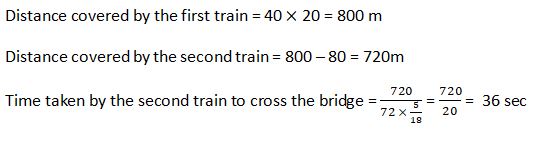
A train whose speed is 40 m/s crosses a bridge in 20 seconds. Another train which is 80m shorter than the first train crosses the same bridge at the speed of 72 km/hr. Find the time taken by the second train to cross the bridge.
More Time and distance Questions
- A train takes 30 minutes to travel 20 km, but due to maintenance, its speed is reduced by 25% for the next 10 km. Find the total time taken by the train to...
- A person covers a certain distance by car, driving at the speed of 90 kmph and returns back to the starting point, riding on a bike at the speed of 60 kmph...
- Sheila walks at the speed of her usual speed (20/21) and determines a clear distance in eight minutes more than the time it takes in normal speed. Calculat...
- The radius of a circular garden is 42 m. The distance (in m) covered by running 8 rounds around it, is: (Take )
- The average speed of a bus is half the speed of a train. The train covers 5200 km in 13 hours. How much distance will the bus cover in 36 minutes?
- Three people – Rohan, Suresh, and Tarun – run at speeds in the ratio 5:4:6. If Tarun takes 18 minutes to finish a race, how long will Rohan take to complet...
- A car travels from city ‘A’ to city ‘B’ covering (1/3)rd of the total distance in 5 hours and the rest in 7 hours. If it takes 8 hours to return to city ‘A...
- The speed of a racer bike is 30% more than a normal bike. If the time taken by the racer bike to cover (3x + 46) km is equal to the time taken by the norma...
- A car was driven for 2.5 hours at a speed of 100 km/h and then for 1.5 hours at a speed of 80 km/h. Find the car's average speed for the total journey.
- Amit covers a journey in 12 hours at a constant speed of 18 km/h. At what speed should he travel to cover the same distance in just 9 hours?
Hey! Ask a query
Please enter email id
The email must be a valid email address.
Please enter Mobile Number
Please enter valid Mobile Number
Please enter your Doubt

Think You're Ready for RBI Grade B?
RBI Grade B 2026 Phase 1 Memory Based Paper
- 200 Questions with Detailed Solutions
- Section-wise Coverage (GA, English, Quant & Reasoning)