SEBI Grade A Syllabus 2026: Complete Phase 1 & Phase 2 Syllabus, Exam Pattern and Preparation Guide
The Securities and Exchange Board of India (SEBI) conducts the Grade A (Assistant Manager) examination to recruit officers for various streams such as General, Legal, Information Technology, Engineering, Research, Official Language, and Electrical Engineering.
Among these, the General Stream attracts the highest number of applicants every year due to its diverse career opportunities and attractive salary package.
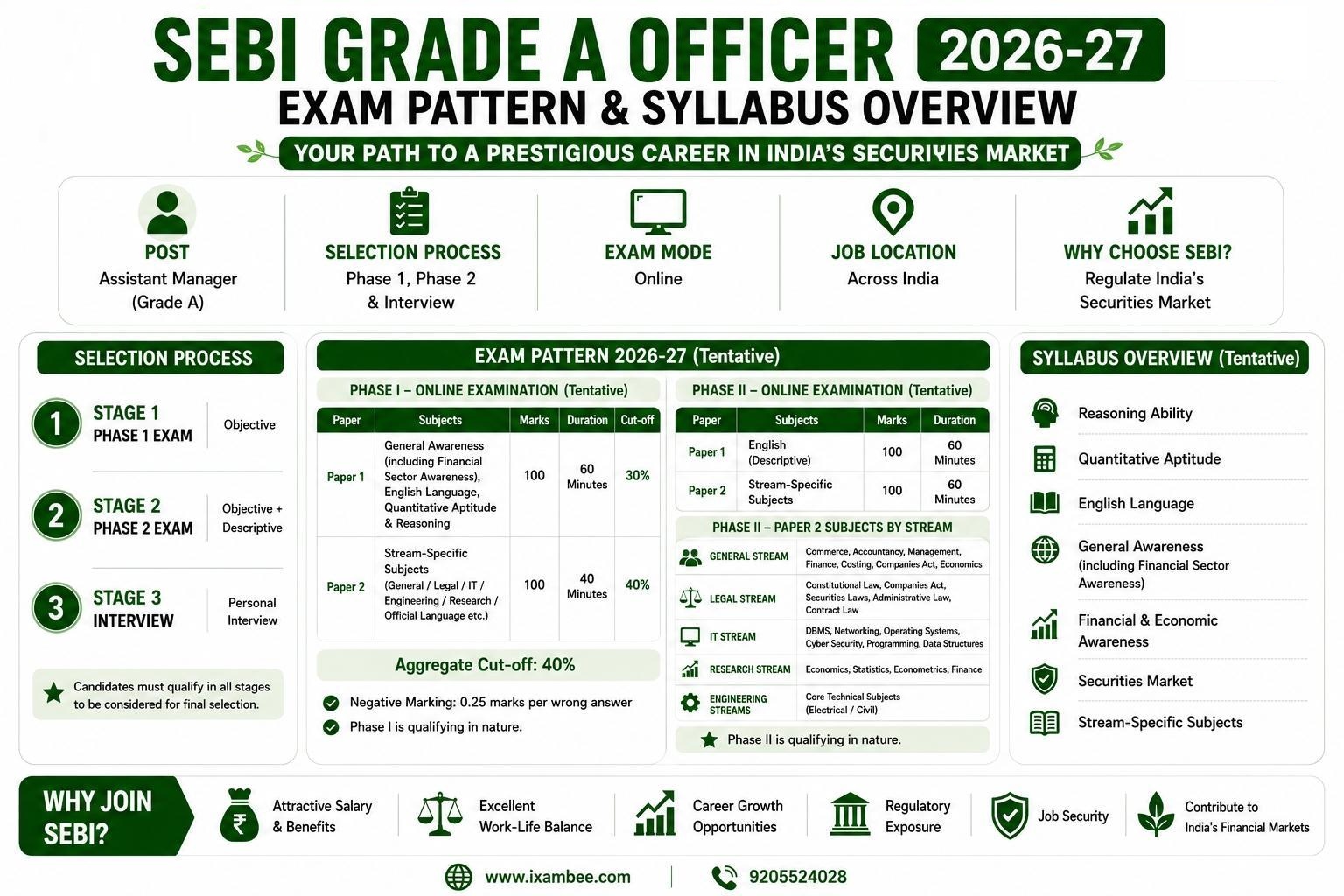
Success in the SEBI Grade A examination depends on understanding the syllabus thoroughly before beginning preparation. Since the exam consists of multiple stages covering aptitude, finance, economics, management, commerce, accountancy, English writing, and current affairs, candidates should prepare according to the syllabus prescribed for each phase.
This article provides the complete SEBI Grade A syllabus for both Phase 1 and Phase 2 examinations, along with the latest exam pattern, subject-wise topics, and important preparation insights.
Download the study material for free
What is the SEBI Grade A Selection Process?
The recruitment process consists of three stages.
| Stage | Examination | Nature |
|---|---|---|
| Phase 1 | Online Screening Test | Qualifying |
| Phase 2 | Online Examination | Merit-based |
| Phase 3 | Interview | Final Selection |
Candidates must qualify for each stage before progressing to the next round. Marks obtained in Phase 2 and the Interview are considered while preparing the final merit list.
What is the SEBI Grade A Exam Pattern?
Phase 1 Exam Pattern
Phase 1 consists of two papers conducted online.
| Paper | Subjects | Marks | Duration |
|---|---|---|---|
| Paper 1 | General Awareness, English Language, Quantitative Aptitude, Reasoning Ability | 100 | 60 Minutes |
| Paper 2 | Commerce, Accountancy, Management, Finance, Costing, Companies Act, Economics | 100 | 40 Minutes |
Important Points
- Both papers are objective in nature.
- There is sectional timing.
- Negative marking applies for incorrect answers.
- Phase 1 is qualifying in nature, but candidates must secure both sectional and overall cut-offs.
What is the Phase 1 SEBI Grade A Syllabus?
Phase 1 evaluates a candidate's aptitude, awareness, and understanding of subjects related to finance and management. The syllabus can broadly be divided into six sections.
| Section | Focus Area |
|---|---|
| General Awareness | Current Affairs, Banking, Financial Markets |
| English Language | Grammar, Vocabulary, Comprehension |
| Quantitative Aptitude | Arithmetic, Algebra, Data Interpretation |
| Reasoning Ability | Logical Thinking and Analytical Skills |
| Financial Awareness | Capital Markets, SEBI Functions |
| Commerce & Management Basics | Business Environment and Finance |
General Awareness Syllabus
General Awareness carries significant importance because it requires conceptual understanding along with knowledge of recent developments. The focus should remain on national, international, economic, and financial events from the previous six to eight months.
Topics Covered
| Topic | Areas Included |
|---|---|
| Current Affairs | National and International Events |
| Banking Awareness | RBI, Monetary Policy, Banking Terms |
| Financial Awareness | Financial Institutions, Capital Markets |
| Indian Economy | Economic Indicators, Inflation, GDP |
| Budget & Economic Survey | Government Schemes, Fiscal Policies |
| Static GK | Important Days, Organisations, Books and Authors |
| Government Schemes | Financial Inclusion and Social Welfare |
| Awards & Honours | National and International Awards |
| Reports & Indexes | Global Economic Reports and Rankings |
| International Organisations | IMF, World Bank, WTO, ADB and Others |
Preparation Tip
Reading financial newspapers and following developments related to the Indian economy, stock markets, and SEBI notifications helps strengthen this section.
English Language Syllabus
The English section tests grammar, comprehension, vocabulary, and sentence construction skills.
| Topic | Description |
|---|---|
| Reading Comprehension | Understanding passages and inference-based questions |
| Cloze Test | Context-based vocabulary and grammar |
| Error Detection | Grammar and sentence correction |
| Sentence Improvement | Improving sentence structure |
| Para Jumbles | Logical arrangement of sentences |
| Fill in the Blanks | Vocabulary and grammar usage |
| Synonyms & Antonyms | Word meanings |
| Idioms & Phrases | Common English expressions |
| Sentence Completion | Grammar-based questions |
| Vocabulary | One-word substitutions and word usage |
Candidates should regularly practise comprehension passages and grammar exercises to improve both speed and accuracy.
Quantitative Aptitude Syllabus
Quantitative Aptitude evaluates numerical ability and problem-solving skills.
| Arithmetic | Advanced Mathematics |
|---|---|
| Percentage | Algebra |
| Profit and Loss | Probability |
| Simple & Compound Interest | Permutation & Combination |
| Ratio & Proportion | Number System |
| Average | Quadratic Equations |
| Partnership | Simplification |
| Time & Work | Approximation |
| Time, Speed & Distance | Data Sufficiency |
| Pipes & Cisterns | Quantity Comparison |
| Mixtures & Allegations | Data Interpretation |
| Ages | Missing Number Series |
Data Interpretation Topics
- Bar Graphs
- Pie Charts
- Line Graphs
- Tabular DI
- Caselet DI
Regular practice with calculation shortcuts and mock tests can significantly improve performance in this section.
Reasoning Ability Syllabus
Reasoning assesses analytical thinking and decision-making skills.
| Topic | Coverage |
|---|---|
| Seating Arrangement | Circular and Linear |
| Puzzles | Floor, Box and Scheduling |
| Blood Relations | Family Tree Problems |
| Coding-Decoding | Pattern Recognition |
| Direction Sense | Distance and Direction |
| Syllogism | Logical Conclusions |
| Inequalities | Direct and Coded |
| Input-Output | Machine-based Questions |
| Data Sufficiency | Logical Analysis |
| Statement & Assumptions | Critical Reasoning |
| Statement & Conclusions | Logical Decision Making |
| Order & Ranking | Position-based Questions |
| Alphabet Test | Series and Arrangements |
| Analogy & Classification | Logical Relationships |
The difficulty level is generally moderate to high, making regular puzzle practice essential.
What are the Paper 2 (Phase 1) Subject Areas?
Paper 2 evaluates candidates' knowledge of subjects relevant to the General Stream.
| Subject | Weightage |
|---|---|
| Commerce | High |
| Accountancy | High |
| Management | Moderate |
| Finance | High |
| Costing | Moderate |
| Companies Act | Moderate |
| Economics | High |
Instead of testing isolated facts, Paper 2 focuses on conceptual understanding and practical application of these subjects.
Commerce Syllabus
Commerce forms the foundation of business and corporate operations.
Major Topics
- Business Environment
- Business Communication
- Business Policy
- Marketing Management
- Consumer Behaviour
- Human Resource Management
- International Business
- Entrepreneurship
- Business Ethics
- Corporate Governance
Candidates should focus on understanding business functions rather than memorising definitions.
Accountancy Syllabus
Accountancy evaluates knowledge of accounting principles and financial reporting.
Topics
- Accounting Standards
- Journal and Ledger
- Trial Balance
- Final Accounts
- Cash Flow Statement
- Bank Reconciliation Statement
- Depreciation
- Inventory Valuation
- Financial Statement Analysis
- Ratio Analysis
- Partnership Accounts
- Company Accounts
Questions may also assess interpretation of financial statements and accounting concepts.
What is the SEBI Grade A Syllabus 2026 (General Stream)?
Phase 2 SEBI Grade A Syllabus
Unlike Phase 1, which serves as a screening test, Phase 2 plays a decisive role in the final merit list. The examination evaluates a candidate's conceptual understanding of finance, management, commerce, economics, and regulatory frameworks applicable to India's financial markets.
For the General Stream, Phase 2 consists of two papers.
| Paper | Subject | Type | Marks | Duration |
|---|---|---|---|---|
| Paper 1 | English (Descriptive) | Descriptive | 100 | 60 Minutes |
| Paper 2 | Commerce, Accountancy, Management, Finance, Costing, Companies Act & Economics | Objective | 100 | 40 Minutes |
Note: The final merit list is prepared based on the marks obtained in Phase 2 and the Interview. Therefore, candidates should allocate sufficient preparation time to both papers.
What is the Detailed Phase 2 Paper 2 Syllabus?
Although the syllabus overlaps with Phase 1, Phase 2 requires a deeper understanding of concepts and their practical applications. Questions are often analytical rather than purely factual.
Management Syllabus
Management is one of the core subjects in the General Stream. Candidates should understand both classical management theories and their practical relevance in modern organizations.
| Topic | Key Areas |
|---|---|
| Principles of Management | Evolution, Functions, Management Theories |
| Planning | Objectives, Policies, Procedures, Decision Making |
| Organising | Organisation Structure, Delegation, Authority and Responsibility |
| Staffing | Recruitment, Selection, Training, Performance Appraisal |
| Directing | Leadership, Motivation, Communication |
| Controlling | Performance Measurement and Corrective Actions |
| Human Resource Management | HR Planning, Employee Relations, Compensation |
| Organisational Behaviour | Personality, Perception, Learning, Attitude |
| Leadership | Leadership Styles, Trait and Behavioural Theories |
| Motivation | Maslow, Herzberg, McGregor, Vroom |
| Communication | Formal, Informal, Business Communication |
| Corporate Governance | Ethics, CSR, Stakeholder Management |
| Change Management | Resistance to Change, Organisational Development |
Preparation Strategy
Instead of memorising definitions, focus on understanding how different management theories are applied in business situations. Questions frequently test practical interpretation.
Finance Syllabus
Finance is among the most important sections of the SEBI Grade A examination because it directly relates to the regulator's role in overseeing India's securities market.
| Topic | Coverage |
|---|---|
| Financial System | Structure and Components |
| Financial Markets | Money Market and Capital Market |
| Financial Institutions | RBI, SEBI, Banks, NBFCs, Mutual Funds |
| Primary Market | IPO, FPO, Rights Issue, Private Placement |
| Secondary Market | Stock Exchanges, Trading Mechanism |
| Debt Market | Bonds, Debentures, Government Securities |
| Equity Market | Shares, Listing Process, Trading |
| Derivatives | Futures, Options, Swaps |
| Mutual Funds | Types, NAV, SIP, Risk Factors |
| Portfolio Management | Diversification, Risk-Return Analysis |
| Risk Management | Credit Risk, Market Risk, Liquidity Risk |
| Financial Ratios | Liquidity, Profitability and Solvency Ratios |
| Capital Budgeting | NPV, IRR, Payback Period |
| Time Value of Money | Present Value and Future Value |
| Working Capital Management | Cash, Inventory and Receivables |
| Corporate Finance | Capital Structure and Cost of Capital |
Market-Related Topics
Candidates should also study:
- SEBI's objectives and regulatory functions
- Stock exchanges in India
- Market intermediaries
- Depositories and custodians
- Insider trading regulations
- Investor protection measures
- Collective Investment Schemes
- Alternative Investment Funds (AIFs)
- REITs and InvITs
- Corporate governance norms
These topics frequently appear because they directly relate to SEBI's responsibilities.
Costing Syllabus
Cost Accounting focuses on cost determination and managerial decision-making.
| Topic | Description |
|---|---|
| Introduction to Cost Accounting | Objectives and Scope |
| Cost Concepts | Fixed, Variable, Semi-variable Costs |
| Material Cost | Inventory Control Techniques |
| Labour Cost | Wage Systems and Labour Turnover |
| Overheads | Allocation and Apportionment |
| Unit Costing | Cost Sheet Preparation |
| Job Costing | Job-wise Cost Calculation |
| Process Costing | Process Losses and Joint Products |
| Marginal Costing | Contribution and Break-even Analysis |
| Budgetary Control | Flexible and Fixed Budgets |
| Standard Costing | Variance Analysis |
| Cost Control | Cost Reduction Techniques |
Focus Areas
Candidates should practise numerical problems involving cost sheets, break-even analysis, and variance calculations.
Companies Act Syllabus
This section tests knowledge of corporate laws governing companies in India.
| Topic | Coverage |
|---|---|
| Companies Act, 2013 | Overview and Objectives |
| Incorporation of Companies | Types and Formation |
| Memorandum of Association | Clauses and Alteration |
| Articles of Association | Contents and Amendment |
| Share Capital | Equity and Preference Shares |
| Prospectus | Issue and Disclosure Requirements |
| Directors | Appointment, Powers and Duties |
| Board Meetings | Conduct and Compliance |
| Corporate Governance | Independent Directors, Audit Committee |
| Accounts and Audit | Financial Statements and Audit Requirements |
| Dividend | Declaration and Payment |
| Corporate Social Responsibility | CSR Provisions |
| Winding Up | Modes and Procedures |
Additional Areas
Candidates should also understand:
- Related party transactions
- Share buyback
- Insider trading restrictions
- Role of independent directors
- Corporate compliance requirements
Economics Syllabus
Microeconomics
| Topic | Coverage |
|---|---|
| Demand and Supply | Elasticity and Equilibrium |
| Consumer Behaviour | Utility Analysis |
| Production Theory | Laws of Production |
| Cost and Revenue | Cost Curves |
| Market Structures | Perfect Competition, Monopoly, Oligopoly |
| Pricing | Different Pricing Methods |
Macroeconomics
| Topic | Coverage |
|---|---|
| National Income | GDP, GNP, NNP |
| Inflation | Causes and Control |
| Monetary Policy | RBI Functions |
| Fiscal Policy | Government Revenue and Expenditure |
| Balance of Payments | Current and Capital Account |
| Exchange Rates | Appreciation and Depreciation |
| Unemployment | Types and Remedies |
| Economic Growth | Development Indicators |
Indian Economy
| Topic | Coverage |
|---|---|
| Economic Reforms | Liberalisation, Privatisation and Globalisation |
| Banking System | Structure and Functions |
| Public Finance | Taxation and Budget |
| Government Schemes | Financial Inclusion Initiatives |
| Agriculture | Current Issues |
| Infrastructure | Energy, Transport and Urban Development |
| External Sector | Trade and Foreign Investment |
| Economic Survey | Key Highlights |
| Union Budget | Fiscal Announcements |
Candidates should also keep track of recent economic developments, policy changes, and important reports released by the RBI, SEBI, Ministry of Finance, IMF, and World Bank.
Best Books for SEBI Grade A Preparation
The right study material can simplify preparation and improve conceptual understanding. Candidates should combine standard textbooks with current affairs resources and mock tests.
| Subject | Preparation Approach |
|---|---|
| General Awareness | Read financial newspapers and follow current affairs regularly. |
| English | Practise descriptive writing and improve grammar through regular reading. |
| Quantitative Aptitude | Focus on arithmetic fundamentals before moving to advanced topics. |
| Reasoning | Solve puzzles and mock tests regularly to improve speed. |
| Finance | Build conceptual clarity and relate topics to current market developments. |
| Economics | Study concepts alongside current economic policies and reports. |
| Companies Act | Learn important provisions instead of memorising every section number. |
| Costing | Practise numerical questions consistently. |
| Management | Understand theories through practical business examples. |
| Accountancy | Revise accounting standards, journal entries, and financial statement analysis. |
What are the Details About the SEBI Grade A Interview Stage?
Candidates who clear Phase 2 are shortlisted for the interview round. While the interview assesses technical knowledge, it also evaluates a candidate's communication skills, analytical thinking, awareness of financial markets, and suitability for a regulatory role at SEBI.
The interview panel may ask questions related to the candidate's educational background, work experience, current financial and economic developments, and topics covered in the Phase 2 syllabus.
What Skills are Assessed During the Interview?
| Assessment Area | What the Panel Looks For |
|---|---|
| Subject Knowledge | Understanding of finance, economics, commerce, and management concepts |
| Financial Market Awareness | Knowledge of recent market developments, SEBI regulations, and policy changes |
| Communication Skills | Ability to explain ideas clearly and confidently |
| Analytical Thinking | Logical approach to solving practical and regulatory issues |
| Personality Traits | Integrity, professionalism, leadership, and decision-making ability |
| Current Affairs | Awareness of national, international, and financial news |
Interview Preparation Tips
- Revise the entire Phase 2 syllabus, especially Finance, Economics, and Companies Act.
- Stay updated with recent SEBI circulars, RBI announcements, Union Budget, and Economic Survey.
- Read business newspapers and financial magazines regularly.
- Be prepared to answer questions about your graduation subject, previous work experience, and reasons for joining SEBI.
- Practise mock interviews to improve confidence and communication.
What SEBI Grade A Preparation Strategies Should I Follow?
Preparing for the SEBI Grade A examination requires balancing aptitude-based subjects with professional subjects. Since the syllabus is extensive, candidates should divide their preparation into manageable stages.
Step 1: Understand the Syllabus
Begin by reading the complete syllabus and identifying the topics you are already familiar with. This helps you allocate more time to subjects that require additional effort.
Step 2: Build Strong Fundamentals
Develop conceptual clarity in Finance, Economics, Accountancy, and Management before moving on to practice questions. A solid understanding of the basics makes it easier to solve application-based problems.
Step 3: Follow Current Affairs Daily
General Awareness is heavily focused on recent developments. Along with national and international news, candidates should pay attention to:
- SEBI notifications and circulars
- RBI monetary policy updates
- Banking and financial sector news
- Capital market developments
- Government schemes
- Economic Survey
- Union Budget
- Important reports released by international organisations
Step 4: Practise Mock Tests
Mock tests help improve speed, accuracy, and time management. They also familiarise candidates with the actual exam pattern and identify weak areas that require additional revision.
Step 5: Revise Regularly
Since the syllabus includes multiple subjects, frequent revision is essential. Maintaining concise notes, formula sheets, and topic-wise summaries can make revision more effective.
Conclusion
The SEBI Grade A syllabus covers a broad range of subjects, making it one of the more comprehensive examinations in the regulatory sector.
While Phase 1 tests aptitude and general awareness, Phase 2 evaluates a candidate's conceptual understanding of finance, economics, management, commerce, accountancy, costing, and corporate laws.
A well-planned preparation strategy, consistent revision, and regular practice with mock tests can significantly improve performance in both phases.
Candidates should also stay informed about developments in India's financial markets and regulatory environment, as current affairs play an important role throughout the selection process.