


Question
In the following question, two statements are given each followed by two conclusions I, II &
In the following question, two statements are given each followed by two conclusions I, II &
III. You have to consider the statements to be true even if they seem to be at variance from commonly known facts. You have to decide which of the given conclusions, if any, follows from the given statements. Statements :
I. Some letters are paper.
II. All papers are objects.
III. Some objects are subjects. Conclusion:
I. Some papers are not subjects.
II. All subjects are objects.
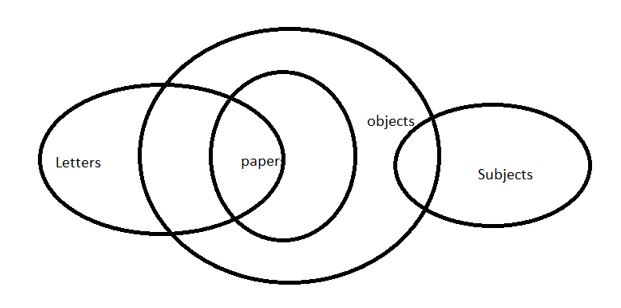 Conclusion I: Not necessarily true based on given venn diagram. Conclusion II: Not necessarily true based on given venn diagram. Hence, option (4) is the correct answer.
More Statement and conclusions Questions
- Read the given statements and conclusions carefully. Assuming that the information given in the statements is true, even if it appears to be at variance wi...
- In the following question, a relationship between different elements is shown in the statement followed by two conclusions (I) and (II). Assuming the state...
- Statements: Only a few Rayon is Cotton. No Cotton is Muslin. Only a few Muslin is Modal. All Modal are Silk. Conclusions: I. Some Silk can be Muslin. II. S...
- Statement: Only a few horses are camel. Mostly camel are rabbit. Each rabbit is cow. Conclusion: 1. All horse being camel is a possibility. 2. All camel b...
- Three statements are given followed by three conclusions numbered I, II and III. Assuming the statements to be true, even if they seem to be at variance wi...
- Statement: Atleast some goa are Shimla. A few Shimla are Nainital. Only a few Delhi are Shimla. All Shimla are Agra. Conclusion: All Nainital be...
- In the question, assuming the given statements to be true, find which of the conclusion (s) among given two conclusions is /are definitely true, and then g...
- A situation is given, followed by two conclusions I and II. Read the situation and both the conclusions carefully and select the correct answer. Situation:...
- Statements: M @ N, P @ R, P & N Conclusions: a ) M @ P b) R & M
- Statements: S * K, T $ K, K @ B Conclusions: a) S $ B b) S @ B
Hey! Ask a query
Please enter email id
The email must be a valid email address.
Please enter Mobile Number
Please enter valid Mobile Number
Please enter your Doubt

Think You're Ready for RBI Grade B?
RBI Grade B 2026 Phase 1 Memory Based Paper
- 200 Questions with Detailed Solutions
- Section-wise Coverage (GA, English, Quant & Reasoning)