


Question
How many persons sit between D and G, if counted from the right of G?
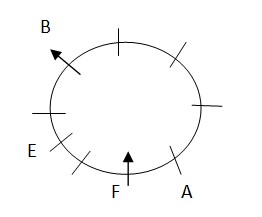 H sits 2nd to the left of D, who faces towards the centre. G sits 2nd to the left of C, who doesn’t face same direction as B. H doesn’t sit with F. So, H sits 3rd to the right of B or immediate left of B and C sits immediate left of F or 4th to the right of F. Case I: C sits immediate left of F:
 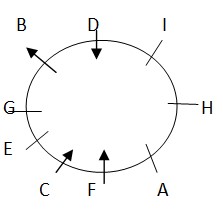 Case II: C sits 4th to the right of F:
 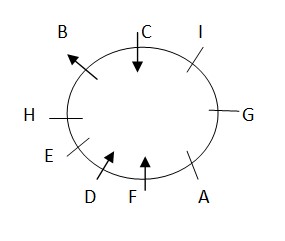 I doesn’t sit adjacent to H, so case I is rejected. Immediate neighbors of G face opposite direction to G. So, G must face towards the centre while I and A face outside and H and E face outside. The final seating arrangement is given below: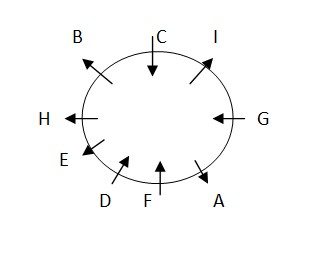
More Seating Arrangement Questions
- Who among the following person sits opposite to the one who is third to the left of B?
- What is the position of A with respect to his maternal Uncle?
- Six persons D, E, F, G, H and I sit around an equilateral triangular shaped table facing towards the centre. One person sits at each side of the table and ...
- Find the total distance travelled by him before reaching railway station ?
- Statements: All amit are ashwani. Only a few arjun are ashish. Some ashish are Aryan. Some ashish are not ashwani. Conclusions: I) Some ashwani ca...
- Who is sitting second to the right of V?
- Who is preparing for UPSC?
- D likes which of the colour?
- Who among the following does like fruits Kiwi?
- Harman, Sunil, Varun, Naman and Bhavesh are arranged in descending order of the height from the top. Harman is at third place. Bhavesh is between Naman and...
Relevant for Exams:
Hey! Ask a query
Please enter email id
The email must be a valid email address.
Please enter Mobile Number
Please enter valid Mobile Number
Please enter your Doubt

Think You're Ready for RBI Grade B?
RBI Grade B 2026 Phase 1 Memory Based Paper
- 200 Questions with Detailed Solutions
- Section-wise Coverage (GA, English, Quant & Reasoning)