


Question
Who among the following person who teaches Sanskrit?
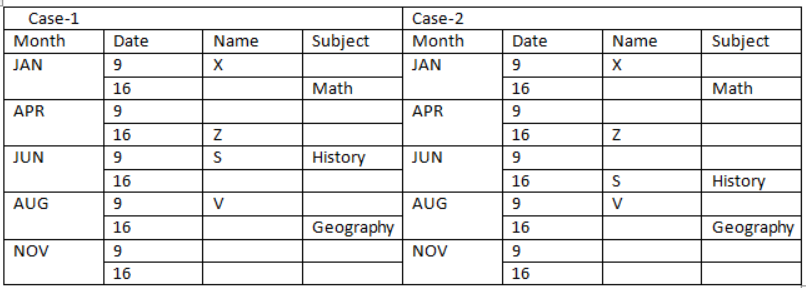 Four persons are attending lectures between the one who teaches Economics and R. R attends lecture just after the one who teaches Sanskrit, both attend a lecture in a different month. That means, in case (2) R attends the lecture on 9th June, case (1) is not valid. The number of persons attending lectures between the one who teaches Economics and Y is one less than the number of persons attending lectures between T and the one who teaches History. That means, in case (2a) Y teaches Geography, and T attends the lecture on 9th April, in case (2b) Y teaches Geography, and T attends the lecture on 9th November, in case (2c) Y attends the lecture on 9th November, and T teaches Geography. Based on the above given information we have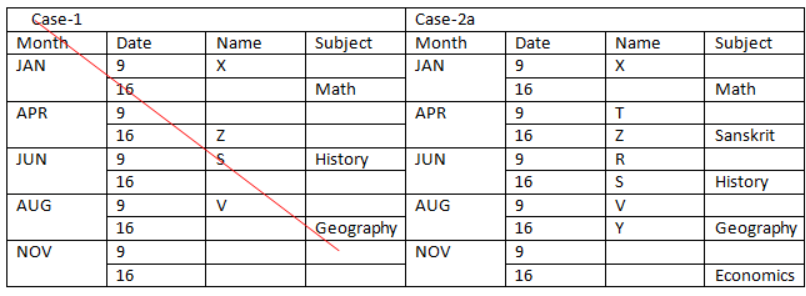
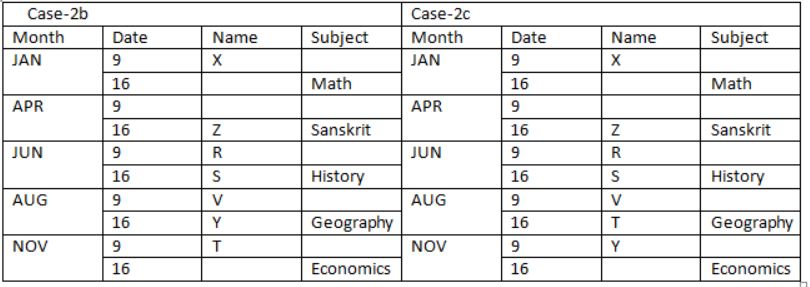 Case (1) is not valid as R attends lecture just after the one who teaches Sanskrit, both attend a lecture in a different month. Again, we have: The number of persons attending a lecture between U and the one who teaches English is the same as the number of persons attending the lecture between Q and the one who teaches Biology. U attends lectures three months after the one who teaches English. The one who likes Hindi attends lecture just before U, who doesn’t teach maths. That means, U teaches Economics. At least three persons are attending a lecture between W and the one who teaches Civics, who attends a lecture in one of the month having 30 days. That means, in case (2a) T teaches Civics, case (2b) & case (2c) are not valid. Case (2b) & case (2c) are not valid as At least three persons are attending lectures between W and the one who teaches Civics. Based on the above given information we have the final arrangement as follows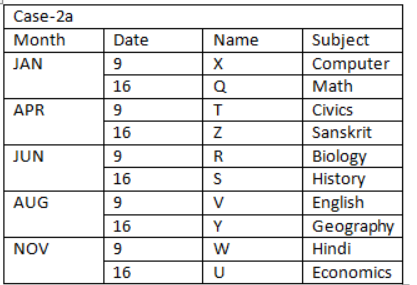
More Puzzles Questions
- Six boxes G, H, I, J, K and L are kept one above another such that bottommost box is numbered as 1 and the box immediately above it is numbered as 2 and so...
- ____ likes Purple.
- Which of the following combinations is correct?
- Who celebrates his birthday on 15th of April?
- Which box is placed at the bottom?
- What is the position of the box with lily?
- Who among the following person stays on flat no. 2 of floor no. 5?
- How many persons live above P?
- Who among the following sits second to the right of A?
- How many persons are there between A and F?
Relevant for Exams:
Hey! Ask a query
Please enter email id
The email must be a valid email address.
Please enter Mobile Number
Please enter valid Mobile Number
Please enter your Doubt

Think You're Ready for RBI Grade B?
RBI Grade B 2026 Phase 1 Memory Based Paper
- 200 Questions with Detailed Solutions
- Section-wise Coverage (GA, English, Quant & Reasoning)