


Question
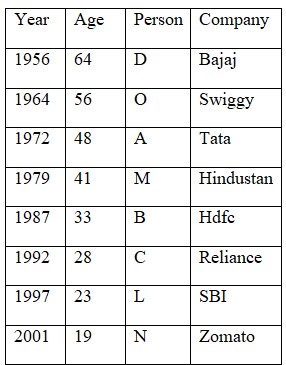
The person whose age is third highest works for which company?
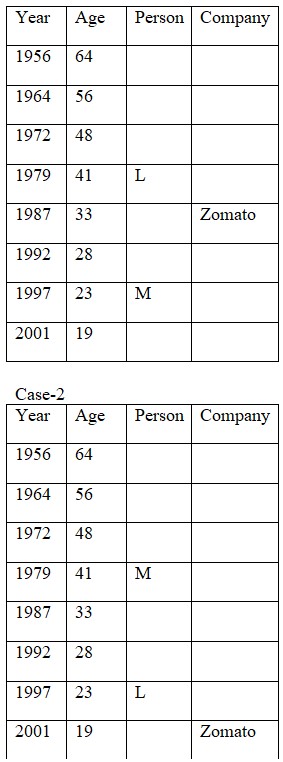 There is only one person born between the one who works for Swiggy and M, whose age is prime number. A's age is multiples of three and does not born after 1982. CASE1 is eliminated and CASE 2 has 2 possibilities. Case-2a
 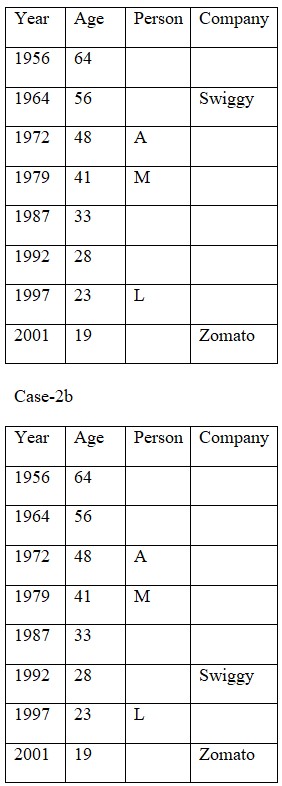 There are only two persons born between the one who works for RELIANCE and A, who does not, works for Swiggy. From here CASE 2b also eliminated B is five year elder then C.The age of O is four times the age difference between the one who works for zomato and B
 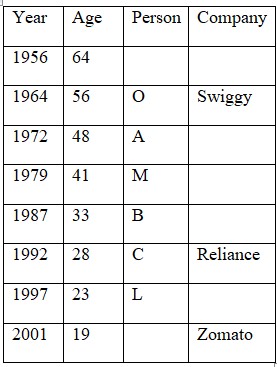 Age of the person who works for BAJAJ is perfect square. C is not elder than the person one who works for HDFC. Age of the person who works for BAJAJ is perfect square. As many persons born between D and the one who works for Swiggy is same as the persons born between M and the one who works for Tata. Not more than three and less than two person born Between N and the one who works for Hindustan
 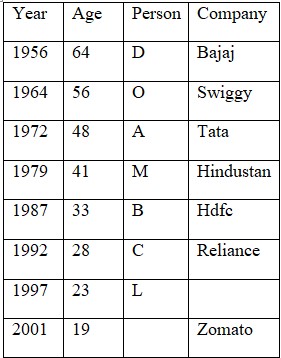 So Final Arrangement
  .
.More Puzzles Questions
- Four of the following five are alike to in a certain way and so form a group. Which one of the following does not belong to the group?
- Five persons F, G, H, I, and J live on different floor of a five-storey building. The bottommost floor is numbered as 1 and the topmost floor is numbered a...
- What is the birth year of one who likes ACER?
- Which combination represents D’s favourite colour and the subject?
- Which of the following boxes is numbered 331?
- How many boxes are placed between box S and box R?
- A belongs to which of the following cities?
- Seven persons S, T, U, V, W, X and Y live on different floor of a seven-storey building. The bottommost floor is numbered as 1 and the topmost floor is num...
- Which of the following pair of persons are immediate neighbors?
- Who among the following celebrate their birthdays immediately before and immediately after Kansal?
Relevant for Exams:
Hey! Ask a query
Please enter email id
The email must be a valid email address.
Please enter Mobile Number
Please enter valid Mobile Number
Please enter your Doubt

Think You're Ready for RBI Grade B?
RBI Grade B 2026 Phase 1 Memory Based Paper
- 200 Questions with Detailed Solutions
- Section-wise Coverage (GA, English, Quant & Reasoning)