


Question
Which of the following statements is true as per the given arrangement?
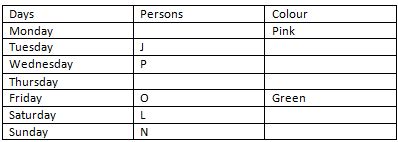 CASE-2
 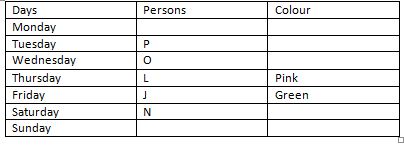 only three people were appointed after the one who likes Black. Case 2 gets eliminated. The number of medals secured by Person J is the blue of the number of medals secured by K. Total number of medals secured by the person who likes Green is the multiple of the number of medals secured by P and K. Only one people was appointed between O and the one who likes red. K was appointed immediately after the one who likes red. More than two people were appointed between M and the one who likes white. N does not likes Yellow and White. Person M secured more medals than the Person O. The number of medals secured by Person L is the Blue of the number of medals secured by P. Total number of medals secured by P is less than 3. The total number of medals secured by K is less than 4. Only two people were appointed after the one who likes Green.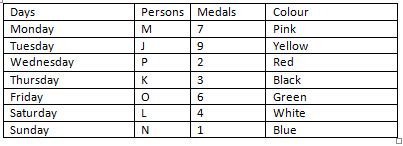
More Puzzles Questions
- __ and __ live on same floor.
- Which among the following pair of persons lives on the same floor?
- ___ is the Team Leader.
- Who worked in eBay and in which day of the week?
- How many assignments were completed by student Y?
- Who among the following person participates on August 17?
- As many people live above E is same as that of below___?
- How many persons sit between 5th youngest person of the family and A’s married son?
- Who lives on the same floor with A?
- Find the odd set of numbers from the given alternatives?
Relevant for Exams:
Hey! Ask a query
Please enter email id
The email must be a valid email address.
Please enter Mobile Number
Please enter valid Mobile Number
Please enter your Doubt

Think You're Ready for RBI Grade B?
RBI Grade B 2026 Phase 1 Memory Based Paper
- 200 Questions with Detailed Solutions
- Section-wise Coverage (GA, English, Quant & Reasoning)