


Question
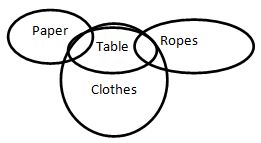
Read the given statements and conclusions carefully. Assuming that the information given in the statements is true, even if it appears to be at variance with commonly known facts, decide which of the given conclusions logically follow(s) from the statements. Statements: Some papers are tables. Some ropes are tables All tables are clothes. Conclusions: (
- I Some papers are clothes. (I
- I Some ropes are clothes. (II
- I No cloth is a rope. (I
- V No paper is a rope.
More Previous year papers Questions
- In a group of 102 students, Priya’s rank is 25th from the top and Kusum’s rank is 20th from the bottom. How many students are between Priya and Kusum?
- Find the missing number in the series: 44, 40, ___, 32, 28.
- 1, 2, 3, 4, 5 and 6 are written on different faces of a dice. Three different positions of the same dice are shown below. Find the number on the face oppos...
- F attends the exam on which of the following subjects?
- Which answer figure will complete the pattern in the question figure? (rotation is not allowed)
- Which of the following numbers will replace the question mark (?) and complete the given number series? 15, 19 , 21, 25 , 27, ?
- Which two signs should be interchanged to make the following equation correct? 16× 25÷ (121 - 11) = 389
- Who among the following persons attend the exam on Saturday?
- Three statements are given, followed by three conclusions numbered I, II and III. Assuming the statements to be true, even if they seem to be at variance w...
- Select the option that represents the correct order of the given words as they would appear in an English dictionary. 1. Diamond 2. Dialogue 3. Dictator 4....
Hey! Ask a query
Please enter email id
The email must be a valid email address.
Please enter Mobile Number
Please enter valid Mobile Number
Please enter your Doubt

Think You're Ready for RBI Grade B?
RBI Grade B 2026 Phase 1 Memory Based Paper
- 200 Questions with Detailed Solutions
- Section-wise Coverage (GA, English, Quant & Reasoning)