


Question
The question given below consists of two statements numbered I, and II given below it. You have to decide whether the data provided in the statements are sufficient to answer the question. Read all the statement and answer the question. Six persons, L, M, N, O, P, and Q work in a Police Department. Each of them has different designation (from senior to junior), the order is DCP, IG, DIG, SP, ASP and DSP but not necessarily in the same order. DCP is the senior most, while DSP is the junior most designation. How many designations are there between the designation of O and Q? Statement I: P is three designations senior to
The question given below consists of two statements numbered I, and II given below it. You have to decide whether the data provided in the statements are sufficient to answer the question. Read all the statement and answer the question. Six persons, L, M, N, O, P, and Q work in a Police Department. Each of them has different designation (from senior to junior), the order is DCP, IG, DIG, SP, ASP and DSP but not necessarily in the same order. DCP is the senior most, while DSP is the junior most designation. How many designations are there between the designation of O and Q? Statement I: P is three designations senior to
L. P is not the IG. M is immediate junior to N. Neither M nor N is ASP. O is senior to Q. Q is not DSP. Statement II: M is immediate senior to P. At most three persons are junior to P. There are two designations between the designation of M and Q. Q is junior to
M. N is senior to O. O is senior to
L. O is not senior to
M.
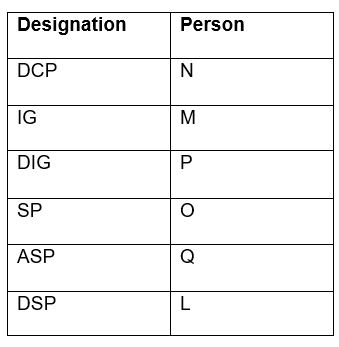 There is no designation between the designation of O and Q. From statement II, M is immediate senior to P. At most three persons are junior to P. There are two designations between the designation of M and Q. Q is junior to M. N is senior to O. O is senior to L. O is not senior to M.
 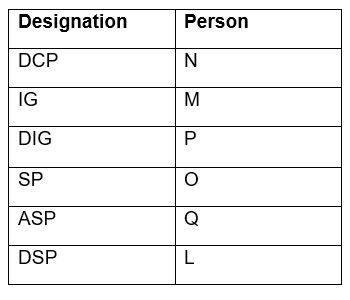 There is no designation between the designation of O and Q. So, data either in statement I alone or in statement II alone is sufficient to answer the question.
More Data Sufficiency Questions
- Five person P, Q, R, S and T all are sitting around a circle. Who are sitting around the circular table facing towards the centre? I. S sits to immediate l...
- A, B, C, D , E and F are sitting around a circular table facing the center. Who sits in front of C? I.A sits second to the right of F, who is second to th...
- How many persons are sitting in the row (assuming all are facing north)? Statement I: Sanjiv sits 5th from the right end of the row. Rinku sits 11th from t...
- Six people, A, B, C, D, E, and F, went for exam, on different days from Sunday to Friday, of the same week. How many persons went after B? Statement I: B w...
- Is E the son of T? I: G is sister of E. G is daughter of Q. Q is father of D . D is son of T. T has only one daughter. II: T is father of G.G is the only ...
- Who amongst A, B, C, D and E is the second tallest? I.A is shorter than B, E is not the shortest. II.C is shorter than A, D is not the shortest.
- What is the difference between the ages of Rekha and Beenu?
- The question given below consists of two statements numbered I and II below them. You have to decide whether the data provided in the statements are suffic...
- Eight persons, P, Q, R, S, T, U, V and W are sitting in a row. All of them are facing the north. Who is sitting at the extreme left end? Statements: I. Thr...
- Six cartons, L through Q are placed one above another, where the bottommost position is 1 and the position above it is 2 and so on. Which carton is placed ...
Relevant for Exams:
Hey! Ask a query
Please enter email id
The email must be a valid email address.
Please enter Mobile Number
Please enter valid Mobile Number
Please enter your Doubt

Think You're Ready for RBI Grade B?
RBI Grade B 2026 Phase 1 Memory Based Paper
- 200 Questions with Detailed Solutions
- Section-wise Coverage (GA, English, Quant & Reasoning)