


Question
Six persons namely – Rahul, Ganesh, Pooja, Dinesh, Reshma and Hemant are sitting in a circular table facing center but not necessarily in same order. Each person likes different pet Parrot, Horse, Monkey, Cat, Rat and Dog not necessary in same order. Who sits immediate right of the one who likes Rat?
Six persons namely – Rahul, Ganesh, Pooja, Dinesh, Reshma and Hemant are sitting in a circular table facing center but not necessarily in same order. Each person likes different pet Parrot, Horse, Monkey, Cat, Rat and Dog not necessary in same order. Who sits immediate right of the one who likes Rat?
I. Reshma sits second to left of Dinesh, who sits third to right of Ganesh. One who likes Dog sits immediate neighbor of Ganesh and sits second to right of one who likes Parrot. One who likes Dog sits immediate right of Rahul who likes Cat. Hemant sits second to left of one who likes Monkey, who sits immediate neighbor of Pooja.
II. Dinesh likes Parrot sits second to left of Hemant, who sits second to left of Reshma. Pooja sits second to the left of Rahul, who sits immediate left of one who likes Dog and Rahul likes Cat. The One who likes Horse sit immediate neighbor of Hemant. Reshma likes monkey.
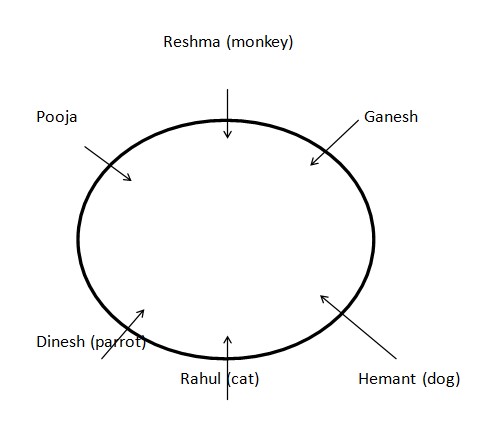 Since, we don’t know who likes Rat, thus result can’t be determined. Hence, statement I is not sufficient. From II: We have: Dinesh likes Parrot sits second to left of Hemant, who sits second to left of Reshma. Pooja sits second to left of Rahul, who sits immediate left of one who likes Dog and Rahul likes Cat. One who likes Monkey sits second to right of one who likes Dog, which means Reshma likes Monkey. One who likes Horse sit immediate neighbor of Hemant, that means Ganesh likes Horse. Reshma likes monkey. Based on above given information we get:
 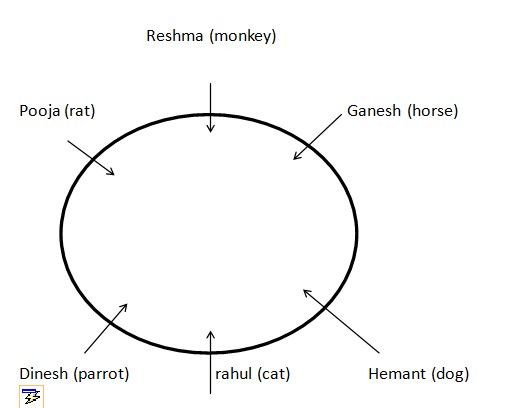 Thus, Dinesh sits immediate right of one who likes Rat. Hence, statement II is alone sufficient.
More Data Sufficiency Questions
- The question given below consists of two statements numbered I and II given below it. You have to decide whether the data provided in the statements are su...
- Six persons R, S, T, U, V and W have different heights. Who is the second tallest person? Statement I: R is taller than V and U. S is taller than T but sh...
- There are six members G, H, I, J, K, L in the family of three generations. There are couples in each generation of the family. How is G related to K? State...
- Among M, N, O, P and Q sitting around a circular table facing the centre, who sits second to the right of O? I. O sits to the immediate right of M. Only tw...
- Six persons J, K, L, M, N and O sit around a circular table and face away from the centre. The distance between two adjacent persons is same. Who sits seco...
- Five persons Sahil, Sonu, Ankush, Deepak, and Aryan having different heights. Who among them is the tallest person? Statements: I) Sonu is taller than Anku...
- Three mangoes M1, M2, and M3 are shared by five persons A, B, C, D and E. A shares mango with E. Mango M2 is shared with C, who shares it with D but not wi...
- The question given below consists of two statements numbered I and II given below it. You have to decide whether the data provided in the statements are su...
- The question given below consists of two statements numbered I and II given below it. You have to decide whether the data provided in the statements are su...
- The question given below consists of two statements numbered I and II given below it. You have to decide whether the data provided in the statements are su...
Relevant for Exams:
Hey! Ask a query
Please enter email id
The email must be a valid email address.
Please enter Mobile Number
Please enter valid Mobile Number
Please enter your Doubt

Think You're Ready for RBI Grade B?
RBI Grade B 2026 Phase 1 Memory Based Paper
- 200 Questions with Detailed Solutions
- Section-wise Coverage (GA, English, Quant & Reasoning)