


Question
Seven persons namely – Reena, Heena, Gautam, Ziyana, Hari, Rohit and Jyoti are sitting in a row not necessary in same order in such a way that some are facing north while others are facing south. Reena sits third to left of Hari, either of them sits at end of the row and Rohit sits immediate left of Reena. Rohit sits second to left of Ziyana, who is facing south. How many person sits facing south?
Seven persons namely – Reena, Heena, Gautam, Ziyana, Hari, Rohit and Jyoti are sitting in a row not necessary in same order in such a way that some are facing north while others are facing south. Reena sits third to left of Hari, either of them sits at end of the row and Rohit sits immediate left of Reena. Rohit sits second to left of Ziyana, who is facing south. How many person sits facing south?
I. Person sitting immediate neighbor of Ziyana sits fourth to right of Jyoti. Person sitting at end of the row sits facing in opposite direction and Gautam sits third from right end. Hari faces north direction.
II. Person sitting immediate left of Rohit sits fourth to right of Jyoti and Gautam sits second to left of Hari.
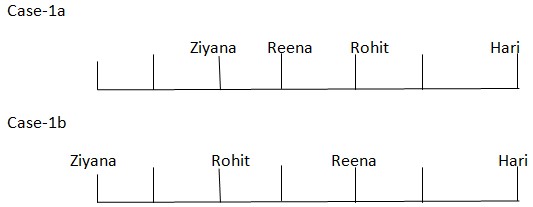 From I: We have: Person sitting immediate neighbor of Ziyana sits fourth to right of Jyoti, which means Jyoti must sits facing south. Person sitting at end of the row sits facing in opposite direction, which means person at left end sits facing south. Gautam sits third from right end, which means case (1a) is not valid. Based on above given information, we have following result:
 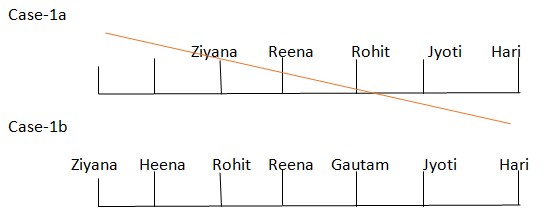 Case1a Gautam sits third from right end, this condition is not satisfied so rejected. Since, direction facing of Heena, Rohit and Gautam is not known, thus we can’t determine required result. Hence, statement I is not sufficient. From II: We have: Person sitting immediate left of Rohit sits fourth to right of Jyoti, which means in case (1a) Rohit sits facing south and in case (1b) Rohit sits facing north. Gautam sits second to left of Hari, which means case (1a) is not valid. Based on above given information, we get following result: case-1b
  Since, direction of Heena and gautam is not known, thus result can’t be determined. Hence, statement II is not sufficient. From I and II: Based on above given statements we get: Case-1b
  Since, direction of Heena and Gautam is not known, thus result can’t be determined. Hence, statement I and II together are not sufficient.
More Data Sufficiency Questions
- In which direction is the dog with respect to his kennel? I. The dog runs towards his master who is standing towards the left of the kennel of the dog and...
- Statements: G ≤ H, H ≤ J, L < G Conclusions: I. L < H II. J > L
- The question given below consists of two statements numbered I and II given below it. You have to decide whether the data provided in the statements are su...
- Among A, B, C, D and E, which is the smallest? I. D is greater or equal to E. B is equal to C, which is greater than D. II. E is smaller than A, which is s...
- How is P related to E?
- F is in which direction with respect to E? I. B is to the east of C, who is to the south of D. E is to the southwest of D and F is to the east of D. II. ...
- Among A, B, C, D and E, which is the smallest? I. D is greater or equal to E. B is equal to C, which is greater than D. II. E is smaller than A, which i...
- Who scores the highest runs in a match, among five players E, F, G, H, and I? I. E scores equal to F, who scores five runs more than G. II. H does not sc...
- How is R related to Q? I. A is wife of one of the sons of T and mother of Q who is grandson of R. II. R is mother of Y. Y is father of Q but Q is not dau...
- How is Y related to J? I. J is father of two children and husband of C, who is sister of D and D is Y’s mother. II. Y is son of M, who is brother of C. J...
Hey! Ask a query
Please enter email id
The email must be a valid email address.
Please enter Mobile Number
Please enter valid Mobile Number
Please enter your Doubt

Think You're Ready for RBI Grade B?
RBI Grade B 2026 Phase 1 Memory Based Paper
- 200 Questions with Detailed Solutions
- Section-wise Coverage (GA, English, Quant & Reasoning)