


Question
Eight boxes namely -A, B, C, D, E, F, G and H are kept one above another not necessarily in the same order. Box C is kept third from bottom at a gap of two from box D, which is kept adjacent to box B and box A is kept at a gap of one from
Eight boxes namely -A, B, C, D, E, F, G and H are kept one above another not necessarily in the same order. Box C is kept third from bottom at a gap of two from box D, which is kept adjacent to box B and box A is kept at a gap of one from
B. Which box is kept immediate above box E?
I. Box G is kept at a gap of two from box A and Box H is neither kept at bottom nor adjacent of
C. Box G is kept at a gap of two from box F.
II. Box F is kept at a gap of two from box G, which is kept adjacent of box
C. Box H is kept immediate neighbor of box
A.
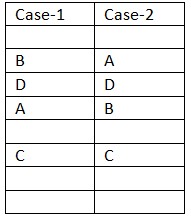 From I: We have: Box H is neither kept at bottom nor immediate neighbor of C, which means box H is kept at top. Box G is kept at a gap of two from box A, which means in case (1) G is kept immediate above box C and in case (2) box G is kept immediate above box C. Box G is kept at a gap of two from box F, which means case (1) is not valid and in case (2) box F is kept at bottom. Based on above given information we get final arrangement as follow:
 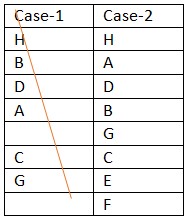 Thus, box C is kept immediate above box E. Hence, statement I alone is sufficient. From II: We have: Box H is kept immediate neighbor of box A, which means in case (1) box H is kept immediately below box A and in case (2) the box H is kept immediately above box A. Box F is kept at a gap of two from box G, which is kept immediate neighbor of box C, that means case (1) is not valid and in case (2) box G is kept immediate above box C. Based on above given information we get final arrangement as follow:
 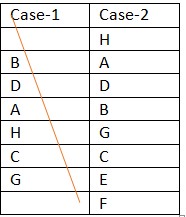 Thus, box C is kept immediate above box E. Hence, statement II alone is sufficient.
More Data Sufficiency Questions
- How many children does Mr. Jagdish has? I. Mr. Jagdish has six sons and each has one sister. II. Number of sons of Mr. Jagdish is six times the number of h...
- The question given below consists of three statements numbered I, II and III given below it. You have to decide whether the data provided in the statements...
- Who amongst A, B, C, D and E is the second tallest? I.A is shorter than B, E is not the shortest. II.C is shorter than A, D is not the shortest.
- Five persons M, N, O, P and Q, who all are of different heights. Who among the following is the shortest? Statement I: N is shorter than only one person. ...
- Seven boxes viz. A, B, C, D, E, F and G are kept one above other in the form of stack. How many boxes are kept above box E? I. Only two boxes are kept betw...
- The question given below consists of two statements numbered I and II given below it. You have to decide whether the data provided in the statements are su...
- The question given below consists of two statements numbered I and II given below it. You have to decide whether the data provided in the statements are su...
- Five persons R, S, T, U, and V live on different floors of a five-storey building such that the bottommost floor is numbered 1 and the floor immediately ab...
- How is E related to D? I. D is the son of A’s wife who is the daughter of E’s wife. II. E’s wife is mother-in-law of D’s mother.
- The question given below consists of two statements I and II given below it. You have to decide whether the data provided in the statements are sufficient ...
Relevant for Exams:
Hey! Ask a query
Please enter email id
The email must be a valid email address.
Please enter Mobile Number
Please enter valid Mobile Number
Please enter your Doubt

Think You're Ready for RBI Grade B?
RBI Grade B 2026 Phase 1 Memory Based Paper
- 200 Questions with Detailed Solutions
- Section-wise Coverage (GA, English, Quant & Reasoning)