


Question
Six persons P, Q, R, S, T and U are sitting in a circular table. Each of them faces inside the table but not necessarily in the same order. Who among the following persons sits second to the left of U?
Six persons P, Q, R, S, T and U are sitting in a circular table. Each of them faces inside the table but not necessarily in the same order. Who among the following persons sits second to the left of U?
I. Two persons sit between T and P. S is not sits an immediate neighbour of either T or Q. The numbers of persons sit between S and Q is same as R and U.
II. Three persons sit between R and U. R is not an immediate neighbour of Q. Two persons sit between S and U.
III. S is not an immediate neighbour of Q. One person sits between S and P. T sits third to the left of P. U is not an immediate neighbour of S.
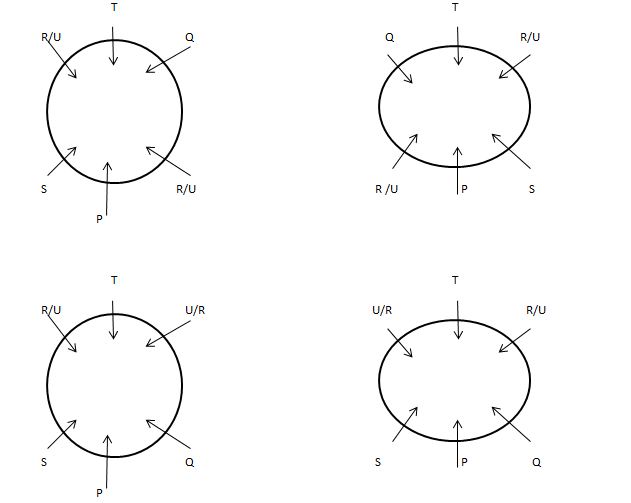 Statement II: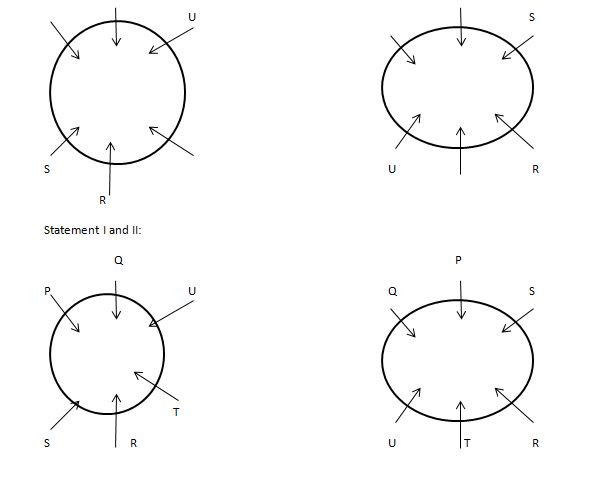
More Data Sufficiency Questions
- A, B, C, D , E and F are sitting around a circular table facing the center. Who sits in front of C? I.A sits second to the right of F, who is second to the...
- In which direction is the dog with respect to his kennel? I. The dog runs towards his master who is standing towards the left of the kennel of the dog and...
- How is P related to E?
- Seven person namely – G, H, I, J, K, L and M have different height. How many person are taller to J? Statement I: J is taller to K, H but not as much as G,...
- Among six friends S, T, U, V,W and X, who gets the second highest marks? I. X gets more marks than U and W but not as much as T. V gets more marks than W ...
- Among six people P, Q, R, S, T and U, each having a different marks which is 12,17,23,25,26 and 29 (marks are arranged in decreasing order from left to rig...
- How is ‘dog’ coded in a code language? I. ‘loyal and intelligent dog’ is coded as ‘la po hi do’ II. ‘dog is running fast’ is coded as ‘po ro no ji’
- Six persons A, B, C, D, T and U have different marks in a class test. Who has 2nd highest marks? Statement I: C has more marks than D and T. At least two p...
- Who is brother in law of Y? I. Y is mother of Z and is married to the brother of A, who is female. II. V and X are brothers of A. U is wife of X.
- The question given below consists of two statements numbered I and II given below it. You have to decide whether the data provided in the statements are su...
Hey! Ask a query
Please enter email id
The email must be a valid email address.
Please enter Mobile Number
Please enter valid Mobile Number
Please enter your Doubt

Think You're Ready for RBI Grade B?
RBI Grade B 2026 Phase 1 Memory Based Paper
- 200 Questions with Detailed Solutions
- Section-wise Coverage (GA, English, Quant & Reasoning)