


Question
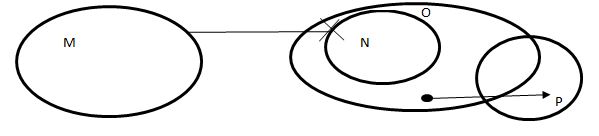
Statement: Few M are not N. All N are O. Only a few O are P. Conclusion: 1. All M can be N. 2. Some M are not P is a possibility. 3. Some P are not N. 4. All P are
Statement: Few M are not N. All N are O. Only a few O are P. Conclusion: 1. All M can be N. 2. Some M are not P is a possibility. 3. Some P are not N. 4. All P are
M.
More Reasoning Miscellaneous Questions
- How many symbols are immediately followed by a number?
- Statement: Indian Culture is getting forgotten and the country is losing its rich heritage. Assumptions: I. Westernization has affected Indian traditions a...
- A series contains thirteen consecutive odd numbers. If the average of these numbers is 41, determine the ratio of the first number to the last number in th...
- Which of the following storage types has no moving parts?
- निम्नलिखित प्रश्नों में, प्रश्नवाचक चिन्ह(?) के स्थान पर लगभग क्या मूल्य आएगा ? 29.51% of 689.82 - 19.69% of 450.15 = ?
- The product of two numbers is 15.75. If one of the numbers is 4.5, then find the other number.
- By interchanging the given two signs and numbers which of the following equation will be correct? × and ÷, 7 and 9
- 1. Walls 2. Floor 3. Roof 4. Room 5. Foundation 6. Window
- . If the consonants of the following words are arranged first, followed by the vowels as per the English alphabetical order and then the consonants are cha...
- Select the option that will complete the below series. U2C, O7D, I23E, E72F, A220G,?
Relevant for Exams:
Hey! Ask a query
Please enter email id
The email must be a valid email address.
Please enter Mobile Number
Please enter valid Mobile Number
Please enter your Doubt

Think You're Ready for RBI Grade B?
RBI Grade B 2026 Phase 1 Memory Based Paper
- 200 Questions with Detailed Solutions
- Section-wise Coverage (GA, English, Quant & Reasoning)