


Question
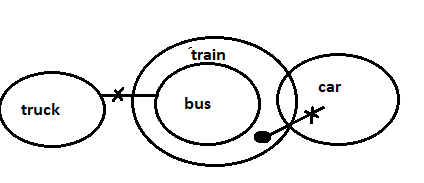
Statements: No truck is a bus. All bus are train. Only a few train are car. Conclusions:
Statements: No truck is a bus. All bus are train. Only a few train are car. Conclusions:
I. All bus may be car.
II. All truck are train is a possibility.
III. All car can be train.
More Statement and conclusions Questions
- Consider the given statements to be true even if they seems to be at variance with the commonly known facts and decide which of the given conclusions logic...
- Based on the scenario given, choose the decision from the options which would be most suitable. Research shows that playing outdoors improves the overall ...
- Statements: X ≥ P ≥ O = S; S ≤ H < N; N > I Conclusions: I. O ≥ N II. I > O III. S < X
- Read the given statements and conclusions carefully. Assuming that the information given in the statements is true, even if it appears to be at variance wi...
- Statements: V > I < Z > T = C ≥ A > G ≥ R Conclusion I: A < Z II: C > R
- Statement: W < X; W ≥ Y > Z; T ≥ U > X Conclusion: I. Z ≥ X II. U ≥ W
- Read the given statements and conclusions carefully. Assuming that the information given in the statements is true, even if it appears to be at variance wi...
- A question is followed by two statements numbered (I) and (II). You have to decide whether the data provided in the statements are sufficient/necessary to ...
- Statements: T ≤ K = E ≤ Q, J = Q < H ≤ S ≤ V, A ≤ V < O = Y Conclusions: I. T < V II. O ≥ H
- Statements: Only apricots are walnuts. Only a few almonds are apricots. All cashews are almonds. Conclusions: 1) Some cashew being apricot is a possib...
Hey! Ask a query
Please enter email id
The email must be a valid email address.
Please enter Mobile Number
Please enter valid Mobile Number
Please enter your Doubt

Think You're Ready for RBI Grade B?
RBI Grade B 2026 Phase 1 Memory Based Paper
- 200 Questions with Detailed Solutions
- Section-wise Coverage (GA, English, Quant & Reasoning)