


Question
Statement- 1-Some clocks are watches. 2-Some watches are walls. 3-Some walls are houses. 4-Some houses are rooms. Conclusion- 1. Some rooms are watches. 2. Some rooms are houses. 3. No watch is a room.
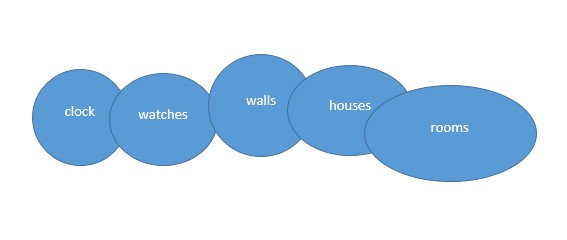 So here conclusion either I or III does not follows
 More Syllogism Questions
- Statements: Some Lantern are Light. Only a few Light are Lamp. Some Lamp are Torch. Conclusions: I. Some Torch are not Lantern. II. No Light being To...
- Statements: No subject is predicate. All predicate is vowel. Only a few vowel is preposition. Conclusions: I. No vowel is subject. II. Mostly predicate is ...
- Below are given statements followed by some conclusions. You have to take the given statements to be true even if they seem to be at variance math the comm...
- Statements: Some earth are moon. Some moon are sun. Conclusions: I. Some earth are sun. II. Some moon are earth.
- In the following questions below are given some statements followed by some conclusions based on those statements. Taking the given statements to be true e...
- In the questions given below, there are three statements followed by two conclusions I and II. You have to take the three given statements to be true even ...
- Two statements are followed by three conclusions numbered I, II and III. Assuming the statements to be true, even if they do not conform to real-world know...
- In each group of questions below are two conclusions followed by five set of statements. You have to choose the correct set of statements that logically sa...
- Statements: Some TVs are laptops. Some laptops are computers. All computers are mobiles. All mobiles are radios. Conclusions: I. Some computers are TVs. II...
- In the question below some statements are given followed by three conclusions I, II and III. You have to take the given statements to be true even if they ...
Relevant for Exams:
Hey! Ask a query
Please enter email id
The email must be a valid email address.
Please enter Mobile Number
Please enter valid Mobile Number
Please enter your Doubt

Think You're Ready for RBI Grade B?
RBI Grade B 2026 Phase 1 Memory Based Paper
- 200 Questions with Detailed Solutions
- Section-wise Coverage (GA, English, Quant & Reasoning)