


Question
How many persons sit between S and X?
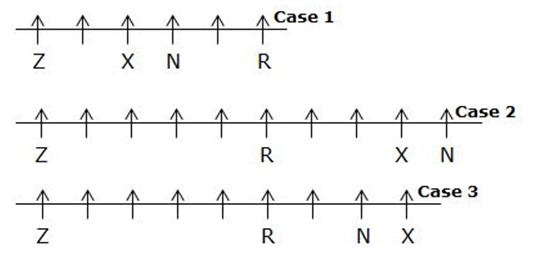 S sits third to the left of Z and is third from one of the extreme ends of the line.
 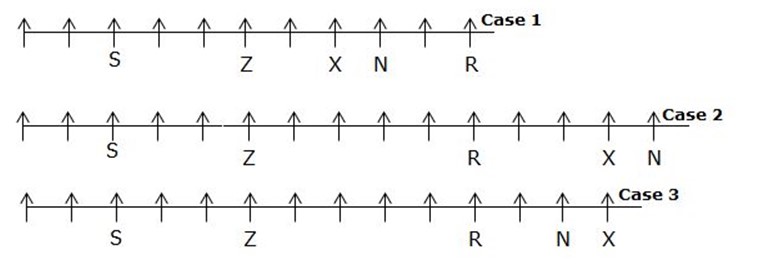 V sits second to the right of K and is an immediate neighbor of Z. M sits exactly between R and V. Here Case 1 gets eliminated.
 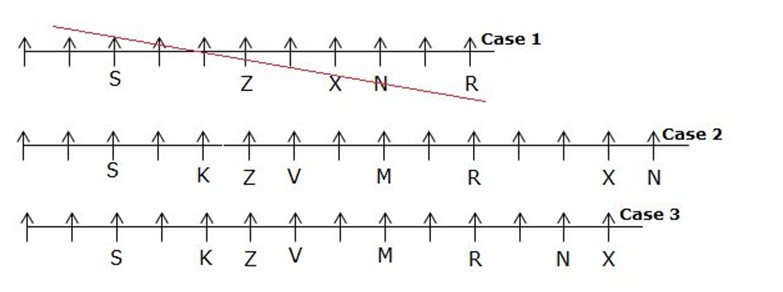 More than three persons sit between M and N, who sits third to the left of Q. There are no seats to the right of Q. Here, Case 3 gets eliminated and hence the final arrangement is,
More Reasoning Miscellaneous Questions
- Find the odd word pair out from the given options.
- A sum of Rs. 4,000 becomes Rs. 6,912 in 3 years at a certain rate of interest compounded annually. What is the rate of interest?
- Statements: J = S ≤ A = Y > X, W ≥ J > O = B Conclusion: I. W ≥ S II. S > B III. B < A
- If radius of a cone is 7 cm and its height is 15 cm, then find the volume (in cm3) of the cone.
- The ratio of the income and savings of John is 5:2, respectively. If his expenditure increases by an amount which is equal to half of his initial savings a...
- A financial institution gives compound interest at the rate of 10% per annum, compounded half yearly. What is the interest earned after one year on a depos...
- 17 मई 2000 के 5 दिन पहले बुधवार था तो 2 व्बजण् 1999 को क्या दिन होगा ?
- A car travels 560 km using 40 litres of petrol. How far can it travel using 35 litres of petrol?
- Which of the following is an example of Personal Digital Assistants?
- If in certain way ‘unjust’ is related to ‘flower’ in step-II and ‘broccoli’ is related to ‘42’ in step-V, then in the same way ‘87’ is related to what in s...
Relevant for Exams:
Hey! Ask a query
Please enter email id
The email must be a valid email address.
Please enter Mobile Number
Please enter valid Mobile Number
Please enter your Doubt

Think You're Ready for RBI Grade B?
RBI Grade B 2026 Phase 1 Memory Based Paper
- 200 Questions with Detailed Solutions
- Section-wise Coverage (GA, English, Quant & Reasoning)