


Question
If A and I interchange their position, and C and F interchange their position, then who among the following will be sitting to the immediate left of I?
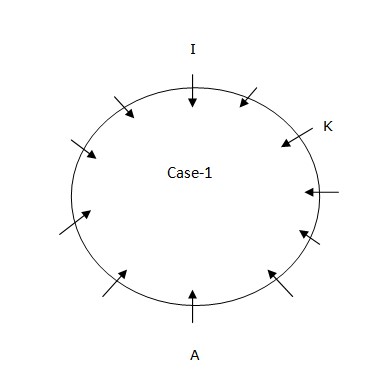 Only four persons sit between K and J. Here we get two possibilities Case (1) and Case (2).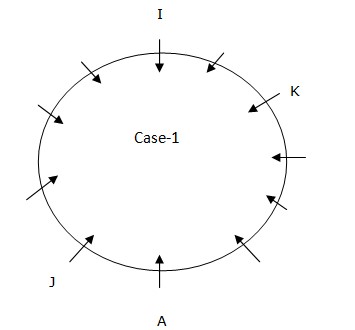
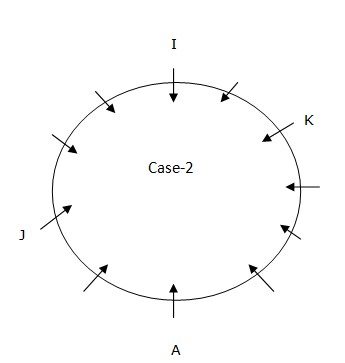 D is an immediate neighbor of J. B sits fifth to the right of D.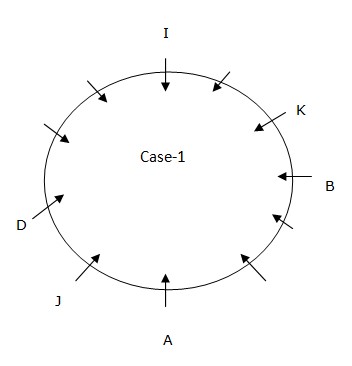
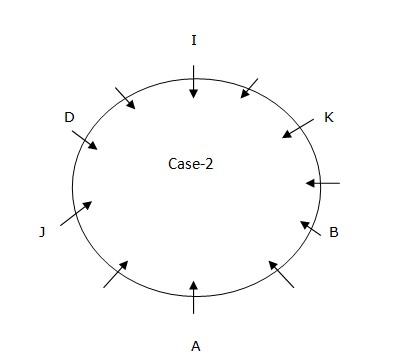 H sits third to the left of K. E sits second to the left of C. Here Case 1 gets eliminated.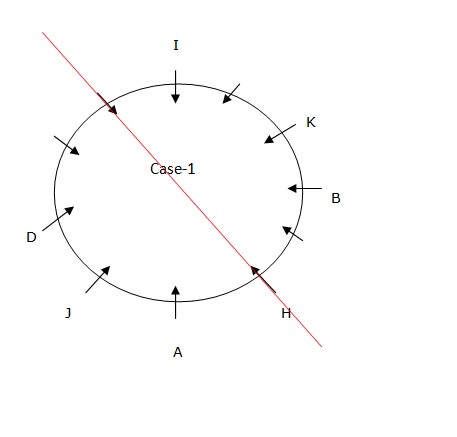
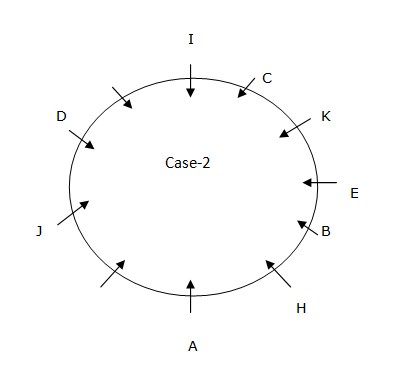 Number of letters between E and I in the alphabetical series is same as the number of persons sitting between A and G.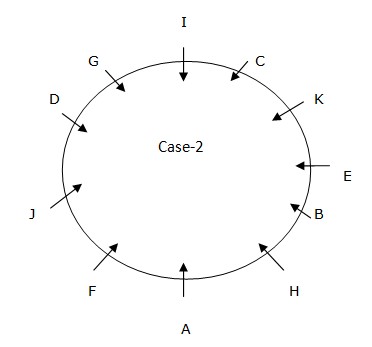
More Seating Arrangement Questions
- Statements: Some A is B. Only B is C. Only a few B is D. No D is E. Conclusions: I) Some C is D is a possibility. II) Each D is A is a possibilit...
- Six people, G, H, I, J, K and L are sitting around a circular table facing towards the centre (but not necessarily in the same manner). One person is sitti...
- Which of the following statement(s) is/are false? I. Only one person sits between P and the one who likes Blueberry when counted left of P. II. T sits imme...
- Who among the following is an immediate neighbor of Pallav and Padma?
- Who sits third to the left of Ketan?
- Who sits opposite to F?
- How many persons sit between E and A from the right of E?
- Who among the following sits second to the left of E?
- If third and fourth letters of all the words are replaced by its succeeding letter, then how many words formed which has at least one vowel?
- Six persons A, B, C, D E and F are sitting around a circle facing the centre. A sits third to the left of E. B is not an immediate neighbour of A. Only one...
Relevant for Exams:
Hey! Ask a query
Please enter email id
The email must be a valid email address.
Please enter Mobile Number
Please enter valid Mobile Number
Please enter your Doubt

Think You're Ready for RBI Grade B?
RBI Grade B 2026 Phase 1 Memory Based Paper
- 200 Questions with Detailed Solutions
- Section-wise Coverage (GA, English, Quant & Reasoning)