


Question
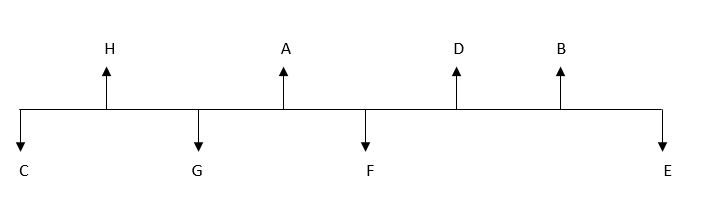
Four of the following five are alike in certain way based on the given arrangement and also form a group. Which is the one that does not belong to that group?
More Seating Arrangement Questions
- Who site second to the right of E.
- __ Sits fifth to the left of C and sits __ to the left of B.
- Who sits adjacent to W?
- The number of persons sits between R and S is the same as between O and _____, when counted from the right of both S and O?
- Who among the following person sits seventeenth from the right end?
- LY, KY, AY, MY, SY, TY, and QY are sitting in a row facing north. TY is immediate right of SY. SY is fourth to the right of QY. QY and LY are both at extre...
- How is U related to T?
- Who is R’s husband?
- There are five persons D, E, F, G and H, who sit in a straight row. F sits second to the right of D. Neither E nor H sits to the left of F. G sits second t...
- What is the position of O with respect to Z?
Hey! Ask a query
Please enter email id
The email must be a valid email address.
Please enter Mobile Number
Please enter valid Mobile Number
Please enter your Doubt

Think You're Ready for RBI Grade B?
RBI Grade B 2026 Phase 1 Memory Based Paper
- 200 Questions with Detailed Solutions
- Section-wise Coverage (GA, English, Quant & Reasoning)