


Question
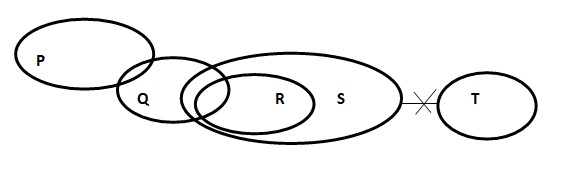
Statement: Mostly P are Q. P few Q are R. All R are S. No S is T. Conclusion : 1. Only S are R. 2. All T being R is possibility. 3. Some Q being T is a possibility.
More Reasoning Miscellaneous Questions
- By interchanging the given two signs and numbers which of the following equation will be not correct? × and ÷, 2 and 6 I. 7 – 4 × 3 ÷ 6 + 2 = 8 II. 6 – 8 ×...
- In the word ‘LICENSE’, first all the letters are written in an alphabetical order form, then remove all the vowels from the arrangement then how many such...
- A boat covers a distance of 132 km downstream in 6 hours. If the ratio of upstream speed to downstream speed of the boat is 4:11, then find the distance tr...
- निम्नलिखित प्रश्नों में, प्रश्नवाचक चिन्ह(?) के स्थान पर लगभग क्या मूल्य आएगा ? 8.02% of 599.82 + 49.79% of 395.75 = ?
- What will be the fourth step for the following input? Input: 76 172 372 43 243 361 165
- When the digits, which are odd in the number ‘67894532’ are decreased by 2 and the remaining digits are increased by 1, then what is the sum of 5th digit f...
- The present ages of Priya and Tina are in the ratio 2:5, respectively. Eight years hence, the ratio of their ages will become 5:11. Find the present age of...
- 1. Walls 2. Floor 3. Roof 4. Room 5. Foundation 6. Window
- The number of persons sits between L and O is the same as between M and _____, when counted from the right of both O and M?
- In a certain code language, ‘PLATTER’ is coded as ‘7312259’ and ‘MARINE’ is coded as ‘419955’. How will HERITAGE’ be coded in that language?
Relevant for Exams:
Hey! Ask a query
Please enter email id
The email must be a valid email address.
Please enter Mobile Number
Please enter valid Mobile Number
Please enter your Doubt

Think You're Ready for RBI Grade B?
RBI Grade B 2026 Phase 1 Memory Based Paper
- 200 Questions with Detailed Solutions
- Section-wise Coverage (GA, English, Quant & Reasoning)