


Question
How many seats are there around the table?

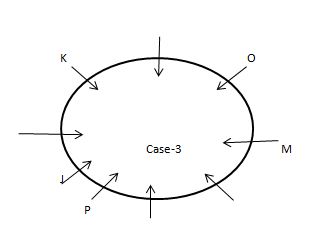 STEP II: L sits to the immediate left of N who sits second to the left of P. Both L and J sit adjacent to each other. The number of persons sits between N and O is one less than the number of persons sits between O and L when counted from the right of both N and O respectively. At least one person sits between K and L when counted from the right of K. As per these statements, CASE I and CASE III get eliminated and we continue with CASE II and the final arrangement will look like this: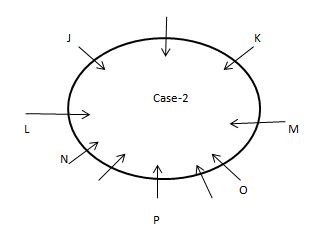
More Reasoning Miscellaneous Questions
- The group of wires that transfer data are known as the:
- Statements: Some drives are laptops. All laptops are keyboards. No keyboard is a computer. Conclusions: I. Some drives are not keyboards. II. Some laptop...
- p,q से 6 गुना बड़ा है। p q से कितने प्रतिषत कम है ?
- Identify the figure that will complete the following pattern.
- Statements: P > Q < R = U ≤ V = S ≤ W ≥ X > I Conclusions: I. Q ≥ V II. R ≤ W
- Read the direction carefully and answer the following question. Six friends F, G, H, I, J and K each has a different height. G is taller than only K. F and...
- How many steps will be required to get the final output from the following input? Input: 182 317 67 249 417 91 293
- Among V, W, X, Y and Z, each of them has different height. X’s height is more than W. Y’s height is more than V and less than Z. W is not the shortest pers...
- In the question given below, a passage is given followed by five statements which may or may not be inferred from the passage. Select the correct statement...
- Statement: I: There is increase in fog level due to pollution in Delhi in the last week of November. II: Most of the flights were cancelled in the last ...
Relevant for Exams:
Hey! Ask a query
Please enter email id
The email must be a valid email address.
Please enter Mobile Number
Please enter valid Mobile Number
Please enter your Doubt

Think You're Ready for RBI Grade B?
RBI Grade B 2026 Phase 1 Memory Based Paper
- 200 Questions with Detailed Solutions
- Section-wise Coverage (GA, English, Quant & Reasoning)