


Question
Who lives on the topmost floor?
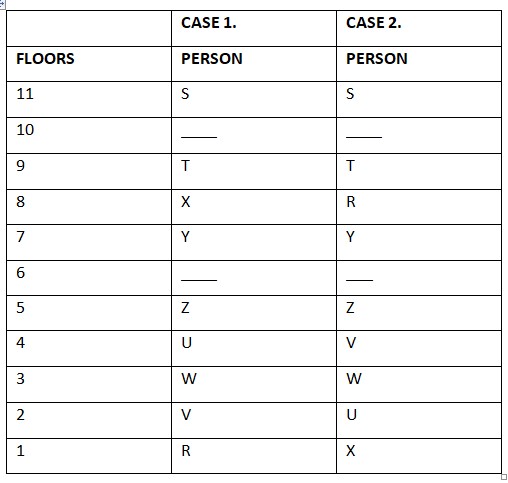
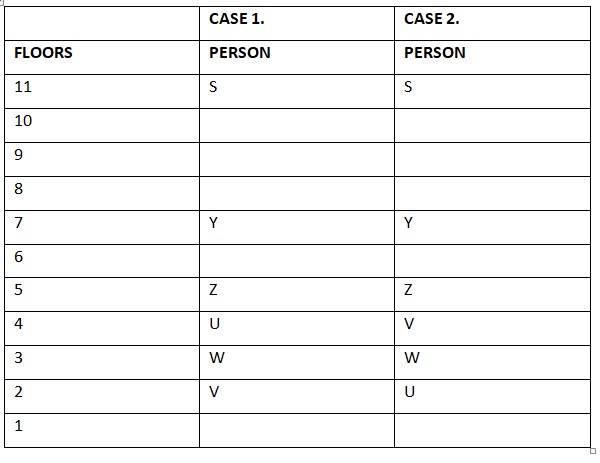 (v) None of the vacant floor is an odd-numbered floor. (vi) V does not live on a floor immediately above or immediately below X’s floor. There is one vacant floor between the floors on which S and T live. (vii) The number of floors between the two vacant floors is the same as the floor number on which W lives. (viii) X lives on an odd-numbered floor. X lives below T’s floor. R lives on an even numbered floor. T lives at floor no. 9 and vacant floor is floor no.10. We know that W lives at floor no. 3. So, there will be gap of three floors between vacant floors. Other vacant floor is floor no. 6. Case 1 will get discarded as X will live at floor no. 8 but X lives on an odd-numbered floor.
  Final arrangement as shown below: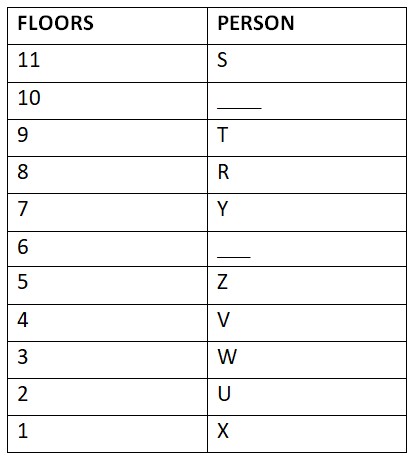
More Puzzles Questions
- How many persons are celebrating between F and the one who works in Tech Mahindra?
- C visits on which of the following place?
- Which of the following box has kept exactly in the middle of box B and box E?
- Kajal is working in which company?
- Five sweets, Ladoo, Petha, Peda, Rasgulla and Jalebi, are kept one above the other (not necessarily in the same order). Ladoo is four places above the Peda...
- How many persons celebrate their birthday between Gupta and Mangal?
- Which of the following day is off?
- On which of the following shelf number does Box G is kept from the top?
- Four of the following five are alike in a certain way and hence form a group. Which among the following one does not belong to the group?
- Which of the following statement is true?
Relevant for Exams:
Hey! Ask a query
Please enter email id
The email must be a valid email address.
Please enter Mobile Number
Please enter valid Mobile Number
Please enter your Doubt

Think You're Ready for RBI Grade B?
RBI Grade B 2026 Phase 1 Memory Based Paper
- 200 Questions with Detailed Solutions
- Section-wise Coverage (GA, English, Quant & Reasoning)