


Question
Who among the following couples are seated at same bench?
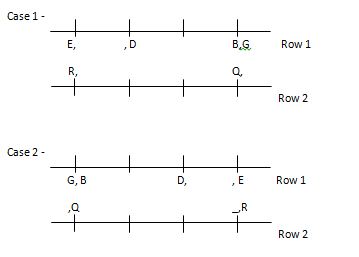 From the given statements, T sits 2nd to the left of the one who faces to E. Here Case 1 is ruled out now. Both P and M, sit on same bench. More than one person sit between M and T. One person sit between C and D. Here one more possibility is added – Case 2a. There is one bench gap between H and C. H does not face P. A sits 2nd to the left of F.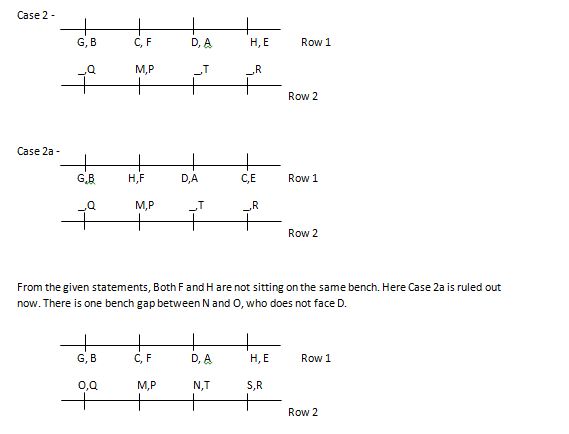
More Puzzles Questions
- Four of the five among the following are similar in such a way to form a group, which one of following doesn’t belong to the group?
- Who lives immediate below Z?
- Person-M uses which of the following laptop?
- Study the following information carefully and answer the given questions: (i) Six students P, Q, R, S, T and U are in different branches of Engineering, v...
- How many persons attend lecture between the one who teaches computer and T?
- What is Megha by profession?
- Six persons T, U, V, W, X and Y live in a six storey building but not necessarily in the same order. The bottommost floor is numbered as 1st and the topmos...
- Seven persons, P, Q, R, S, T, U and V, live in a seven-storey building, but not necessarily in the same order. Bottommost floor is numbered as 1 and the to...
- Statements: Only a few Male are Boy. Some Boy are Female. Only Female are Girl. Conclusion I) Some Female are Boy. II) Some Girl are Male.
- Achillea was exhibited by which state?
Relevant for Exams:
Hey! Ask a query
Please enter email id
The email must be a valid email address.
Please enter Mobile Number
Please enter valid Mobile Number
Please enter your Doubt

Think You're Ready for RBI Grade B?
RBI Grade B 2026 Phase 1 Memory Based Paper
- 200 Questions with Detailed Solutions
- Section-wise Coverage (GA, English, Quant & Reasoning)