


Question
Who among the following appeared for IBPS Clerk?
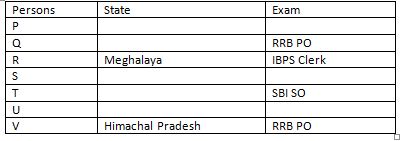 U and the person who belongs to Himachal Pradesh appeared for same exam. Therefore, U appeared for RRB PO. The person who belongs to Haryana appeared for RRB PO. The person who belongs to Punjab appeared for IBPS Clerk. S neither belongs to Haryana nor Madhya Pradesh. So, S belongs to Assam. T does not belong to Bihar. Therefore U belongs to Bihar. Final table
More Puzzles Questions
- What is the position of G with respect to the one who read The Pioneer?
- Who among the following person lives South west of N and North west of Q?
- Who is/are live(s) west of R?
- Whose anniversary is on 27th of July?
- How many books are kept between Hindi and Computer books?
- Who among the following likes Armaan malik?
- What is Gagan by profession?
- G, H, I, K, and L live on six different floors of the same building. The lowermost floor in the building is numbered 6, the floor above it is numbered 5, a...
- Which of the following movies does Kunal like?
- How many persons completed the training between G and C?
Relevant for Exams:
Hey! Ask a query
Please enter email id
The email must be a valid email address.
Please enter Mobile Number
Please enter valid Mobile Number
Please enter your Doubt

Think You're Ready for RBI Grade B?
RBI Grade B 2026 Phase 1 Memory Based Paper
- 200 Questions with Detailed Solutions
- Section-wise Coverage (GA, English, Quant & Reasoning)