


Question
Which of the following Flat is vacant?
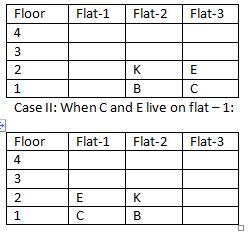 3. G and A live on same floor. I lives to the immediate west of G. G lives immediately below the vacant flat and the flat number of vacant flat and G is same. A lives in flat – 1. There is one floor between G and F. Now, G lives immediately below vacant flat so, the vacant flat must be in topmost floor. Case I: When C and E live on flat – 3:
 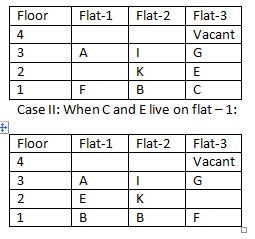 5. D lives somewhere above J in same flat number, but not on flat 3. Now, we cannot fix D and J in same flat number in case II, so, case II is invalid. The final arrangement is as follows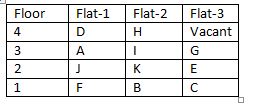
More Puzzles Questions
- Four of the following five are like a group find the one that does not like that group?
- Which of the following statement is true?
- Which of the following combinations is definitely correct?
- Which of the following is true regarding Ashwani?
- Who likes Brown?
- How many boxes are kept between box H and the box which contains mango?
- Who sits second to the right of the one who like Pepsi?
- How many persons goes between L and R?
- Who purchased bungalow in year 1993?
- ____ lives on first floor.
Hey! Ask a query
Please enter email id
The email must be a valid email address.
Please enter Mobile Number
Please enter valid Mobile Number
Please enter your Doubt

Think You're Ready for RBI Grade B?
RBI Grade B 2026 Phase 1 Memory Based Paper
- 200 Questions with Detailed Solutions
- Section-wise Coverage (GA, English, Quant & Reasoning)