


Question
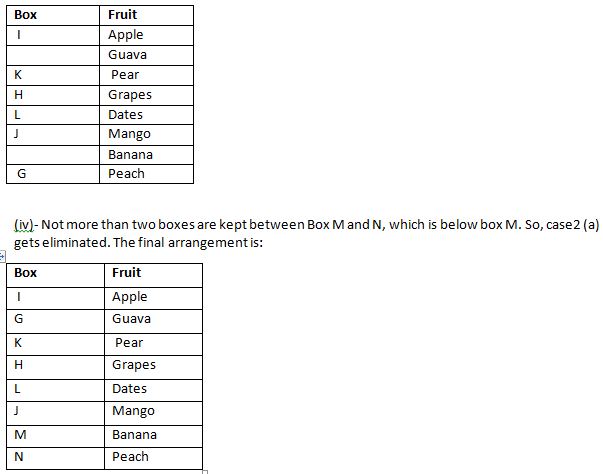
How many boxes are kept between box N and the box which contains Dates?
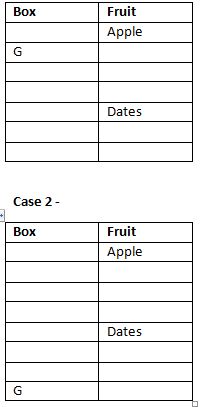 (ii)- Two boxes are between boxes I and H, which is below box I. Neither box I nor the box which contains Apple in bottom four. Box H does not contain Dates. Box I is just above the box which contains Guava. We get further 2 possibilities in both the cases.
 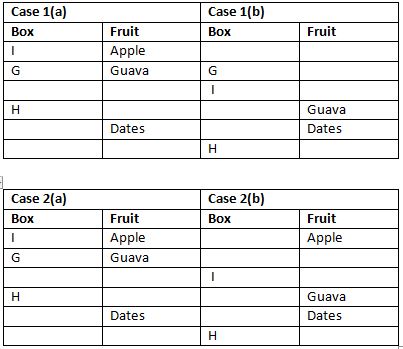 (iii)- Box J is just above the box which contains Banana. Box J is below Box H but not just below. Case1 (b) and Case2 (b) gets eliminated. The bottommost box does not contain Banana. Box K contains Pear but is not the bottommost. Box H does not contain Mango or Peach. The bottommost box does not contain Mango. Three boxes are kept between box L and the box which contains Apple. Case 1(a) -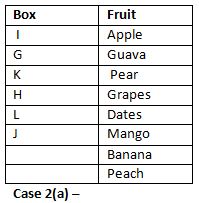
More Puzzles Questions
- What is car of the person who went toBali?
- Read the directions carefully and answer the following questions. A, B, C, D, E, and F live on a three floored building. The bottommost floor is numbered ...
- How many persons live between E and F?
- What is the position of R with respect to T?
- How many persons live below K (considering both types of flats)?
- Which among the following groups is working in Reliance?
- Which is the first function to be held in the banquet hall
- What is the age of the one who likes Mango?
- Which of the following combination is not true?
- On what month does B make a booking?
Relevant for Exams:
Hey! Ask a query
Please enter email id
The email must be a valid email address.
Please enter Mobile Number
Please enter valid Mobile Number
Please enter your Doubt

Think You're Ready for RBI Grade B?
RBI Grade B 2026 Phase 1 Memory Based Paper
- 200 Questions with Detailed Solutions
- Section-wise Coverage (GA, English, Quant & Reasoning)