
Question
How many boxes are there in the arrangement?
Read the given information carefully and answer the questions given beside: Certain number of boxes are placed one above the other. Some of the boxes have different number of balls. No two boxes have same number of balls. There are four boxes between Box E and Box B, which at the topmost position. Two boxes are placed between Box E and Box C. One box is placed between Box C and Box D, which has 12 balls. One box is placed between Box F and Box D. Box placed immediately below of Box C contains one ball more than Box G. Two boxes are placed between Box F and Box G. Box G is not placed immediately below of the box, which has even numbered balls. Box G has 9 balls. Maximum ten boxes are placed one above the other. At least one box is there between topmost box and Box G.Solution
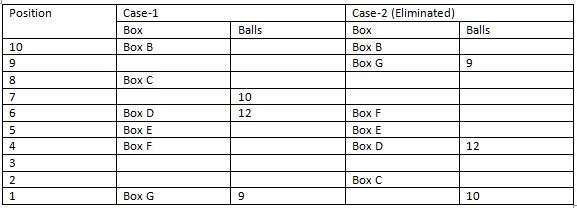
Maximum ten boxes are placed one above the other. There are four boxes between Box E and Box B, which at the topmost position. Two boxes are placed between Box E and Box C. One box is placed between Box C and Box D, which has 12 balls. One box is placed between Box F and Box D. Inferences: From above statements, Given, maximum 10 boxes are placed one above the other. Let the position of the box in lowermost is numbered as 1 and topmost is 10 (note: We start with 10 boxes, if necessary it can be changed with respect to given statements) Given, Box B is at topmost position. Then, Box E is fifth to below Box B (4 boxes between them) Box C is placed either 3rd to above Box E or 3rd to below Box E (2 boxes between them). Thus we get two possibilities. Case-1: Here, Box C is placed 3rd to above Box E. Then, Box D (12 balls) is placed 2nd to below Box C (1 box is between them). Box F is 2nd to below Box D (1 box is between them, only possibility) Case-2: Here, Box C is placed 3rd to below Box E. Then, Box D (12 balls) is placed 2nd to above Box C (1 box is between them, only possibility). Box F is 2nd to above Box D (1 box is between them, only possibility) By using above information, we get the following table as shown
Practice Next
P and Q together started a business with initial investment in the ratio of 1:3, respectively. The time-period of investment for P and Q is in the ratio...
- Ramesh and Suresh invested Rs. 2400 and Rs. 1800 in a business. At the end of the year, the profit was Rs. 8400. What is the difference in their share of p...
A, B, and C invested Rs. 3600, Rs. 2400, and Rs. x, respectively, in a business for equal time. If the profit received by C is Rs. 1200 out of a total p...
In a business there are two partners βPβ and βQβ. βPβ started the business with the capital of Rs. 25000 and after 3 months βQβ joined h...
Together, "Arjun" and "Vicky" invested Rs. 12,000 and Rs. 8,000 in a firm. After eight months, "Vicky" added Rs. 2000 to his initial investment, whereas...
M and N started a partnership with investments of Rs. 10,000 and Rs. 8,000. After 6 months, M increased his contribution by Rs. 2,000 and O joined with ...
Raj invested Rs.32000 in a business. After 7 months, Rohan joins him with an investment of Rs.P. If at the end of the year the profit is Rs.55000 and pr...
The savings of Arun and Bhaskar are same. The difference between the expenditure of Bhaskar and the savings of both Arun and Bhaskar together is 0. The ...
βPβ and βQβ started a business with investment of Rs. 3,000 and Rs. 4,200, respectively. After 8 months, βPβ increased his investment by Rs....
βAβ and βBβ started a business by investing Rs. βaβ and Rs. βa + 250β, respectively. If 12 months later the ratio of profit shares of οΏ½...
