


Question
Who went toHawaii?
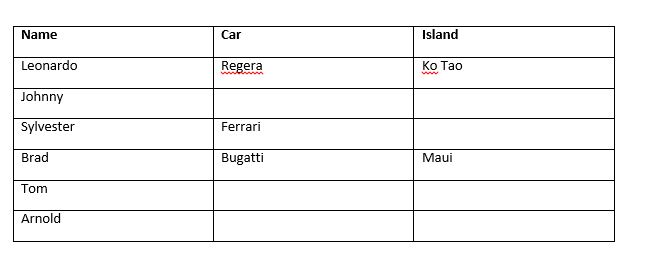 Since From (v), Neither Johnny nor Arnold is having Lamborghini. So, the only person left who could have Lamborghini is Tom. Therefore, Tom is having Lamborghini. Since From (ii), person who went to Sumatra is having Lamborghini. Therefore, Tom is having Lamborghini and went to Sumatra.
 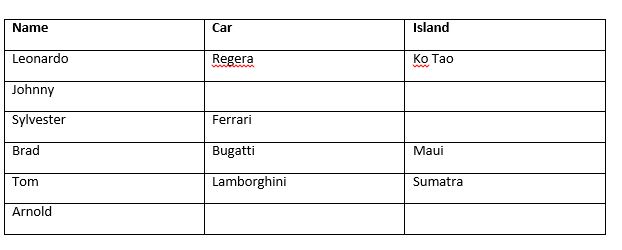 Since From (i), Sylvester is neither went to Hawaii or Ko Tao and also from (iv) Sylvester does not went to Bali. Therefore, the only Island left for Sylvester is Santorini. From (iv), Arnolddo not went to Hawaii. Therefore, only Island left for Arnold is Bali.
 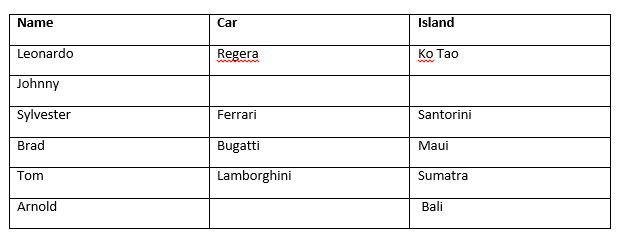 Now, only person left is Johnny and the only Island left is Hawaii. Therefore, Johnny went to Hawaii. The only car left for Johnny and Arnold is Aston Martin. Therefore, Johnny and Arnold are havingAston Martin.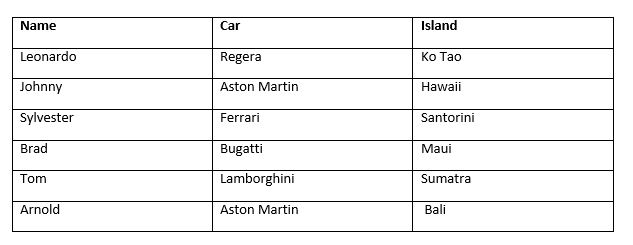
More Puzzles Questions
- B visits the country on which of the following day?
- How many persons visits between the one, who visits Germany and the one, who has Yellow colour?
- C lives on which of the following floor?
- Which of the following combination is correct?
- Read the directions carefully and answer the following questions. A, B, C, D, E, and F live on a three floored building. The bottommost floor is numbered ...
- Which of the following statement is true?
- Which of the following statements is true?
- Who among the following person likes Black?
- ________ is at the bottommost position?
- How many shopkeepers auctioned after the one who likes Reebok?
Relevant for Exams:
Hey! Ask a query
Please enter email id
The email must be a valid email address.
Please enter Mobile Number
Please enter valid Mobile Number
Please enter your Doubt

Think You're Ready for RBI Grade B?
RBI Grade B 2026 Phase 1 Memory Based Paper
- 200 Questions with Detailed Solutions
- Section-wise Coverage (GA, English, Quant & Reasoning)