


Question
How many persons purchased bungalow between Babli and Farun?
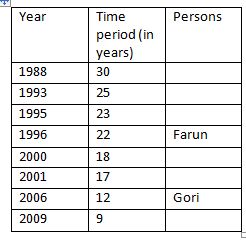 Babli purchased his bungalow immediately before Deepa. Only one person purchased his bungalow between Deepa and Ishu, who purchased in a leap year. Amit was neither the first nor the last person to buy a bungalow. The only left leap year is 2000, so that's the year when Ishu purchased. Thus Amit purchased in mid i.e. in 2001.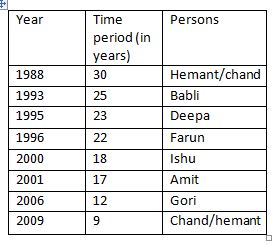
More Puzzles Questions
- Who among the following lives at the topmost floor?
- Seven different coloured books are kept one after the other. i. The RED book is just on the top of the ORANGE book. ii. The BLUE book is between the GREEN ...
- Who purchased bungalow in year 1993?
- E is living on which of the following floors?
- How many persons live between V and W?
- Choose the incorrect pair.
- Who among the following person has started on November 17th?
- Who likes Brown?
- Who among the following live immediately above F?
- Which of the following colour is filled in box D?
Relevant for Exams:
Hey! Ask a query
Please enter email id
The email must be a valid email address.
Please enter Mobile Number
Please enter valid Mobile Number
Please enter your Doubt

Think You're Ready for RBI Grade B?
RBI Grade B 2026 Phase 1 Memory Based Paper
- 200 Questions with Detailed Solutions
- Section-wise Coverage (GA, English, Quant & Reasoning)