


Question
In the question two statements are given, followed by two conclusions, I and
In the question two statements are given, followed by two conclusions, I and
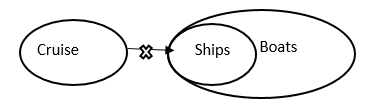
II. You have to consider the statements to be true even if it seems to be at variance from commonly known facts. You have to decide which of the given conclusions, if any, follows from the given statements. Statement: 1. All ships are boats. 2. No cruise are ships. Conclusion:
I. Some boats are cruise.
II. All cruise are boats.
More Previous year papers Questions
- Choose the pair of words which are differently related from the rest:
- 'P + Q' means 'P is the daughter of Q' 'P × Q' means 'P is the son of Q' 'P – Q' means 'P is the wife of Q' Which of the following options is correct for t...
- In a certain code language, MILLION is written as IMLLOIN. How will HILTON be written as in that code language?
- Eight boys B1, B2, B3, B4, B5, B6, B7 and B8 are sitting in a row facing towards the north (not necessarily in the same order). B6 is fifth to the right of...
- Which one of the following images numbered as (1), (2), (3), (4) will be the next image for the given series?
- Select the letter-cluster from among the given options that can replace the question mark (?) in the following series. QHD, MNV, ITN, EZF, AFX, ?
- If ‘J @ I % H # G & F’, then how is I related to F?
- Identify the figure that completes the pattern (rotation is NOT allowed).
- Which of the answer figure, completes the figure matrix?
- The sequence of folding a piece of paper and the manner in which the folded paper has been cut is shown in the following figures. How would this paper look...
Relevant for Exams:
Hey! Ask a query
Please enter email id
The email must be a valid email address.
Please enter Mobile Number
Please enter valid Mobile Number
Please enter your Doubt

Think You're Ready for RBI Grade B?
RBI Grade B 2026 Phase 1 Memory Based Paper
- 200 Questions with Detailed Solutions
- Section-wise Coverage (GA, English, Quant & Reasoning)