


Question
Who likes Blue?
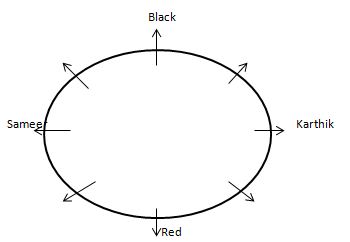 Only two persons sit between Siraj and the one who has likes Black. From this statement, we will have two cases: Siraj will sit either at place no. 2 or 8. Gopal is an immediate neighbour of Anil. Anil is not an immediate neighbour of Sameer or Karthik and he does not likes Black. The one who likes Green sits second to the right of Gopal. Anil cannot sit at place no. 6, 5, 4 and 8. So, only place left for him is place no. 1. As Gopal is an immediate neighbour of Anil. So, Gopal will sit either at place no. 8 or 2. The one who likes Green sits either at place no. 4 or 2. Only three people sit between the one who likes Green and the one who likes Yellow. So, the one who likes Yellow sits either at place no. 6 or 8. Varun sits second to the right of the one who likes Yellow. So, Varun sits either at place no. 4 or 6.
 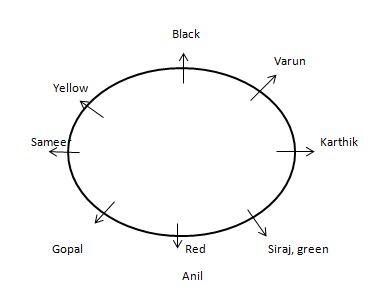 CASE-2
 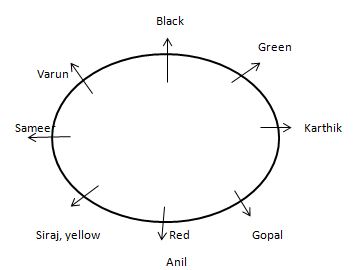 Gopal does not likes Blue. The one who likes Blue is not an immediate neighbor of Gopal. Salman sits on the immediate right of the one who likes Blue. The one who likes Pink sits on the immediate right of the one who likes Cream. Case 1 will get discarded as the one who likes Blue cannot sit at place no. 7 and 8. If the one who likes Blue sits either at place no. 4 or 3, then there is no place for Salman as Salman sits on the immediate right of the one who likes Blue In case 2, if the one who likes Blue sits at place no. 6, then Salman sits at place no. 5. The one who likes Pink and the one who likes Cream sit at place no. 3 and 2 respectively Only person left for place no. 4 is Rajan. Only colour left for Sameer is White Case-1
  CASE-2
 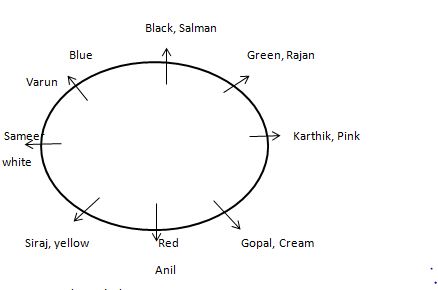 Final arrangement as shown below:
More Input Output Questions
- Which element is exactly between “course” and “85” in the second step of the given arrangement?
- Which of the following is the last step for the following input? Input: 310, 105, 45, 241, 417, 36, 281
- Which of the following steps will be the last but one of the above input?
- Salman likes which of the colour?
- . Input: “the style and bringing it for everyone”, which of the following will be step IV?
- How many elements are there between ‘03’ and ‘45’ in step-II?
- Which of the following would be the last step of the rearrangement?
- Which element is fifth to the left of the element which is ninth from the left end of the fourth step?
- Input: Design usually recreate vintage and old styles How many more steps is required to complete the rearrangement?
- Which number would be at the fourth position from the left end in the last step of the output?
Hey! Ask a query
Please enter email id
The email must be a valid email address.
Please enter Mobile Number
Please enter valid Mobile Number
Please enter your Doubt

Think You're Ready for RBI Grade B?
RBI Grade B 2026 Phase 1 Memory Based Paper
- 200 Questions with Detailed Solutions
- Section-wise Coverage (GA, English, Quant & Reasoning)