


Question
The question given below consists of two statements numbered I and II given below it. You have to decide whether the data provided in the statements are sufficient to answer the question. Read all the statements and answer the question . Eight persons J, K, L, M, N, O, P, and Q sit around a square table such that one person sits at each corner of the table and one person sit at the middle of each side of the table. The persons, who sit at the corners face towards the centre of the table and the persons, who sit at middle of the side face away from the centre of the table. Who sits third to the left of M? Statement I: Only two persons sit between K and L (from either side of the table). L sits immediate left of J, who sits at one of the corners. M is an immediate neighbour of both J and K. O sits third to the left of Q. N faces away from the centre of the table. Statement II: Q sits third to the right of J. Q faces away from the centre of the table. N sits second to the left of Q. Only one person sits between L and N (from either side of the table). O sits second to the right of P. L and O are immediate neighbours of each other. M and Q are not immediate neighbours.
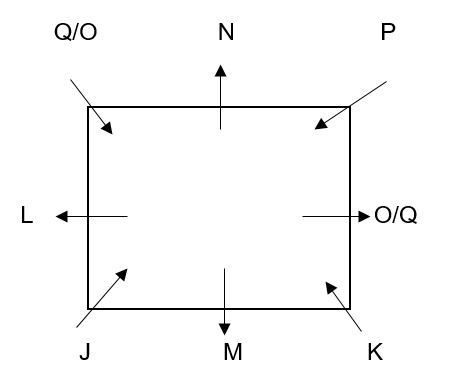 P sits third to the left of M. So, data given in statement I alone is sufficient to answer the question. From statement II alone, Q sits third to the right of J. Q faces away from the centre of the table. N sits second to the left of Q. Only one person sits between L and N (from either side of the table) . O sits second to the right of P. L and O are immediate neighbours of each other. P and T are not immediate neighbours. We get:
 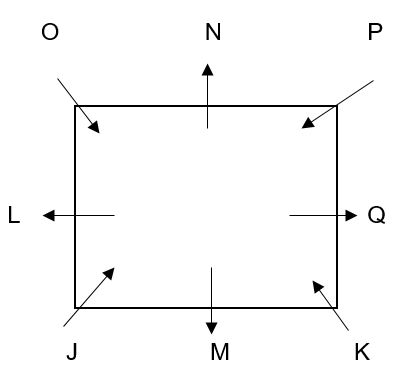 P sits third to the left of M. So, data given in statement II alone is sufficient to answer the question. Therefore, data given either in statement I alone or in statement II alone is sufficient to answer the question.
More Data Sufficiency Questions
- How is ‘ready’ written in a code language? I. In the code language ‘ready to go’ is written as ‘so lo do’ and ‘ready the way’ is written as ‘na do ka’. ...
- The question given below consists of two statements numbered I and II given below it. You have to decide whether the data provided in the statements are su...
- What is the favorite sport of Sarita? Statement I: Sarita devotes maximum time watching Cricket. Statement II: Sarita does not like Football but her brothe...
- The question below can be answered using the sentence given in only one of the options. Find out the option which can be used to answer the question. Eigh...
- How far is point Q from point Y? I. Q is 5 m north of B. C is 7 m east of Q. Y is west of Q such that C, Q and Y form a straight line of 10 m. II. Z is sou...
- The question given below consists of two statements numbered I and II given below it. You have to decide whether the data provided in the statements are su...
- In the given coded language, how is the word ‘come’ coded? Statement I: ‘you come forward and’ is coded as ‘bk, dk, rk, sk’ and ‘forward always win’ is cod...
- What is the position of A with respect to B in a round table seating arrangement facing towards the centre? I. Seven persons A, B, C, D, E, F and G sat aro...
- Out of five members (L, M, N, O and P) of a family, how many members are males? I. L is father of P, whose only son is N. II. P has two sisters, M and O.
- Is ‘MORE’ the word formed from these four letters? I. The word starts with M. There is only one letter between E and O. II. There is only one letter betw...
Relevant for Exams:
Hey! Ask a query
Please enter email id
The email must be a valid email address.
Please enter Mobile Number
Please enter valid Mobile Number
Please enter your Doubt

Think You're Ready for RBI Grade B?
RBI Grade B 2026 Phase 1 Memory Based Paper
- 200 Questions with Detailed Solutions
- Section-wise Coverage (GA, English, Quant & Reasoning)