


Question
The question given below consists of three statements numbered R, II and III given below it. You have to decide whether the data provided in the statements are sufficient to answer the question. Read all the statements and answer the question. There are seven persons D, E, F, G, H, I, and J in a family of three generations. No single person in the family is a parent. How is G related to H? Statement I: D is the wife of J, who is the grandfather of F. F is married to G. Statement II: E is the father-in-law of G. I is the brother of H. Statement III: The gender of H and G is same. I is not the son of J.
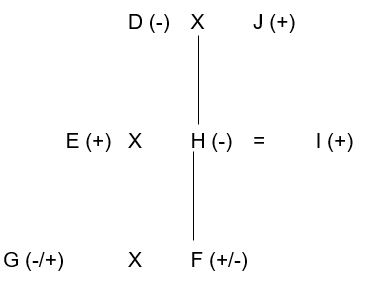 Case 2:
 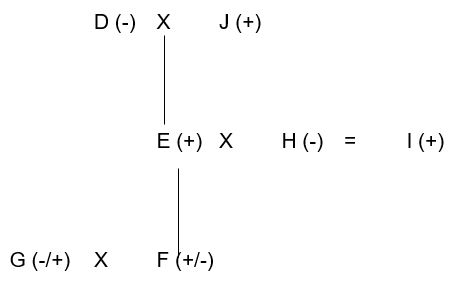 From statements I and II together, we cannot answer the above question. From statements I and III together, we get:
 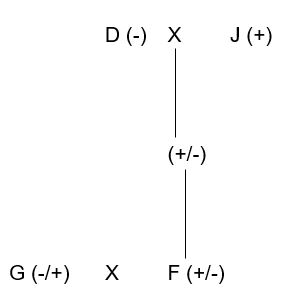 From statements I and III together, we cannot answer the above question. From statements II and III together, we get:
 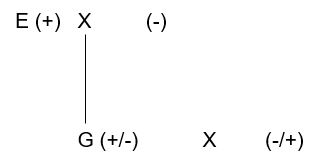 From statements II and III together, we cannot answer the above question. From statements I, II and III together, we get:
 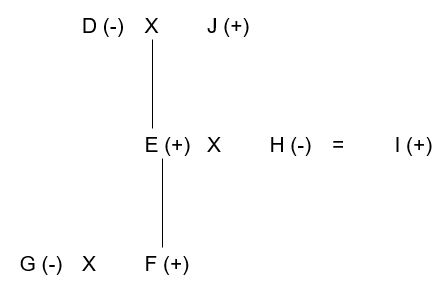 From statements I, II and III together we get, G is the daughter-in-law of H. Therefore, data given in statements I, II and III together is sufficient to answer the question.
More Data Sufficiency Questions
- Each of the questions below, consists of a question and three statements numbered I, II and III. You have to decide whether the data provided in the statem...
- The question given below consists of two statements numbered I and II given below it. You have to decide whether the data provided in the statements are su...
- Among A, B, C, D, E and F, is A greater than C? I. B is equal to D, who is equal or smaller than A. E is greater than or equal to D and smaller than or eq...
- The question given below consists of some statements given below it. You have to decide whether the data provided in the statements are sufficient to answe...
- The question below consists of two statements 1 and 2. Decide whether the facts provided in the statements are sufficient to answer the question. Questio...
- A is in which direction with respect to B? I. A and B start walking from the same point in opposite directions and after walking 5 kms each, both turn tow...
- The question given below consists of two statements numbered I and II given below it. You have to decide whether the data provided in the statements are su...
- In a certain code language “third conviction past’ is coded as “bns, los, rvd”. “conviction three months” is coded as “los, mna, asm”. What is the code for...
- Six persons (T, U, V, W, X, and Y) have different weights. Y is heavier than only two persons. Who is the heaviest person? Statement I: T is heavier than ...
- The question given below consists of three statements numbered I, II and III given below it. You have to decide whether the data provided in the statements...
Relevant for Exams:
Hey! Ask a query
Please enter email id
The email must be a valid email address.
Please enter Mobile Number
Please enter valid Mobile Number
Please enter your Doubt

Think You're Ready for RBI Grade B?
RBI Grade B 2026 Phase 1 Memory Based Paper
- 200 Questions with Detailed Solutions
- Section-wise Coverage (GA, English, Quant & Reasoning)